
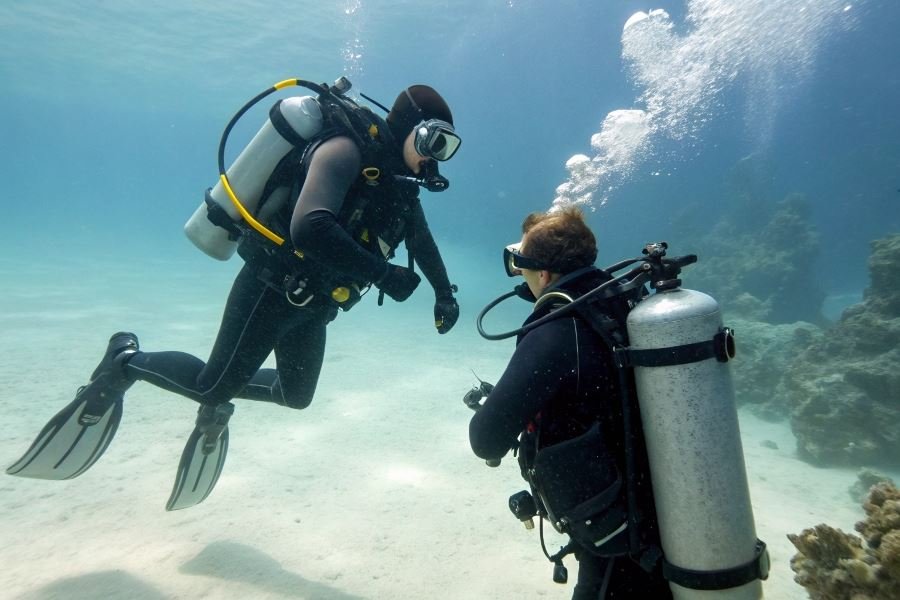
Imagine descending 100 feet below the surface, surrounded by nothing but blue. Your life literally depends on knowing how long you can stay there. One glance at your wrist tells you everything.
That small device strapped to your arm isn’t just another gadget—it’s the difference between a safe ascent and decompression sickness. Dive computers have revolutionized underwater exploration, transforming what was once a complex calculation process involving dive tables and watches into an automated, real-time monitoring system that tracks depth, time, and nitrogen absorption.
The digital brain behind your bubbles
At their core, dive computers are sophisticated instruments designed to track your underwater journey. They continuously calculate nitrogen saturation in your tissues based on your depth profile, warning you when it’s time to ascend and how quickly you can safely return to the surface. Unlike traditional dive tables that use predetermined, conservative profiles, dive computers provide personalized data that maximizes your bottom time while maintaining safety margins.
From bulky consoles to wrist-worn wonders
The evolution of dive computers tells a fascinating story of technological advancement. The first commercially successful models appeared in the 1980s—bulky, console-mounted units with limited functionality. Fast forward to today, and we’re seeing sleek, wrist-mounted computers with color displays, Bluetooth connectivity, and the ability to track multiple gas mixes.
Why your life underwater demands digital precision
Every diver needs a reliable dive computer for three critical reasons:
- Safety: Dive computers continuously monitor your depth and time, calculating decompression obligations in real-time
- Extended dive times: They typically allow longer bottom times than traditional tables
- Comprehensive data: Modern units track everything from water temperature to ascent rates
The best dive computers balance sophisticated functionality with intuitive interfaces, ensuring you can focus on the underwater world rather than deciphering complex displays during critical moments.
Essential Features That Make or Break Dive Computers
When you’re 30 meters below the surface, your dive computer becomes your lifeline. The best computers for diving: what to pay attention to goes beyond just picking a device with the most buttons or the flashiest screen. It’s about finding a reliable underwater companion that keeps you safe while enhancing your diving experience.
Crystal Clear Displays That Cut Through the Blue
The underwater world doesn’t wait for you to squint at your screen. Visibility is non-negotiable when selecting a dive computer. The latest Shearwater Teric models feature high-contrast OLED displays that remain readable even in murky conditions. Meanwhile, Garmin Descent computers offer customizable color schemes that pop against different underwater environments.
What separates good from great is viewing angle performance – can you read it when your wrist is at an awkward angle during that turtle encounter? Look for screens with at least 170° viewing angles and backlight options that don’t blind you during night dives.
Decompression Algorithms That Keep You Safe
Behind every dive computer’s friendly interface lies complex mathematics that could save your life. Most recreational dive computers use either the Bühlmann ZHL-16C or RGBM (Reduced Gradient Bubble Model) algorithms.
The Suunto D5 employs a modified RGBM that tends to be more conservative, while Scubapro G2 computers offer multiple algorithm choices, allowing you to match your computer to your diving style:
| Algorithm Type | Best For | Conservatism |
|---|---|---|
| Bühlmann ZHL-16C | Technical diving | Customizable |
| RGBM | Recreational diving | More conservative |
| VPM-B | Deep/mixed gas diving | Variable conservatism |
Battery Life That Won’t Leave You Hanging
Nothing kills confidence faster than a low battery warning at depth. Modern dive computers typically offer between 30-60 hours of dive time per charge. The Oceanic ProPlus X boasts an impressive 40+ hours in dive mode, while traditional models like the Cressi Leonardo use replaceable batteries that last up to 3 years with regular diving.
Consider your charging options carefully – USB-C has become the standard, but some expedition-focused computers still use proprietary chargers that could leave you stranded if forgotten.
Depth Ratings That Match Your Ambitions
While most recreational dive computers are rated to 100-120 meters, technical divers should look for units tested beyond 150 meters. The pressure sensors’ accuracy matters more than maximum depth for most divers – look for ±1% accuracy across the full range.
The Ratio iX3M GPS Deep stands out with its 300-meter rating and titanium housing, making it virtually crush-proof for technical diving applications.
Gas Integration That Simplifies Monitoring
Air integration has evolved from simple pressure readings to sophisticated gas management systems. Wireless transmitters like those compatible with the Aqualung i770R can monitor up to 4 different tanks, perfect for technical divers using multiple gas mixes.
The true game-changer is closed-circuit rebreather (CCR) compatibility found in advanced computers like the Shearwater Perdix AI, which can monitor oxygen partial pressure from multiple sensors simultaneously.
When selecting your next dive computer, prioritize these essential features based on your diving style and ambitions. The right computer doesn’t just track your depth and time – it becomes an extension of your diving consciousness, keeping you safe while you explore the underwater world.
Top 3 Dive Computers That Will Transform Your Underwater Experience
Diving technology has evolved dramatically since the first dive computers appeared in the 1980s. Today’s models offer unprecedented accuracy, connectivity, and features that make diving safer and more enjoyable than ever. Let’s explore the best dive computers across three price categories to help you find your perfect underwater companion.
Entry-level excellence for new divers
For those just getting their fins wet, an entry-level dive computer provides essential functionality without overwhelming complexity or cost.
The Suunto Zoop Novo remains the gold standard for beginners at $299. Its large, high-contrast display is readable in all conditions, while the four-button interface makes navigation intuitive even with gloves. The Zoop Novo supports air and nitrox modes and offers a 140-hour logbook—perfect for your first hundred dives.
The Cressi Leonardo deserves serious consideration at $249. This single-button computer simplifies operation while still providing critical data like depth, dive time, and decompression requirements. Its conservative algorithm offers an extra safety margin that instructors appreciate for new divers.
What makes these computers special isn’t just their price—it’s their focus on presenting essential information clearly without unnecessary complications.
Mid-range marvels with advanced capabilities
As your diving evolves, mid-range computers offer enhanced features that expand your underwater possibilities.
The Garmin Descent G1 ($549) brilliantly balances dive functionality with everyday wearability. This solar-powered computer offers multi-gas support, 3D compass, and impressive 25-hour battery life in dive mode. Its smartwatch capabilities mean you’ll wear it long after surfacing.
The Shearwater Peregrine ($495) delivers technical diving features in an accessible package. Its full-color display presents information with exceptional clarity, while the intuitive interface makes accessing advanced features straightforward. With air, nitrox, and gauge modes, it’s a computer that grows with your skills.
| Computer | Display | Battery Life | Gas Mixes | Price |
|---|---|---|---|---|
| Garmin Descent G1 | Monochrome | 25 hours (dive) | Air/Nitrox/Trimix | $549 |
| Shearwater Peregrine | Full Color | 30+ hours | Air/Nitrox | $495 |
Professional powerhouses for technical diving
For technical divers pushing boundaries, professional-grade computers deliver capabilities that match your ambition.
The Shearwater Teric ($1,095) represents the pinnacle of wrist-mounted dive computing. This full-color, multi-gas computer handles everything from recreational dives to complex decompression profiles with trimix. Wireless air integration monitors up to two transmitters, while Bluetooth connectivity makes dive logging effortless.
The Garmin Descent Mk3i ($1,499) combines advanced dive features with comprehensive fitness tracking. Its standout SubWave sonar technology allows diver-to-diver communication up to 30 meters away—a game-changer for group safety. With support for up to 6 transmitters, you’ll have complete gas management data at a glance.
Technical divers understand that these computers aren’t luxury items—they’re essential safety equipment that provides critical decision-making data in environments where mistakes can be costly.
Both models feature customizable displays, rechargeable batteries, and robust construction designed to withstand the rigors of technical diving. Their intuitive interfaces ensure you can access vital information quickly, even in challenging conditions.
The right dive computer transforms your underwater experience by providing reliable data that enhances both safety and enjoyment. Whether you’re making your first descent or planning complex technical dives, today’s computers offer unprecedented capabilities at every price point.