
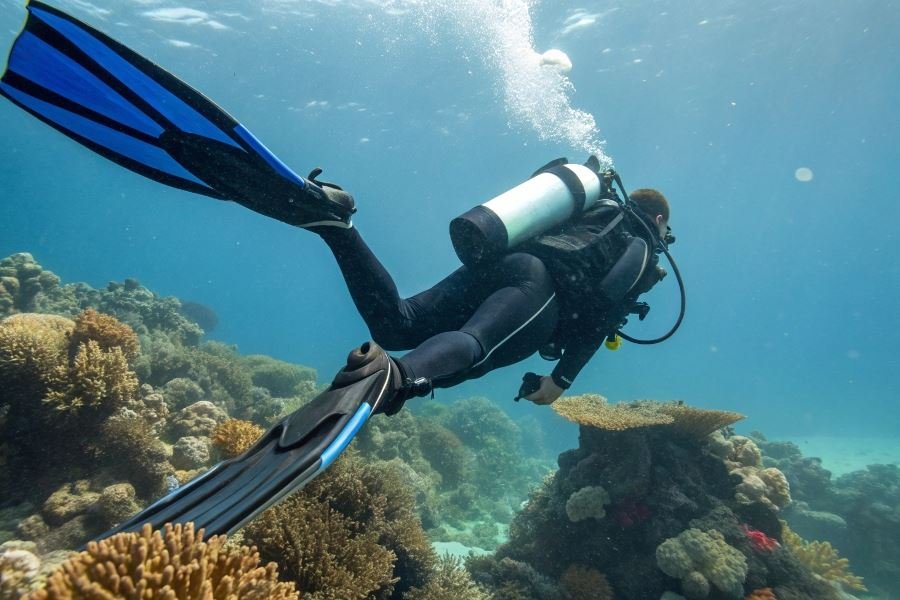
Ever stood at airport check-in watching the scale creep up as you place your diving gear on it, silently calculating excess baggage fees? For passionate divers who love to explore underwater worlds beyond their local dive spots, the struggle is real.
Travel-friendly buoyancy compensator devices (BCDs) have revolutionized how we approach dive travel. These lightweight marvels offer the perfect balance between functionality and portability, allowing divers to pack their essential life-support equipment without sacrificing precious luggage space or weight allowance.
The traveler’s edge: Why specialized BCDs matter
Standard BCDs typically weigh 7-9 pounds and take up significant space in luggage. In contrast, travel BCDs can weigh as little as 4 pounds when dry and fold down to the size of a laptop bag. This difference becomes crucial when navigating international flights with strict baggage restrictions or when trekking to remote dive locations.
The magic of travel BCDs lies in their thoughtful design elements:
- Minimalist construction with streamlined profiles and reduced padding
- Foldable backplates that collapse for compact storage
- Lightweight materials like denier nylon that maintain durability
- Integrated weight systems designed for reduced bulk
Beyond weight: Functional differences that matter
Travel BCDs aren’t simply stripped-down versions of their bulkier counterparts. Manufacturers have reimagined these essential pieces of equipment with clever adaptations:
“The best travel BCDs don’t compromise safety for convenience—they simply engineer around the constraints.”
Many feature quick-dry materials, removable pockets, and simplified inflation systems. While they typically offer less lift capacity than standard BCDs, they’re perfectly calibrated for warm-water diving with minimal exposure protection—exactly the conditions most travel divers seek.
Top 3 Travel BCDs That Won’t Weigh You Down
When diving in exotic locations becomes your passion, the right gear makes all the difference. Seasoned travelers know that buoyancy compensators for travel: lightweight and compact models are game-changers for globe-trotting divers. These specialized BCDs strike the perfect balance between performance and portability, allowing you to explore underwater paradises without luggage nightmares.
What makes a travel BCD worth packing
Before diving into specific models, let’s establish what separates exceptional travel BCDs from the pack. The evaluation criteria fall into four critical categories:
| Criteria | Why It Matters |
|---|---|
| Weight | Every ounce counts when facing airline restrictions |
| Packability | Must compress into tight spaces without damage |
| Durability | Must withstand varied environments and rough handling |
| Performance | No compromises on buoyancy control and comfort |
The best travel BCDs deliver on all fronts without sacrificing your underwater experience. Let’s explore the standout performers that deserve space in your dive bag.
The lightweight champions analyzed
Aqua Lung Rogue
Weight: 5.2 lbs (2.4 kg)
Price: $499
The Aqua Lung Rogue revolutionizes the travel BCD concept with its modular design. The genius lies in its ability to strip down to basics or build up with additional components based on your diving conditions.
What sets it apart: The removable bladder system allows you to customize lift capacity while the minimalist harness folds nearly flat in luggage.
Pros:
- Modular components for customization
- Exceptional weight distribution
- Folds to the size of a laptop
Cons:
- Higher price point
- Learning curve for modular system
- Limited integrated weight capacity
Scubapro Go
Weight: 6.3 lbs (2.9 kg)
Price: $429
The Scubapro Go strikes an impressive balance between lightweight construction and robust performance. Its air-travel friendly design doesn’t sacrifice the features serious divers demand.
What sets it apart: The fold-and-roll design with quick-drying materials makes this BCD ready for back-to-back dive days during intensive travel itineraries.
Pros:
- Exceptional durability for a lightweight model
- Intuitive pocket placement
- Comfortable back padding even with aluminum tanks
Cons:
- Slightly heavier than competitors
- Limited color options
- D-rings could be more strategically placed
Cressi Travelight
Weight: 4.8 lbs (2.2 kg)
Price: $349
The Cressi Travelight earns its spot through sheer minimalist engineering. This featherweight champion delivers surprising performance despite being the lightest option in our lineup.
What sets it apart: The bladder design provides impressive lift capacity (35 lbs) despite the ultralight construction, making it suitable for both warm-water and cold-water diving with proper exposure protection.
Pros:
- Lightest full-featured BCD available
- Most affordable option in our top three
- Packs down to the size of a small backpack
Cons:
- Less padding means less comfort on long dives
- Fewer attachment points for accessories
- Integrated weight system feels less secure than heavier models
Matching BCDs to travel scenarios
For island-hopping adventures with strict weight limits, the Cressi Travelight excels. When diving remote locations requiring self-sufficiency and gear attachment, the Aqua Lung Rogue’s modularity proves invaluable. For divers balancing frequent travel with performance demands, the Scubapro Go delivers the most well-rounded experience.
The perfect travel BCD ultimately depends on your specific diving style, destinations, and priorities. What remains constant is that these three models represent the pinnacle of portable buoyancy control for the serious traveling diver.
Finding Your Perfect Travel BCD: The Ultimate Decision Guide
Matching BCD features to your diving adventures
The ideal travel buoyancy compensator isn’t universal—it’s personal. When selecting your lightweight companion, consider your diving environment first. Tropical reef explorers benefit from minimalist designs like the Aqua Lung Rogue with its modular construction, while cold-water travelers need models with higher lift capacity despite the weight penalty.
Your diving frequency matters tremendously. Weekend warriors might prioritize ultra-packability with bladder-only designs like the Scubapro Go, while dedicated dive travelers logging 50+ dives annually should invest in more durable options with reinforced materials.
Technical considerations should drive your decision. If you’re diving with a 7mm wetsuit in colder destinations, you’ll need approximately 5-8 pounds more lift than when diving with a 3mm in warm waters. Similarly, photographers carrying underwater camera rigs require BCDs with integrated trim pockets and D-rings for equipment management.
The perfect travel BCD balances three critical factors: packability for transit, performance underwater, and durability across multiple trips.
Extending your travel BCD lifespan
Travel buoyancy compensators face unique stresses—from baggage handlers to saltwater exposure across diverse environments. Implementing these maintenance practices can double your BCD’s useful life:
Post-dive rinse protocol: Don’t just rinse the exterior. Fill the bladder with fresh water through the inflator, shake vigorously, then drain completely through all dump valves. This removes microscopic salt crystals that accelerate internal corrosion.
Proper storage makes all the difference. Store your BCD partially inflated in cool, dry locations away from direct sunlight. UV exposure degrades lightweight materials faster than standard BCDs.
| Maintenance Task | Frequency | Impact on Lifespan |
|---|---|---|
| External rinse | After every dive | Prevents salt crystal formation |
| Internal bladder rinse | Daily during trips | Prevents valve corrosion |
| Full disassembly cleaning | Every 30 dives | Removes hidden salt deposits |
| Professional service | Annually | Identifies early wear patterns |
Smart investment strategies for travel BCDs
Quality travel BCDs typically range from $350 to $700—a significant investment that deserves careful consideration. The Hollis LTS at $499 represents the mid-range sweet spot, balancing durability with travel-friendly features.
When evaluating long-term value, calculate your cost-per-dive rather than focusing solely on purchase price. A 600BCDlasting300dives(2/dive) offers better value than a 350modelfailingafter100dives(3.50/dive).
Modular systems provide exceptional long-term value. The Dive Rite Transpac XT harness system allows component replacement rather than complete unit replacement when wear occurs.
Consider rental compatibility for extended trips. If your travel BCD uses standard inflator connections compatible with rental tanks worldwide, you’ll avoid compatibility issues in remote locations.
The ultimate travel BCD investment balances initial cost against durability, repair options, and versatility across diving environments. Choose wisely, maintain diligently, and your compact travel companion will deliver years of reliable performance on diving adventures around the globe.