
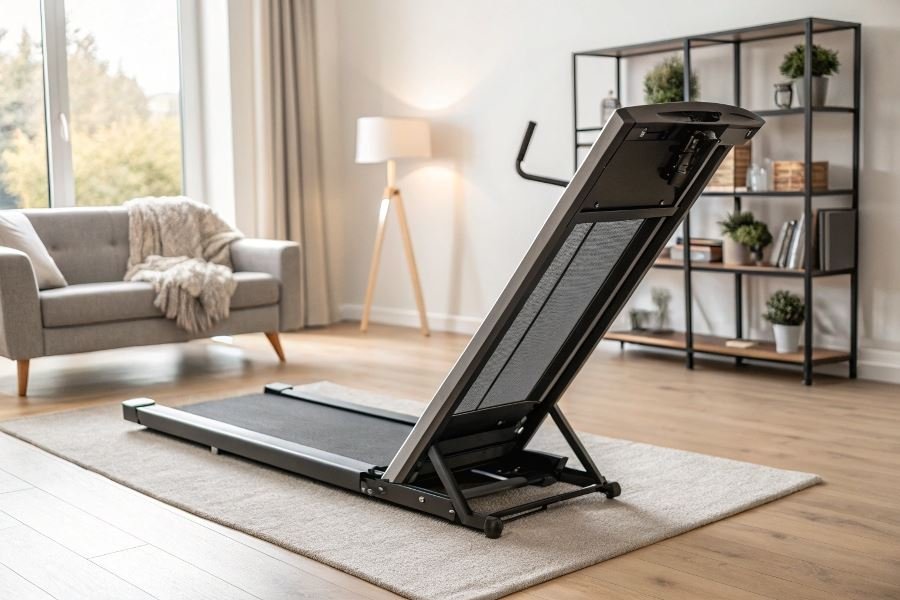
Remember when home gyms meant dedicating an entire room to bulky equipment? Those days are rapidly disappearing as space-efficient fitness solutions transform how Americans stay active at home.
Folding treadmills represent the perfect intersection of convenience and functionality in the modern fitness landscape. Unlike their standard counterparts, these ingenious machines feature a deck that pivots upward when not in use, dramatically reducing their footprint. The defining characteristic isn’t just the folding mechanism—it’s the thoughtful engineering that maintains stability during workouts while offering storage flexibility afterward.
The surge in popularity of these space-conscious cardio machines isn’t surprising. With home fitness participation increasing by nearly 50% since 2019, Americans are seeking equipment that accommodates their living spaces without compromise. Folding treadmills have evolved from flimsy alternatives to robust training platforms capable of supporting serious runners and casual walkers alike.
Before investing in a folding treadmill, consider these critical factors:
- Space requirements: Both in use and folded positions
- Weight capacity: Ensure it supports your body type
- Stability: Quality models minimize wobbling during intense workouts
- Folding mechanism: Look for hydraulic systems that make raising/lowering effortless
- Storage footprint: Some models stand nearly flat against walls
The true value proposition isn’t just about saving space—it’s about removing barriers to consistent exercise. When your treadmill can disappear between workouts, fitness becomes more accessible in apartments, shared living spaces, and homes where dedicated workout rooms aren’t feasible.
Space Warriors: How Folding Treadmills Revolutionize Home Fitness
Let’s face it—finding space for fitness equipment in your home can feel like solving a Rubik’s cube blindfolded. Enter the folding treadmill: the space-saving superhero of home fitness that’s changing the game for apartment dwellers and homeowners alike. These engineering marvels deliver serious workout capabilities without demanding permanent real estate in your living space.
When exploring folding treadmills: advantages and disadvantages become immediately apparent, but the space-efficiency benefits alone make them worth considering for anyone with limited square footage. Modern designs have transformed these machines from clunky compromises into sleek, powerful workout stations that can disappear when not in use.
Apartment-Friendly Fitness Solutions
For apartment dwellers, every square foot counts. Folding treadmills from brands like NordicTrack and Horizon Fitness typically reduce their footprint by 50-70% when folded, turning a 7’ x 3’ exercise machine into something that can slide under a bed or stand flush against a wall.
The average folding treadmill requires just 10-15 square feet of storage space compared to the 30+ square feet needed for operation.
Many models now feature vertical folding designs with heights under 10 inches when collapsed, making them slim enough to store under furniture or in closets. The ProForm SMART Pro 2000 even incorporates SpaceSaver® technology with hydraulic assistance, allowing users to fold the deck with minimal effort.
Portability That Doesn’t Sacrifice Performance
Today’s folding treadmills aren’t just compact—they’re genuinely portable. Key mobility features include:
- Transport wheels that activate when folded
- Hydraulic folding mechanisms requiring just one hand to operate
- Lightweight frames (some under 100 pounds) using aircraft-grade aluminum
- Quick-release systems for tool-free folding/unfolding
The Echelon Stride auto-folds with the push of a button and stands just 10 inches deep when stored. Meanwhile, the Sole F80 includes a safety lock deck that secures the unit when folded vertically.
Functionality Face-Off: Folding vs. Non-Folding
The performance gap between folding and non-folding treadmills has narrowed dramatically. Here’s how they compare:
| Feature | Folding Treadmills | Non-Folding Treadmills |
|---|---|---|
| Motor Power | 2.5-4.0 CHP | 3.0-4.5 CHP |
| Max Speed | 10-12 mph | 12-15 mph |
| Incline Range | 0-15% | 0-20% (some with decline) |
| Deck Cushioning | Good to Excellent | Excellent |
| Weight Capacity | 250-325 lbs | 300-400+ lbs |
| Stability | Good | Excellent |
| Price Range | 500−2,000 | 1, 000−4,000+ |
Premium folding models like the Bowflex Treadmill 22 now offer commercial-grade features including 22-inch HD touchscreens, 20% incline capabilities, and 4.0 CHP motors—specifications that were once exclusive to gym-quality non-folding machines.
The stability difference has also diminished. Advanced locking mechanisms and reinforced frames mean today’s folding treadmills remain rock-solid even during high-intensity interval training. The LifeSpan TR4000i uses a compression system that actually increases deck stability when in use.
For most home users running under 7 mph and weighing less than 300 pounds, the functional differences between quality folding and non-folding treadmills have become virtually imperceptible during workouts—but the difference in your living space when you’re done exercising remains dramatic.
The Hidden Costs of Convenience: Folding Treadmill Tradeoffs
When space-saving meets fitness ambitions, folding treadmills seem like the perfect solution. But before you click “buy,” let’s dive into the less-discussed drawbacks that might make you reconsider. As someone who’s tested dozens of models and watched the evolution of home fitness equipment over the years, I can tell you: the convenience of folding comes with compromises.
The stability equation
Folding treadmills face an inherent engineering challenge: creating a frame that’s both collapsible and rock-solid. This fundamental tension manifests in several ways:
- Reduced weight capacity: Most folding models max out at 250-300 pounds, while commercial-grade non-folding units often support 350+ pounds.
- Higher deck flex: That slight bounce you feel? It’s the folding mechanism introducing play into the frame.
- Speed limitations: Many folding treadmills top out at 10 mph, while fixed frames routinely offer 12+ mph capabilities.
The NordicTrack Commercial 1750 attempts to solve this with reinforced hinges, but physics remains stubborn. During intense interval training or when approaching top speeds, the difference becomes unmistakable. One marathon runner described it as “running on a diving board versus solid ground.”
Durability concerns that compound over time
The folding mechanism introduces additional wear points and maintenance requirements:
The average folding treadmill lifespan is 5-7 years with regular use, compared to 7-10 years for comparable non-folding models.
| Maintenance Task | Folding Models | Non-Folding Models |
|---|---|---|
| Hinge lubrication | Every 3-6 months | N/A |
| Belt alignment | More frequent | Less frequent |
| Frame tightening | Quarterly | Annually |
| Motor strain | Higher | Lower |
The ProForm Pro 2000 addresses some of these issues with sealed bearings, but user reviews consistently mention increased maintenance needs after the 2-3 year mark. The hydraulic systems that make folding effortless are particularly vulnerable to failure, often becoming the first component to require replacement.
The premium paradox
Perhaps the most surprising disadvantage is financial. Despite seeming like a budget-friendly option, folding treadmills often represent poor value:
- Higher cost per feature: Expect to pay 15-20% more for equivalent motor power and deck quality in a folding model.
- Repair expenses: When folding mechanisms fail, repairs average $150-300, a cost never incurred with fixed frames.
- Depreciation rate: Folding treadmills lose value faster, retaining only 20-30% of their purchase price after five years.
The value equation: A $1,200 folding treadmill typically delivers the performance of an $800-900 non-folding model, with the convenience premium accounting for the difference.
When does this investment make sense? If your living situation absolutely demands storage solutions, or if you’ll use the treadmill less than 3 times weekly, the convenience might justify the premium. The Sole F80 strikes perhaps the best balance, with commercial-grade components despite its folding design.
For serious runners, those over 220 pounds, or anyone planning daily use, the compromises in stability and longevity make non-folding models the smarter long-term investment, even in tight spaces.