
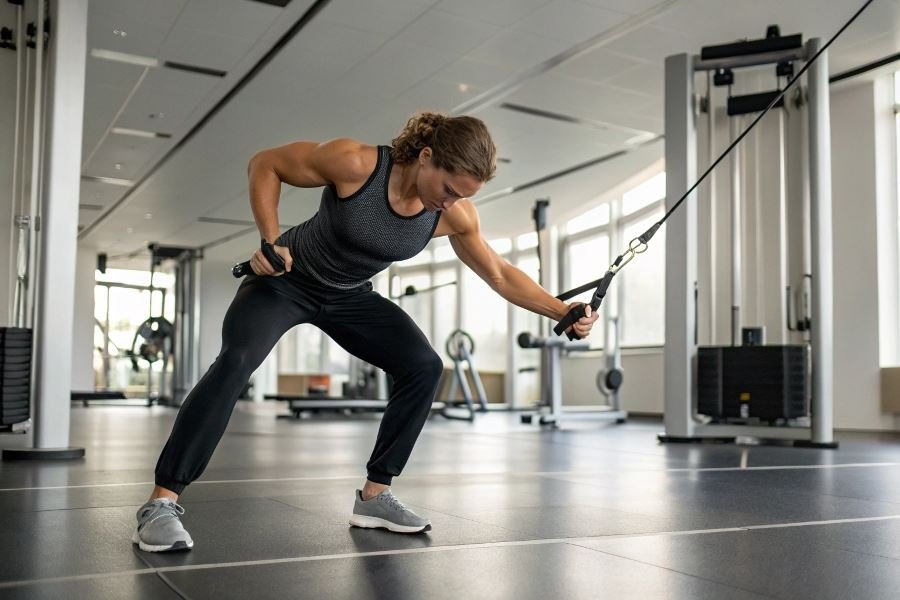
Ever watched an athlete move with such fluid power that it seems almost superhuman? That’s the magic of crossover training in action. These multi-dimensional movements don’t just build muscle—they forge functional strength that translates to everything from carrying groceries to crushing your weekend warrior activities.
Crossover exercises represent the sweet spot where multiple muscle groups work together in harmony, creating movements that mirror real-life activities. Unlike isolated exercises that target single muscles, crossovers engage your body as the interconnected system it was designed to be. The result? Faster gains, better coordination, and injury prevention that traditional workouts simply can’t match.
What you’ll need to get started
The beauty of crossover training lies in its accessibility. While cable machines at the gym offer consistent resistance through full ranges of motion, you can achieve similar effects with resistance bands ($15-30 for a quality set) or even household items. A sturdy chair, a backpack filled with books, or water bottles can substitute for weights in a pinch.
Form first: Safety fundamentals
Proper alignment is non-negotiable. Keep your spine neutral, shoulders back and down, and core engaged throughout each movement. Start with lighter resistance than you think necessary—mastering the movement pattern matters more than the weight you’re moving.
“The most effective exercise is the one performed correctly. Form creates function; function creates results.”
Remember to breathe rhythmically through movements, exhaling during exertion. If you feel pain (not to be confused with muscle fatigue), stop immediately and reassess your form. Your body’s intelligence deserves respect—listen when it speaks.
Upper Body Transformation Through Crossover Training
The cable crossover machine stands as one of the most versatile pieces of equipment in any well-equipped gym. While many fitness enthusiasts gravitate toward free weights, the unique resistance patterns offered by cable systems allow for unparalleled muscle activation across multiple planes of movement. The best crossover exercises for all muscle groups can transform your upper body training by creating constant tension throughout the entire range of motion—something barbells and dumbbells simply cannot replicate.
Chest Development Reimagined
The standard cable crossover represents just the beginning of what’s possible for chest development. By manipulating your body position and angle of pull, you can target different regions of the pectoral muscles with surgical precision.
High-to-Low Crossovers activate the lower chest fibers that often remain underdeveloped in traditional bench press-focused routines. Position the pulleys above shoulder height and drive your hands downward and inward, focusing on squeezing at the midline.
Low-to-High Crossovers engage the often-neglected upper chest region. With pulleys set at the lowest position, drive your hands upward and inward, creating a scooping motion that intensifies activation in the clavicular head of the pectoralis major.
For maximum chest fiber recruitment, incorporate a slight forward lean during standard crossovers, allowing for greater stretch at the eccentric phase and more powerful contraction at the midline.
Shoulder and Upper Back Architecture
Crossover movements aren’t just for chest—they excel at targeting the complex musculature of the shoulders and upper back.
Face Pulls with External Rotation combine rear deltoid activation with rotator cuff strengthening. Set the pulley at upper chest height, grasp rope attachments, and pull toward your face while externally rotating your shoulders at the end range.
| Exercise | Primary Muscles | Secondary Muscles | Recommended Sets/Reps |
|---|---|---|---|
| Face Pulls | Rear Deltoids | Rotator Cuff, Rhomboids | 3-4 sets of 12-15 |
| High Cable Rear Delt Fly | Posterior Deltoids | Trapezius, Rhomboids | 3 sets of 10-12 |
| Cable Upright Row | Lateral Deltoids | Trapezius, Biceps | 3 sets of 8-10 |
Cable Y-Raises target the often-neglected lower trapezius. With cables set low, raise your arms diagonally in a Y pattern, emphasizing scapular retraction at the top position.
Arm and Core Integration
The true magic happens when combining crossover patterns to simultaneously engage arms and core stabilizers.
Cable Woodchoppers create rotational power while engaging the entire anterior chain. Set a single pulley at shoulder height, grasp with both hands, and rotate your torso while pulling the cable across your body.
Standing Cable Curl to Press seamlessly transitions from bicep to shoulder activation. Begin with a cable curl and flow directly into an overhead press, maintaining core tension throughout the movement.
The anti-rotation component of single-arm cable exercises creates an often-overlooked core training stimulus that builds functional strength applicable to athletic movements.
For those seeking complete upper body development, these crossover variations provide the perfect complement to traditional strength training. By incorporating these movements twice weekly with progressive resistance, you’ll experience improvements in muscle definition, functional strength, and joint stability that traditional training methods alone cannot deliver.
Lower Body and Full-Body Crossover Magic
Cable machines aren’t just for sculpting your upper body—they’re secret weapons for building powerful legs and creating total-body integration that traditional exercises simply can’t match. Let’s dive into how crossover principles can revolutionize your lower body training and create seamless full-body power.
Cable crossovers that build leg dominance
The beauty of cable-based lower body training lies in its constant tension and variable resistance patterns. Unlike traditional squats or lunges, cables create resistance from multiple angles, challenging stabilizers you didn’t even know existed.
Cable squat pulls might be the most underrated lower body exercise in the gym. Set cables at mid-height, grab handles with arms extended, and perform a squat while the cables try to pull you forward. This creates tremendous core engagement while building quad and glute strength through a functional pattern.
For posterior chain development, try cable pull-throughs. With the cable set low, face away from the machine, grab the handle between your legs, and hinge forward before driving your hips through. The constant tension at the end range creates hamstring and glute activation that conventional deadlifts miss.
The resistance curve on cable lower body movements perfectly matches human strength curves, creating maximum tension exactly where your muscles need it most.
Full-body integration movements
When we connect upper and lower body movements, magic happens. These exercises trigger hormonal responses and metabolic effects that isolated movements simply can’t match.
The cable lunge with rotation might be the ultimate functional movement. As you lunge forward, rotate your torso toward the front leg while pulling a cable handle across your body. This mimics athletic movements while building core stability, hip mobility, and rotational power.
For pure metabolic impact, nothing beats the cable thruster. Hold handles at shoulder height, squat down, then explosively stand while pressing the handles overhead. This movement chain creates tremendous oxygen demand while building coordination between your pushing muscles and leg drive.
| Exercise | Primary Muscles | Secondary Benefits | Recommended Sets/Reps |
|---|---|---|---|
| Cable Squat Pull | Quads, Glutes | Core stability, balance | 3-4 sets of 10-12 |
| Cable Pull-Through | Hamstrings, Glutes | Lower back health | 3 sets of 12-15 |
| Cable Lunge + Rotation | Quads, Obliques | Rotational power, hip mobility | 3 sets of 8-10 each side |
| Cable Thruster | Quads, Shoulders | Cardiovascular conditioning | 4 sets of 8-10 |
Programming for maximum results
The key to programming crossover movements is understanding their neurological demand. These aren’t simple isolation exercises—they’re complex patterns requiring recovery and strategic implementation.
For beginners, start with 1-2 full-body crossover movements per workout, focusing on mastering form before adding intensity. Intermediate lifters can build entire workouts around these movements, while advanced athletes can use them as finishers after strength work.
A sample lower-body focused routine might look like:
- Cable squat pulls: 3×10
- Alternating cable lunges: 3×8 each side
- Cable pull-throughs: 3×12
- Cable thruster finisher: 2×15
Recovery matters more with integrated movements. Because these exercises recruit so many muscle groups simultaneously, allow 48-72 hours before training the same movement patterns again.
The true power of crossover training isn’t just in the exercises themselves, but in how they teach your body to function as a single coordinated unit rather than isolated parts.