
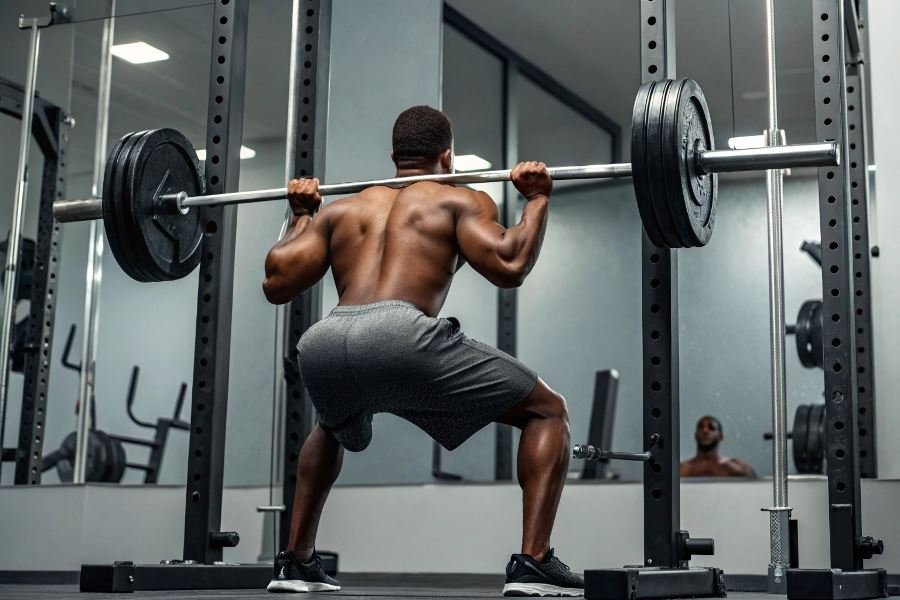
Ever stood in a gym wondering why that steel cage in the corner commands so much respect from serious lifters? That’s the power rack – your ticket to strength training freedom and arguably the most versatile piece of equipment you’ll ever encounter.
A power rack (sometimes called a power cage or squat cage) isn’t just metal and bolts – it’s a complete training ecosystem. This sturdy steel frame features adjustable safety bars, J-hooks for barbell placement, and often pull-up bars on top. Many modern racks include additional attachment points for bands, dip bars, and other accessories that transform this simple structure into a complete gym.
The beauty of power rack training lies in its unmatched versatility and safety profile. When you step inside this steel sanctuary, you’re essentially working with a spotter that never tires. The adjustable safety pins create a fail-safe that allows you to push your limits without fear – something particularly valuable for home gym enthusiasts training alone.
Beyond safety, power racks deliver remarkable training efficiency. They accommodate everything from basic movements like squats and bench presses to advanced techniques like rack pulls and pin presses. This versatility means you can target multiple muscle groups in a single session without equipment changes, making your workouts both time-efficient and incredibly effective.
Before diving into power rack exercises, proper setup is non-negotiable. Always ensure the rack is on level ground, safety pins are correctly positioned at appropriate heights for your exercises, and all components are securely fastened. Remember that even the best safety system requires proper technique – maintain proper form, start with manageable weights, and progress gradually to maximize results while minimizing injury risk.
Unleash Your Strength: Power Rack Exercise Arsenal
The power rack stands as the centerpiece of serious strength training—a steel fortress where fitness goals are conquered rep by rep. This versatile piece of equipment transforms limited space into a complete gym, offering safety and versatility that free weights alone cannot match. Let’s dive into the comprehensive range of exercises that can be performed on a power rack, from foundational movements to advanced variations that will challenge even seasoned lifters.
Compound Movements: Building Your Foundation
The beauty of power rack training lies in its ability to safely facilitate the most effective compound movements in existence. These multi-joint exercises recruit multiple muscle groups simultaneously, delivering maximum results for your training time.
Squats: The undisputed king of lower body exercises becomes even more effective with a power rack. Front squats, back squats, and box squats can all be performed with confidence as the adjustable safety pins prevent disaster if you fail a rep. Position the J-hooks at shoulder height for easy unracking and set safety bars just below your lowest squat position.
Bench Press: Transform your pressing power with proper rack positioning. The horizontal pressing pattern builds impressive chest, shoulder, and tricep development while the safety pins eliminate the fear of being pinned under a heavy barbell. For optimal setup, position yourself so the bar path aligns with your mid-chest when unracked.
Overhead Press: Nothing builds boulder shoulders like pressing weight skyward. The power rack provides the perfect starting position with J-hooks set at upper chest height, allowing you to drive weight vertically without wasting energy cleaning the weight into position.
Pull Exercises: Balanced Development
A well-designed training program balances pushing and pulling movements for structural integrity and aesthetic symmetry.
Pull-ups and Chin-ups: Most quality power racks feature a built-in pull-up bar, typically with multiple grip options. Traditional pull-ups (palms facing away) emphasize lats and upper back, while chin-ups (palms facing you) recruit more bicep activation. For those still building strength, many racks accommodate resistance bands for assisted variations.
Inverted Rows: Position a barbell on the safety pins at waist height and lie underneath. This horizontal pulling motion targets the mid-back, rear deltoids, and biceps while being gentler on the shoulders than vertical pulling.
Table: Pull Exercise Muscle Activation
| Exercise | Primary Muscles | Secondary Muscles |
|---|---|---|
| Pull-ups | Latissimus Dorsi | Biceps, Forearms |
| Chin-ups | Biceps, Latissimus Dorsi | Forearms, Chest |
| Inverted Rows | Rhomboids, Mid-Traps | Rear Deltoids, Biceps |
Core and Accessory Work: Finishing Touches
Rack Pulls: By setting the safety pins at knee height or above, you can perform partial deadlifts that overload the upper portion of the movement. This variation allows for heavier loads than conventional deadlifts while reducing lower back stress—perfect for building tremendous pulling power and grip strength.
Landmine Exercises: Many modern power racks feature landmine attachments or corners where a barbell can be anchored for rotational training. The landmine press, row, and rotation develop functional strength through diagonal and rotational patterns often missing in traditional training.
Core Stabilization: Set a barbell across the safety pins at hip height and perform roll-outs by gripping the bar and extending your body forward. This brutal core exercise challenges your entire anterior chain while the rack provides stability and scalable difficulty.
The versatility of exercises that can be performed on a power rack makes it the smartest investment for home gyms and commercial facilities alike. With proper technique and programming, this single piece of equipment can facilitate complete physical development from beginner to advanced levels, all within a footprint smaller than most cardio machines.
Taking Your Power Rack Training to New Heights
Progressive Overload: The Engine of Growth
Progressive overload isn’t just a training principle—it’s the fundamental driver of all physical adaptation. When applied to power rack training, it becomes a precision tool for continuous improvement.
The beauty of power rack training lies in its measurability. Every workout becomes a data point in your fitness journey. Start by tracking three key variables:
- Weight (absolute resistance)
- Volume (total reps × sets)
- Density (work completed per unit of time)
For optimal strength gains, implement a wave loading approach. Rather than linear progression (adding 5 pounds each week until failure), try this 3-week cycle:
| Week | Weight | Sets | Reps | Rest |
|---|---|---|---|---|
| 1 | 75% 1RM | 4 | 8 | 90 sec |
| 2 | 85% 1RM | 5 | 5 | 2 min |
| 3 | 65% 1RM | 3 | 12 | 60 sec |
This approach prevents plateaus by varying stimulus while maintaining progressive tension. For advanced lifters, consider implementing accommodating resistance with bands or chains, which increase tension at the strongest points of your lift.
Building Balanced Routines Around Your Rack
A well-designed power rack routine should address all major movement patterns while preventing overuse injuries. The key is understanding that your rack isn’t just for squats and bench press—it’s a complete training station.
Create a balanced weekly split using this framework:
- Push day: Rack bench press variations, overhead press, dips
- Pull day: Rack pulls, inverted rows, assisted pull-ups
- Legs day: Squats, lunges, split squats
- Functional day: Landmine exercises, core work, mobility
Balance isn’t just about pushing and pulling—it’s about movement patterns, joint actions, and recovery windows.
For optimal results, incorporate these often-neglected power rack exercises:
- Pin presses (bench with a dead stop at your sticking point)
- Anderson squats (starting from a dead stop at the bottom)
- Rack chins (adjustable height pull-ups for progressive difficulty)
- Landmine presses (using the rack corner for rotational strength)
Customizing Rack Training for Every Level
The versatility of power rack training allows for precise customization across fitness levels. Here’s how to adapt the same basic movements for different goals:
For beginners: Focus on technique development using submaximal loads (60-70% 1RM) with higher repetitions (10-15). Set the safety pins slightly higher than normal to build confidence and create partial range-of-motion training.
For intermediate lifters: Implement variable training zones, alternating between strength-focused sessions (4-6 reps, 80-85% 1RM) and hypertrophy work (8-12 reps, 70-75% 1RM). Begin incorporating paused reps at sticking points.
For advanced athletes: Utilize specialized techniques like:
- Cluster sets (mini-sets with 10-15 second micro-rests)
- Isometric holds at mechanical disadvantage points
- Contrast training (heavy set followed immediately by explosive movement)
The true power of rack training isn’t just in the equipment—it’s in the intelligent application of training principles to your specific needs and goals.
For sport-specific adaptations, adjust your rack setup to match the demands of your activity. Runners might emphasize single-leg stability work, while combat athletes could benefit from explosive rack pulls and Anderson squats to develop starting strength.
Remember that progression isn’t always linear—sometimes it means adding complexity or precision rather than just weight. The power rack gives you the safety and versatility to explore these dimensions of fitness development.