
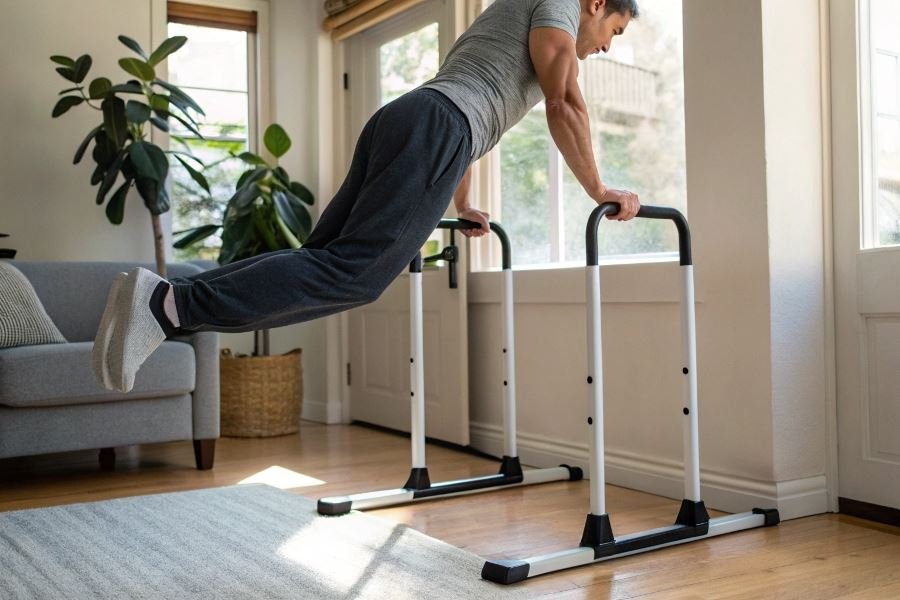
Ever watched Olympic gymnasts effortlessly swing between parallel bars and thought, “I wish I could do that”? Well, now you can—right in your living room. Folding parallel bars have revolutionized home fitness, bringing professional-grade equipment into everyday spaces without requiring Olympic-sized commitment.
Folding parallel bars are adjustable, portable training stations designed to support bodyweight exercises that build upper body and core strength. Unlike their gym counterparts, these compact versions can be folded flat for storage—perfect for those of us who don’t have dedicated home gyms. The beauty lies in their simplicity: two sturdy bars positioned parallel to each other, typically adjustable in height and width, mounted on a foldable base.
Why are these becoming the must-have fitness tool? Home workout equipment sales have skyrocketed as more fitness enthusiasts prioritize convenience without sacrificing quality. The parallel bars’ versatility makes them particularly attractive—they’re not just one-trick ponies.
With a single piece of equipment, you can perform:
- Dips for triceps and chest
- L-sits for core strength
- Push-ups with varied hand positions
- Leg raises for lower abs
- Support holds for shoulder stability
The possibilities extend far beyond basic movements. Advanced users can progress to muscle-ups, handstands, and even the iron cross with consistent practice. This progression pathway makes parallel bars uniquely valuable—they grow with you, challenging beginners and experts alike.
Whether you’re rehabilitating from injury, maintaining fitness, or training for gymnastic strength, folding parallel bars offer professional-grade training that adapts to your space and evolves with your journey.
Maximize Your Home Workout Space
When it comes to building serious upper body strength at home, folding parallel bars represent a game-changing addition to your fitness arsenal. These compact yet robust training stations deliver professional-grade workouts without demanding permanent real estate in your living space.
The evolution of home fitness equipment has transformed how we approach strength training. Folding parallel bars: advantages and disadvantages for home use become immediately apparent when you compare them to traditional fixed equipment. While permanent installations offer stability, their inflexible nature limits your ability to reclaim space when needed—a luxury that folding options provide effortlessly.
Space wizardry that transforms rooms
The primary advantage of folding parallel bars lies in their ingenious design. When fully deployed, they provide the same training surface as commercial gym equipment, but with a crucial difference: they can disappear when not in use. Most models fold to a thickness of just 4-8 inches, allowing for storage under beds, behind doors, or in closets.
This space efficiency proves invaluable for apartment dwellers and homeowners alike. A standard set of Lebert Fitness Equalizers occupies approximately 28×24 inches of floor space during use but can be stored in a fraction of that area. Compare this to permanent dip stations that permanently claim 3-4 square feet of your home.
The best home fitness equipment serves you twice: once during your workout and again by knowing when to disappear.
Muscle-building versatility in one package
Folding parallel bars deliver remarkable exercise versatility, targeting multiple muscle groups through various movements:
| Exercise | Primary Muscles Targeted | Secondary Benefits |
|---|---|---|
| Dips | Triceps, chest, shoulders | Core stabilization |
| L-sits | Core, hip flexors | Shoulder stability |
| Inverted rows | Back, biceps | Grip strength |
| Push-up variations | Chest, shoulders, triceps | Balance, coordination |
| Leg raises | Lower abs, hip flexors | Grip endurance |
This versatility means you’re not investing in a single-purpose piece of equipment. The ability to perform compound movements that engage multiple muscle groups simultaneously creates efficient workouts that maximize your limited home training time.
Financial gains beyond muscle gains
Perhaps the most compelling advantage comes from the cost-effectiveness of folding parallel bars compared to alternatives. A quality set typically ranges from 100−250—a one-time investment that quickly pays dividends.
Consider the math: The average gym membership costs approximately $58 per month in the United States, totaling nearly $700 annually. Within just 4-5 months, your folding parallel bars have essentially paid for themselves. Even premium models like the Ultimate Body Press Dip Bar deliver professional-grade construction at a fraction of what you’d spend on permanent home installations, which often start at $300-500.
The financial efficiency extends beyond purchase price. These bars require zero maintenance costs, consume no electricity, and demand no monthly subscription fees. They represent a refreshingly straightforward approach to fitness in an era of increasingly complex and expensive training options.
The Reality Check on Folding Parallel Bars
Let’s be honest—while folding parallel bars bring the gymnastics studio to your living room, they’re not without their challenges. As someone who’s tested dozens of home fitness equipment setups, I’ve seen the good, the bad, and the downright dangerous. Before you click “buy,” let’s dive into what might make you think twice.
Stability issues that can’t be ignored
The fundamental trade-off with any folding equipment is stability. Unlike commercial gym installations that are bolted to the floor, home parallel bars rely on their base design for stability.
Most folding models use a combination of:
- Wide-stance bases that reduce wobble but increase footprint
- Cross-bracing that improves rigidity but adds weight
- Rubber feet that prevent sliding but may mark floors
The reality: Even premium models like the Lebert Fitness Equalizer can develop slight movement during explosive movements. This isn’t just annoying—it’s potentially dangerous during advanced movements like muscle-ups or back levers.
The difference between commercial and home parallel bars is like comparing a built-in kitchen to a camping stove. Both cook food, but one is engineered for permanence.
Weight capacity limitations that matter
Commercial parallel bars typically support 300+ pounds without breaking a sweat. Home versions? Not always.
| Price Range | Typical Weight Capacity | Suitable For |
|---|---|---|
| Under $100 | 200-250 lbs | Beginners, light training |
| 100−250 | 250-300 lbs | Intermediate users |
| $250+ | 300-400 lbs | Advanced athletes, dynamic movements |
The problem isn’t just about your body weight—it’s about force multiplication. A 180-pound athlete performing a dynamic muscle-up can generate forces exceeding 400 pounds at peak moments. Budget bars simply aren’t engineered for this reality.
The assembly and maintenance equation
Unlike a simple pull-up bar, parallel bars require proper assembly and regular maintenance checks.
Most folding models require:
- Initial assembly (typically 30-60 minutes)
- Periodic tightening of bolts and connections
- Regular inspection of welds and stress points
- Storage considerations when folded
The hidden cost: Time spent maintaining equipment is time not spent training. And if maintenance is neglected, safety risks increase exponentially.
The folding mechanism itself introduces additional wear points. Hinges, locking mechanisms, and folding joints all represent potential failure points that fixed bars simply don’t have.
Maintenance red flags include unusual squeaking, visible wear at connection points, and any perceptible wobble during use. These aren’t just annoyances—they’re your equipment telling you something’s wrong.
For athletes serious about progression, these limitations can become frustrating as your skills advance. What works perfectly for L-sits and basic dips might feel dangerously unstable during more advanced movements.
The bottom line? Folding parallel bars offer convenience at the cost of some stability, weight capacity, and additional maintenance requirements. For many home athletes, these trade-offs are completely acceptable—but going in with eyes wide open means you’ll choose equipment that matches your true needs rather than facing disappointment later.