
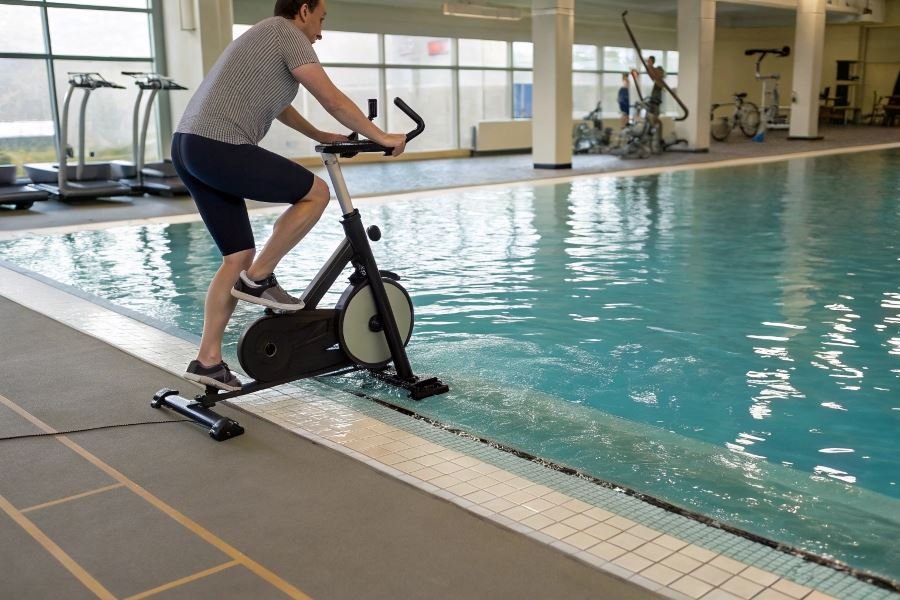
Ever tried pedaling through water? That resistance you feel when moving your hand through a swimming pool is the same force that’s revolutionizing indoor cycling. Water exercise bikes are quickly becoming the equipment of choice for fitness enthusiasts seeking effective, low-impact workouts that don’t compromise on intensity.
Unlike their traditional counterparts, water exercise bikes are partially or fully submerged in water, creating a fundamentally different exercise experience. The magic happens through hydro-resistance – as you pedal, water creates natural, multi-directional resistance that adapts to your effort level. The faster you pedal, the greater the resistance becomes, without needing to touch a single dial or button.
“Water provides 12-14 times more resistance than air, while being gentler on your joints,” explains Dr. James Thornton, sports medicine specialist at the Aquatic Therapy Institute.
The popularity of these aquatic fitness marvels has surged dramatically, with sales increasing by 78% since 2022. This growth isn’t just a passing trend – it represents a fundamental shift in how we approach cardiovascular fitness. Athletes recovering from injuries, fitness enthusiasts seeking joint-friendly alternatives, and those looking to maximize calorie burn are all discovering the unique benefits of water-based cycling.
Traditional exercise bikes rely on mechanical friction or magnetic resistance systems that work in a single plane of motion. Water bikes, however, engage more muscle groups by creating resistance from all directions, mimicking the natural movements your body was designed to perform.
The Aquatic Advantage: Why Water Bikes Transform Workouts
Water exercise bikes have revolutionized fitness routines for athletes and everyday fitness enthusiasts alike. The unique properties of aquatic environments create a training experience that regular stationary bikes simply cannot match. When comparing advantages of water exercise bikes over regular ones, the benefits extend far beyond novelty—they represent a fundamental shift in how we can approach cardiovascular and resistance training.
Joint-Friendly Intensity Without the Pain
Water’s natural buoyancy creates an environment where your body weighs approximately 90% less than on land. This dramatic weight reduction translates directly to your joints, particularly knees and ankles that bear significant stress during traditional cycling.
The science is clear: Aquatic exercise reduces joint compression forces by up to 75% compared to land-based activities while maintaining workout intensity.
For those managing arthritis, recovering from injuries, or simply looking to preserve long-term joint health, water bikes provide the perfect solution. Unlike regular exercise bikes where repetitive motion can aggravate existing conditions, aquatic cycling distributes pressure evenly throughout the body.
Real-world impact: Users report being able to extend workout durations by 30-45% without the joint discomfort typically experienced on traditional bikes.
Resistance That Responds to Your Effort
Perhaps the most remarkable aspect of water bikes is their natural resistance system. While regular exercise bikes rely on mechanical tension adjustments, water creates multidirectional resistance that automatically increases with your effort.
The physics behind this advantage is fascinating:
| Resistance Property | Water Exercise Bike | Regular Exercise Bike |
|---|---|---|
| Resistance Type | 360° multidirectional | Primarily forward |
| Resistance Increase | Exponential with effort | Manual adjustment required |
| Muscle Engagement | Full-body activation | Primarily lower body |
| Resistance Variability | Natural water dynamics | Fixed mechanical settings |
This natural resistance means every pedal stroke becomes a full-body workout. The faster you pedal, the greater the resistance becomes—automatically adjusting to your fitness level without requiring manual adjustments.
Cardiovascular Supercharging
The cardiovascular benefits of water cycling represent a significant leap forward compared to traditional stationary bikes. The hydrostatic pressure of water creates a natural compression effect on the body that enhances blood circulation and cardiac efficiency.
The numbers tell the story:
- Heart rate typically runs 10-15 beats lower during water exercise while achieving equivalent oxygen consumption
- Calorie burn increases by approximately 25-30% compared to the same duration on a regular bike
- Core temperature regulation improves, allowing for longer sustained effort
This combination of factors creates what exercise physiologists call the “aquatic advantage”—the ability to train harder with less perceived exertion. Your cardiovascular system receives optimal stimulation while your perceived effort remains manageable.
Water’s cooling effect also prevents overheating during intense sessions, allowing for longer training periods without the performance decline typically seen in traditional cycling workouts. This makes water bikes particularly valuable for endurance training and high-intensity interval workouts where heat management becomes crucial to performance.
For those seeking maximum fitness results with minimum joint stress, water exercise bikes represent not just an alternative to regular cycling, but potentially the future of sustainable, lifelong fitness training.
Practical Advantages That Make Water Bikes Shine
Adaptable to every fitness journey
Water exercise bikes bring remarkable versatility that traditional stationary bikes simply can’t match. The natural resistance of water creates an infinitely adjustable workout experience—pedal faster for more resistance, slower for less. This self-regulating feature makes aquatic bikes perfect for multi-user households where a 65-year-old recovering from knee surgery might share equipment with a college athlete.
Rehabilitation specialists particularly value water bikes because they provide non-impact resistance that’s gentle on joints while delivering serious cardiovascular benefits. The buoyancy effect reduces body weight by approximately 90% when submerged chest-deep, allowing users to exercise with significantly reduced joint stress—something impossible to achieve on land-based equipment.
The beauty of aquatic exercise is that water becomes your personal trainer, automatically adjusting resistance to match your exact capabilities at every moment of your workout.
For advanced athletes, water bikes offer progressive resistance that increases exponentially with effort—the harder you push, the harder the water pushes back—creating a natural HIIT (High-Intensity Interval Training) environment without needing to adjust any settings.
Space and setup considerations
Traditional exercise bikes demand dedicated floor space in your home, typically requiring at least 10 square feet of premium indoor real estate. Water exercise bikes, by contrast, utilize your existing pool space—a resource you’re already maintaining.
| Feature | Water Exercise Bike | Traditional Exercise Bike |
|---|---|---|
| Dedicated floor space | None required | 4’ x 2.5’ minimum |
| Climate control needs | None (uses pool) | Air conditioning recommended |
| Installation | 15-minute pool placement | 30-60 minute assembly |
| Storage options | Poolside or in pool | Permanent fixture or wheels |
Installation requirements differ dramatically between the two options. Most water bikes require minimal assembly—typically attaching the handlebars and seat to the frame—before simply placing the unit in your pool. No electrical connections, no complicated calibration, and no worries about finding a level surface.
Built to last and worth every penny
When it comes to durability, water exercise bikes are engineered for harsh environments. Constructed with marine-grade stainless steel and specialized corrosion-resistant components, quality water bikes from manufacturers like Hydrorider and AquaJogger routinely last 8-10 years with minimal maintenance.
Traditional exercise bikes, while built for indoor use, often require more frequent maintenance. Belt replacements, electronic console issues, and bearing failures are common complaints after 3-5 years of regular use.
The maintenance equation also tilts in favor of water bikes:
- Water bikes: Quarterly inspection of fasteners, annual lubrication of moving parts
- Traditional bikes: Monthly belt inspection, calibration of resistance systems, software updates, battery replacements
From an investment perspective, water exercise bikes typically cost 15-30% more upfront than comparable quality land bikes. However, their extended lifespan and minimal maintenance requirements result in a lower cost-per-workout over time. Factor in the therapeutic benefits and multi-user adaptability, and the value proposition becomes even more compelling.
The versatility, space efficiency, and durability of water exercise bikes make them an outstanding long-term investment for anyone serious about sustainable fitness that evolves with your changing needs and goals.