
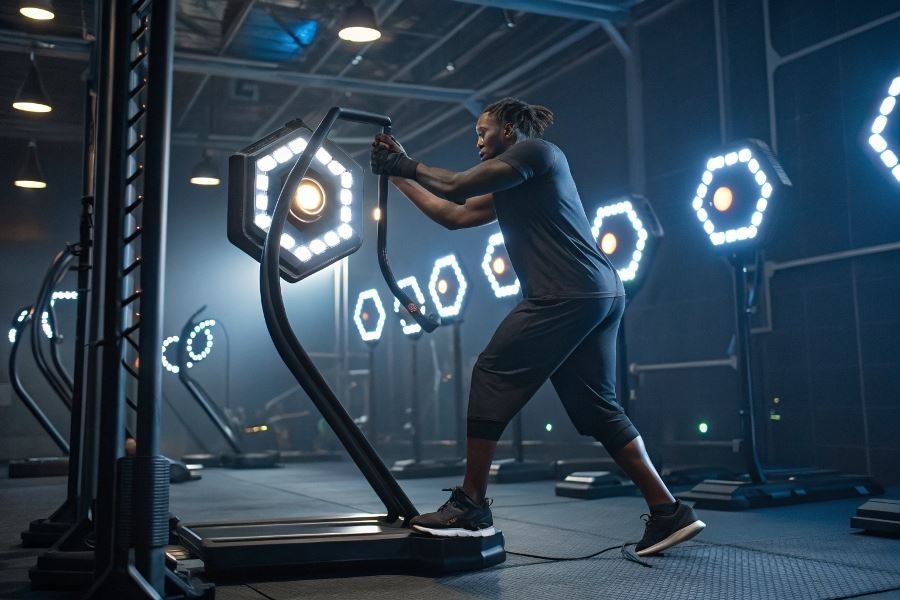
Ever watched an NFL quarterback dodge a 300-pound lineman with milliseconds to spare? That’s not just talent—it’s reaction time and coordination at elite levels.
The difference between good and great athletes often comes down to these split-second abilities. Multifunctional trainers—specialized equipment designed to challenge and enhance your body’s response systems—have revolutionized how we develop these critical skills. Unlike traditional strength equipment, these innovative training tools create unpredictable scenarios that force your nervous system to adapt and respond with lightning speed.
The science behind split-second performance
Reaction time and coordination aren’t just fancy terms—they’re measurable neural pathways that determine athletic success. When LeBron James makes a no-look pass or Simone Biles executes a perfect landing, they’re demonstrating exceptional neuromuscular communication. Research from the Journal of Sports Sciences shows that athletes with superior reaction times (averaging 0.15 seconds faster than competitors) consistently outperform their peers in high-pressure situations.
Beyond the basics: How multifunctional trainers work
These specialized training systems employ various stimuli—lights, sounds, tactile feedback—to create controlled chaos that mimics real-world athletic demands. By incorporating randomized patterns and progressive difficulty levels, they challenge both the brain and body simultaneously. The beauty lies in their versatility: the same equipment can benefit weekend warriors looking to improve tennis reflexes and professional athletes preparing for championship seasons.
The competitive edge: Measurable improvements
When integrated into regular training routines, these systems deliver remarkable results:
- 20% improvement in visual reaction time after just 8 weeks
- Enhanced proprioception (your body’s position awareness)
- Significantly reduced injury rates through improved movement efficiency
Top 3 Multifunctional Trainers That Revolutionize Athletic Performance
When elite athletes talk about the secret sauce behind their lightning-fast reflexes and pinpoint coordination, they’re often referring to specialized training equipment that challenges the brain-body connection in ways traditional workouts simply can’t match. The evolution of multifunctional trainers for developing reaction and coordination has transformed how athletes at all levels prepare for competition, creating training experiences that simultaneously engage multiple physical and cognitive systems.
Reaction Balls and Agility Dots Systems
The humble reaction ball might look like a simple toy, but don’t be fooled—these unpredictable bouncing wonders have become staples in training facilities nationwide. The SKLZ Reaction Ball stands out with its six-sided design that creates genuinely random bounces, forcing athletes to react in milliseconds.
What makes these systems truly effective is their versatility:
- Multi-sport application: Used by baseball fielders, soccer goalkeepers, and tennis players alike
- Progressive difficulty: Start stationary, then add movement patterns
- Minimal space requirements: Effective in areas as small as 10×10 feet
Agility dots systems like the SPRI Quick Dots Agility Trainer complement reaction balls perfectly. These floor markers create infinite pattern possibilities, challenging athletes to improve foot speed, directional changes, and spatial awareness simultaneously.
Pro tip: Combine numbered dots with verbal commands for cognitive-physical integration that mimics game situations.
Electronic Light Board Trainers With Programmable Patterns
Taking reaction training into the digital age, electronic light board systems represent the cutting edge of coordination development. The Fitlight Trainer uses programmable LED discs that athletes must activate through touch, proximity, or motion—creating a fully customizable training experience.
| Feature | Benefit |
|---|---|
| Programmable sequences | Targets sport-specific movement patterns |
| Data tracking | Measures reaction time improvements to 1/1000th second |
| Wireless operation | Allows setup in any training environment |
| Multiple activation methods | Adapts to different training goals (hand touch, body blocking, etc.) |
These systems shine in their ability to replicate the unpredictable nature of competitive sports. A quarterback scanning for receivers, a boxer anticipating punches, or a hockey goalie tracking the puck—all benefit from the rapid decision-making these systems develop.
Balance-Based Multifunctional Trainers With Reactive Elements
The integration of balance challenges with reaction training creates perhaps the most comprehensive coordination development possible. The BOSU Elite combines an unstable platform with attachment points for resistance bands and reaction targets, creating a three-dimensional training environment.
What makes these systems exceptional:
- Proprioceptive engagement: Forces constant body position awareness
- Core activation: Every movement requires stabilization from the center
- Scalable difficulty: Appropriate for rehabilitation patients through pro athletes
The Senaptec Sensory Station takes this concept further by adding cognitive challenges to balance tasks. Athletes must maintain stability while responding to visual cues, creating neural adaptations that transfer directly to competitive performance.
These integrated systems recognize that real-world athletic performance rarely happens from a perfectly balanced, prepared position. By challenging stability and reaction simultaneously, they create training scenarios that mirror the chaotic nature of competition.
When selecting the right multifunctional trainer for your specific needs, consider your training environment, sport-specific demands, and progression goals. The best systems grow with you, offering increasingly complex challenges as your coordination and reaction capabilities improve.
Transform Your Training: Mastering Reaction and Coordination
From Novice to Pro: Progressive Training Methodologies
The journey to lightning-fast reflexes and pinpoint coordination doesn’t happen overnight. Smart progression is the secret sauce that separates effective training from time-wasting workouts. Multifunctional trainers offer the perfect platform for this progression.
For beginners, start with basic visual stimulus response drills. The FITLIGHT Trainer system allows newcomers to begin with simple tap-when-lit exercises at moderate speeds. Focus on accuracy first, then gradually increase tempo as confidence builds.
Intermediate athletes should introduce dual-task challenges – responding to lights while maintaining balance on a BOSU Balance Trainer. This combination forces your brain to process multiple inputs simultaneously, creating neural adaptations that translate directly to sport performance.
Advanced athletes can implement decision-making elements into their drills. Rather than simple reactions, program your BlazePod system to require specific responses to different colored lights – tap blue pods with your left hand, red with your right, and avoid yellow completely. This cognitive-physical integration mirrors the split-second decisions required in competitive environments.
The difference between good and great athletes often comes down to milliseconds of reaction time and millimeters of precision. Progressive training systematically closes these gaps.
Workout Routines That Deliver Results
Quick-Fire Circuit (20 minutes)
- 360° Light Chase (3 rounds)
- Set 8 reaction lights in a circle
- Sprint to each light as it activates
- Rest 60 seconds between rounds
- Hand-Eye Ladder (4 minutes)
- Position lights above agility ladder
- Step through ladder while tapping lights
- Progress from single to alternating hand taps
- Decision Reaction Drill (5 minutes)
- Program 3 color responses (tap/avoid/verbal call)
- Perform while maintaining athletic stance
- Add ball handling for sport specificity
| Workout Component | Duration | Focus Area | Rest Period |
|---|---|---|---|
| 360° Light Chase | 6 min | Whole-body reaction | 60 sec between rounds |
| Hand-Eye Ladder | 4 min | Fine motor coordination | 30 sec between sets |
| Decision Reaction | 5 min | Cognitive-physical integration | 45 sec between sets |
| Cool Down | 5 min | Recovery | None |
Tracking Progress: Numbers Don’t Lie
Measuring improvement provides both motivation and direction for training. Modern multifunctional trainers offer sophisticated metrics that transform subjective “feeling faster” into objective data.
Reaction time should be your primary metric, measured in milliseconds. Most systems like the Dynavision D2 automatically track average response times. Document baseline measurements, then retest every 4-6 weeks. Elite athletes often see improvements of 50-100ms over a dedicated 12-week program.
Accuracy rate matters just as much as speed. Track the percentage of successful responses versus misses or errors. The Senaptec Sensory Station provides detailed accuracy analytics across different drill types.
Complexity tolerance represents your ability to maintain performance as tasks become more challenging. Create a scoring system that combines reaction time, accuracy, and drill difficulty. As your neurological systems adapt, you’ll maintain performance even as complexity increases.
For team settings, implement competitive leaderboards to drive motivation. Nothing pushes improvement like seeing a teammate’s score just above yours on the board. The friendly competition creates an environment where milliseconds matter and coordination becomes currency.