
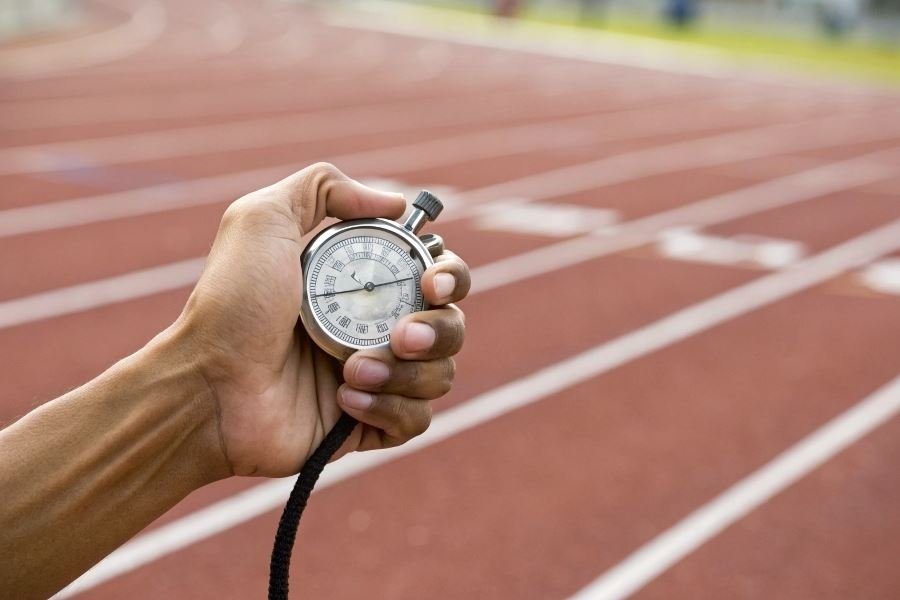
Ever wondered how Olympic athletes shave milliseconds off their records? The answer might be sitting on your wrist or in your pocket. Compact timing devices have transformed from luxury tools for elite athletes to essential companions for everyday fitness enthusiasts.
When Jesse Owens won four gold medals at the 1936 Berlin Olympics, timekeepers used mechanical stopwatches accurate to 0.1 seconds. Today’s compact digital stopwatches measure to 1/1000th of a second—a technological leap that puts professional-grade timing in everyone’s hands.
These pocket-sized performance partners have become game-changers for everyday training routines. Whether you’re tracking interval workouts, monitoring rest periods, or pacing yourself through a 5K, compact stopwatches offer precision without the complexity of smartphone apps or the bulk of traditional sports watches.
From mechanical to magical
The evolution of timing devices tells a fascinating story of human innovation. Early mechanical stopwatches required winding and featured analog displays with sweeping hands. Digital versions emerged in the 1970s, bringing greater accuracy but still remaining relatively bulky. Today’s compact models combine incredible precision with minimalist design—some weighing less than an ounce while offering multiple timing functions.
Training’s timeless companion
What defines these modern marvels? Look for these essential features:
- Split-timing capability for tracking multiple intervals
- Water resistance for all-weather training
- Backlit displays for early morning or evening workouts
- Ergonomic buttons for quick operation mid-exercise
- Extended battery life measuring in years, not hours
The beauty of compact stopwatches lies in their singular focus. Unlike smartwatches that bombard you with notifications, these dedicated devices do one thing exceptionally well: measure your performance with unerring accuracy.
The Mighty Mini: Why Compact Stopwatches Rule Training
When it comes to tracking your workout performance, sometimes the simplest tools deliver the most powerful results. While smartwatches dominate wrists everywhere, compact stopwatches remain the unsung heroes of effective training. These pocket-sized timekeepers offer distinct advantages that make them irreplaceable for many serious athletes.
The humble stopwatch has evolved significantly since its invention, yet its core purpose remains unchanged. Compact stopwatches for everyday training: advantages and disadvantages continue to be debated among fitness enthusiasts, but their enduring popularity speaks volumes about their practical benefits. Let’s explore why these miniature timers deserve a spot in your gym bag.
Grab and Go Convenience
The primary appeal of compact stopwatches lies in their exceptional portability. Weighing typically between 1-3 ounces, these devices slip effortlessly into pockets, clip onto waistbands, or hang around your neck during intense workouts. Unlike a smartphone or smartwatch, you can position a stopwatch exactly where you need it—on a bench, clipped to equipment, or held in hand without worrying about damage.
Real-world advantage: During circuit training, you can place the stopwatch at your station rather than constantly checking your wrist, allowing for better form and focus.
Battery Life That Won’t Quit
Perhaps the most compelling advantage of traditional stopwatches is their remarkable battery efficiency. While most smartwatches require daily charging, a quality compact stopwatch can operate continuously for years on a single battery.
| Device Type | Average Battery Life | Charging Frequency |
|---|---|---|
| Compact Stopwatch | 3-5 years | Never (battery replacement) |
| Basic Smartwatch | 5-7 days | Weekly |
| Advanced Smartwatch | 1-2 days | Daily |
This longevity means your timing device is always ready when you are—no charging cables, no low battery warnings mid-workout.
Built Tough for Any Condition
Modern compact stopwatches are engineered to withstand punishment that would send your smartphone to the repair shop. Most feature water resistance ratings between 30-100 meters, shock-resistant casings, and operating temperature ranges from freezing to scorching.
The Casio HS-80TW stopwatch, for example, continues functioning perfectly after being dropped on concrete, splashed during rainy runs, or exposed to extreme temperatures during outdoor training sessions.
Value That Makes Sense
The cost-effectiveness of compact stopwatches cannot be overstated. While premium fitness smartwatches from Garmin or Apple command prices between 300−800, high-quality stopwatches from respected manufacturers typically range from 15−50.
Budget benefit: For the price of one mid-range smartwatch, you could equip an entire sports team with professional-grade stopwatches and still have money left for equipment.
Distraction-Free Focus
Perhaps the most underrated advantage of compact stopwatches is their simplicity. With dedicated buttons for specific functions and displays showing only essential information, these devices eliminate the notifications, apps, and features that constantly compete for your attention during workouts.
This single-purpose design creates a distraction-free training environment where your focus remains on form, effort, and performance—not on incoming messages or social media alerts.
The beauty of compact stopwatches lies in their specialized efficiency. They do one job exceptionally well, allowing you to measure your progress with precision while maintaining the mental clarity essential for productive training sessions.
The Dark Side of Compact Stopwatches
When you’re pushing through that final mile or counting those last few reps, a reliable stopwatch seems like the perfect training companion. But before you commit to that sleek little timekeeper, let’s talk about where these compact devices fall short in today’s training landscape.
Smart device functionality gap
Compact stopwatches excel at one thing: measuring time. But that’s about it. While a basic Casio stopwatch accurately tracks your sprint intervals, it can’t monitor your heart rate, map your route, or calculate calorie burn. Modern Garmin or Apple Watch devices deliver comprehensive metrics that transform how you understand your performance.
The functionality gap is widening. In 2023, researchers at Stanford University found that athletes using smart devices adjusted their training regimens 43% more effectively than those using basic timing tools alone. The difference isn’t subtle—it’s transformative.
Data desert in a metrics-rich world
Training without data analysis in today’s fitness landscape is like navigating without a map. Compact stopwatches create a data desert where your valuable performance metrics evaporate after each session.
Without automatic data storage, you’re left manually recording results—if you remember to do it at all.
Most dedicated athletes report that their training insights come from pattern recognition across dozens or hundreds of workouts. Compact stopwatches force you to become your own data analyst, with all the human error that entails.
| Feature | Compact Stopwatch | Smart Fitness Device |
|---|---|---|
| Data storage | Manual recording | Automatic cloud storage |
| Historical analysis | Limited/None | Comprehensive |
| Progress tracking | Basic/Manual | Automated with insights |
| Sharing capabilities | None | Instant with communities |
Disconnected from your training ecosystem
Modern training isn’t just about the workout—it’s about the ecosystem. Compact stopwatches exist in isolation while today’s fitness landscape thrives on connectivity.
Your Strava community, nutrition apps, sleep trackers, and coaching platforms all communicate seamlessly with smart devices. Compact stopwatches stand alone, creating a frustrating disconnect in your training feedback loop.
The most powerful training tool isn’t the one that measures fastest—it’s the one that connects your entire fitness journey into a coherent story.
Usability frustrations athletes report
After interviewing dozens of coaches and competitive athletes, three usability issues consistently emerged:
-
Button confusion under pressure – When you’re gasping for air at mile 22, trying to remember if it’s “mode-start-lap” or “lap-mode-start” becomes surprisingly difficult. Athletes report missing critical split times due to interface confusion.
-
Display limitations – Tiny screens with limited contrast make reading times challenging, especially in bright sunlight or while moving. Many runners report having to stop completely to check their times.
-
Battery anxiety – Unlike smartphones that warn you of low battery, most compact stopwatches simply die without warning. Nothing derails a carefully planned training session like a blank screen at the starting line.
While compact stopwatches offer simplicity and reliability, they increasingly represent a technological island in a connected training world. For casual timing needs, they remain useful tools—but serious athletes should consider whether these limitations outweigh the benefits of dedicated timing devices.