
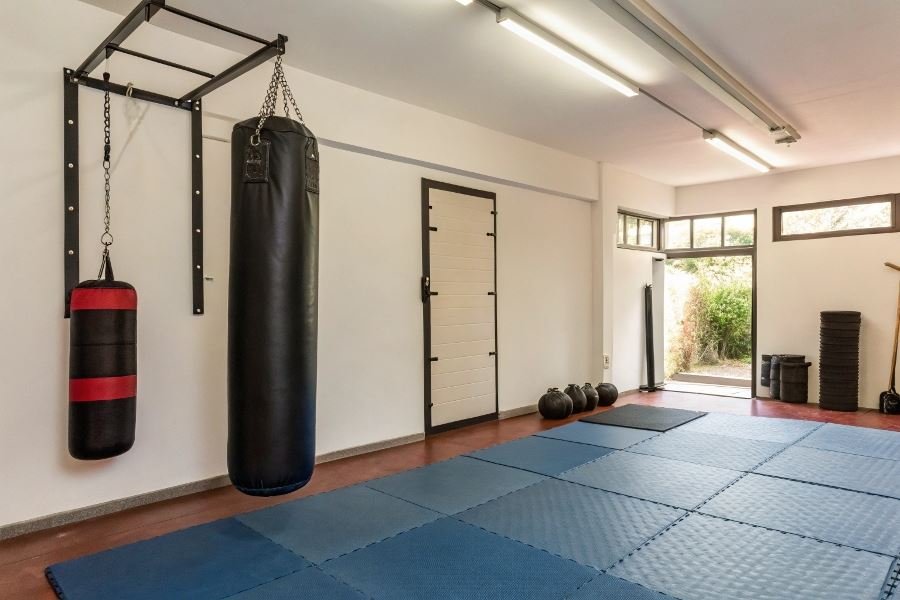
Ever thrown a punch in your living room only to knock over a lamp? Or tried a high kick and hit the ceiling fan? Home martial arts training demands more than just space—it requires the right equipment to transform your practice from dangerous to transformative.
When setting up your home dojo, the equipment you choose can make the difference between steady progress and frustrating plateaus. The right gear doesn’t just protect your body—it accelerates your development by providing appropriate resistance, feedback, and safety margins that allow you to push boundaries without breaking bones (or furniture).
The foundation of effective practice
Proper equipment serves three critical functions in martial arts training: skill development, conditioning, and safety. A heavy bag doesn’t just absorb punches; it teaches proper striking mechanics while building power. Focus mitts don’t merely catch punches; they develop timing and precision that translate directly to sparring scenarios.
“Equipment doesn’t make the martial artist, but the right tools unlock potential that might otherwise remain dormant.”
Selecting equipment for your space and style
Before investing in gear, consider these crucial factors:
- Available space: A 6-foot heavy bag needs more than 6 feet of clearance
- Training goals: Self-defense focus requires different tools than competition prep
- Budget constraints: Quality fundamentals outperform a garage full of mediocre equipment
- Noise tolerance: Some equipment (like speed bags) creates rhythmic sounds neighbors might notice
Discipline-specific requirements
Different martial arts demand specialized equipment. Karate practitioners might prioritize makiwara boards and focus mitts, while Brazilian Jiu-Jitsu demands quality mats above all else. Muay Thai fighters need sturdy heavy bags and potentially shin guards, while Wing Chun practitioners might seek a wooden dummy.
The journey to mastery begins with creating an environment that supports consistent, effective practice—and that starts with understanding exactly what equipment will serve your specific martial path.
Essential Training Equipment for Home Martial Arts Practice
Transforming your home into a martial arts dojo doesn’t require a black belt in interior design—just the right equipment. Whether you’re throwing kicks in your garage or perfecting punches in your basement, proper gear makes all the difference between effective training and potential injury.
When deciding which training equipment is better for home martial arts training, three categories stand out as non-negotiable: striking equipment, protective gear, and appropriate training surfaces. Each plays a crucial role in developing skills while maintaining safety, regardless of your chosen discipline.
Striking Equipment: Your Silent Opponents
Heavy bags serve as the cornerstone of any home martial arts setup. A quality 70-100 pound bag from Everlast provides the resistance needed for developing power in punches and kicks. For apartments where hanging a heavy bag isn’t feasible, freestanding bags with weighted bases offer a solid alternative, though they typically absorb less impact.
Focus mitts and punching pads create opportunities for precision training that bags alone cannot provide.
| Striking Equipment | Best For | Price Range |
|---|---|---|
| Heavy Bag | Power development | $100-300 |
| Focus Mitts | Accuracy, combinations | $30-80 |
| Thai Pads | Kick training | $60-150 |
| Freestanding Bag | Limited space setups | $150-350 |
The difference between basic and premium striking equipment becomes apparent after months of consistent use. Premium options from brands like Century typically feature reinforced stitching and denser filling that maintains shape through years of punishment.
Protective Gear: Your Personal Shield
No serious martial artist trains without proper protection. At minimum, invest in:
Mouthguards – Custom-fit options from Shock Doctor provide superior protection compared to boil-and-bite varieties. Your teeth will thank you.
Gloves – Weight and style depend on your discipline:
- Boxing: 12-16oz training gloves
- MMA: 7oz hybrid gloves
- Muay Thai: Specialized gloves with thumb support
Shin guards become essential when practicing kicks against heavy bags or with partners. Foam-core guards offer mobility while composite guards provide maximum protection.
Hand wraps deserve special mention—these inexpensive strips of cloth prevent wrist injuries and knuckle damage during intense striking sessions.
Training Surfaces: The Foundation of Safety
The floor beneath your feet might be the most overlooked aspect of home training, yet it’s arguably the most important safety feature.
Interlocking foam mats provide the gold standard for home dojos. Look for EVA foam tiles at least 20mm thick for adequate impact absorption. A standard 10’×10’ training area requires approximately 25 square tiles.
| Surface Type | Pros | Cons |
|---|---|---|
| Puzzle Mats | Easy installation, portable | Can separate during dynamic movement |
| Roll-out Mats | Seamless surface, professional feel | Higher cost, storage challenges |
| Tatami-style | Authentic feel, durability | Expensive, requires subfloor |
Beyond the mat itself, consider ceiling height (minimum 8 feet for high kicks), wall padding for areas near striking equipment, and sufficient space around equipment (at least 3 feet clearance) to prevent injuries.
The investment in quality training surfaces from suppliers like Zebra Mats pays dividends in injury prevention and training longevity. Remember that the best equipment serves your specific martial art—a BJJ practitioner needs more mat space than a karate student, while a Muay Thai fighter requires sturdier bags than a Wing Chun practitioner.
With these essentials in place, your home dojo will provide years of effective training without the monthly gym fees.
Equipping Your Martial Arts Journey at Home
Smart budget allocation for maximum impact
Let’s face it—building a home martial arts training space requires investment, but it doesn’t have to break the bank. Start with foundational equipment that delivers the most training value per dollar. A quality heavy bag ($150-300) serves as your cornerstone, offering resistance training, striking practice, and cardio benefits in one package. Brands like Century and Everlast offer durable options with different fill materials to match your striking style.
For grappling enthusiasts, prioritize 1-2 inches of mat coverage ($200-400 for a 10×10 space) before anything else. Your joints will thank you, and quality mats from Zebra Athletics or Dollamur can last 5-10 years with proper care.
Training wisdom: Invest first in equipment that prevents injury and enables consistent practice—everything else is secondary.
Budget-conscious practitioners should consider multi-functional equipment. A Bulgarian bag (80 − 150)offersconditioningbenefitssimilartokettlebellsbutwithmartialarts − specificmovements.Resistancebands(20-50 set) provide strength training that mimics fighting movements without the space requirements of weight stations.
Maximizing training in minimal space
The average apartment dweller has approximately 800-1000 square feet—not exactly a commercial dojo. The solution? Collapsible and wall-mounted equipment that transforms your living space into a training area in seconds.
Space-saving equipment champions:
| Equipment | Space Requirement | Setup/Breakdown Time | Approximate Cost |
|---|---|---|---|
| Wall-mounted heavy bag | 4-6 sq ft when in use | 30 seconds | $200-350 |
| Foldable grappling mats | Storage: 2×2 ft stack | 2 minutes | $150-300 |
| Door frame pull-up bar with attachments | Zero floor space | 45 seconds | $30-100 |
| Resistance band station | 1-2 sq ft storage | 1 minute | $50-150 |
For striking practice in ultra-compact spaces, consider a freestanding reflex bag from Ringside or Title Boxing. These spring-loaded platforms require just 3×3 feet of floor space, can be moved easily, and improve timing and accuracy without the swing radius of traditional heavy bags.
Building equipment that lasts through thousands of rounds
Martial arts equipment faces unique durability challenges—constant impact, moisture from sweat, and frequent use. Investing in maintenance-friendly gear saves money long-term and ensures uninterrupted training.
For heavy bags, look for reinforced stitching at stress points and removable covers that can be washed. Marine-grade vinyl exteriors resist moisture better than canvas alternatives. Fairtex and Hayabusa offer bags with replaceable components, extending their lifespan by years.
Maintenance frequency matters more than intensity. Establish a simple routine:
- Weekly: Wipe down all equipment with antimicrobial cleaner
- Monthly: Check stitching and hardware connections
- Quarterly: Rotate heavy bags to distribute wear evenly
- Annually: Deep clean or replace covers on high-use equipment
For grappling mats, closed-cell foam construction prevents bacterial growth and simplifies cleaning. Interlocking designs allow you to replace individual sections rather than entire mat systems when damage occurs.
The most durable home training setup balances quality materials with proper care. Remember that even mid-range equipment maintained properly will outlast premium gear that’s neglected. Your commitment to equipment maintenance directly translates to training consistency—the true secret to martial arts progress at home.