
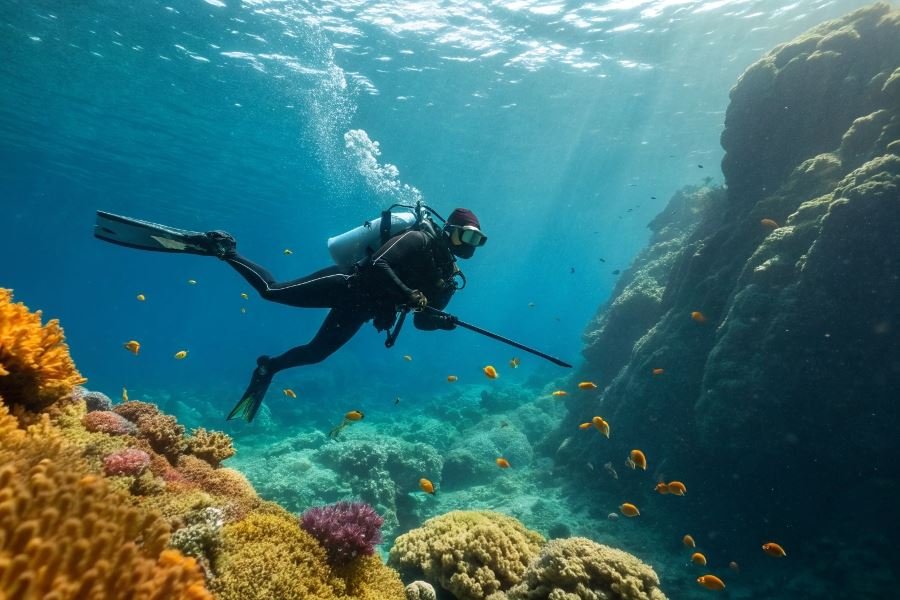
Ever watched a barracuda slice through crystal-clear waters and thought, “I want to be part of that underwater world”? Underwater hunting offers exactly that thrill—but only with the right equipment. The crossbow you’d use on land might as well be a paperweight 30 feet below the surface.
Choosing a crossbow for underwater hunting isn’t just about grabbing any waterproof model. It’s about understanding how water transforms everything—from physics to visibility to your own movements. The perfect underwater crossbow becomes an extension of your body in an environment where humans are naturally disadvantaged.
The underwater difference
Unlike their land-based cousins, underwater crossbows must contend with water resistance that dramatically affects projectile trajectory. Water is approximately 800 times denser than air, creating substantial drag that requires specialized design considerations:
- Shorter, more powerful bands to overcome water resistance
- Hydrodynamic shafts that maintain accuracy despite currents
- Corrosion-resistant materials (marine-grade stainless steel or specialized polymers)
Essential selection factors
Your underwater hunting success hinges on three critical elements:
- Visibility conditions – Murky freshwater requires different configurations than crystal-clear saltwater
- Target species – Pursuing grouper demands different power than hunting lionfish
- Shooting range – Most underwater hunting happens within 6-10 feet, not the 30+ yards of land hunting
“The underwater hunter doesn’t just adapt to the environment—they become part of it. Your crossbow is the critical link in that transformation.” — Veteran spearfisher Mark Ramirez
Essential Features That Make or Break Your Underwater Crossbow
When you dive beneath the surface, your crossbow becomes more than equipment—it becomes your underwater companion. The right choice can mean the difference between a successful hunt and frustration in the depths. Let’s cut through the murk and examine what truly matters.
Material Composition: The Battle Against Saltwater
Saltwater is merciless. It will attack your crossbow with relentless chemical warfare, which is why material selection stands as your first line of defense.
Marine-grade stainless steel components offer excellent corrosion resistance, but come with a weight penalty. Many professional hunters consider this trade-off worthwhile. When evaluating how to choose a crossbow for underwater hunting, always inspect the trigger mechanism’s material—this critical component must withstand repeated exposure to corrosive environments.
Aluminum alloys strike an impressive balance between weight and durability, particularly 6061-T6 and 7075 grades which offer superior salt resistance. For ultimate performance, look for crossbows featuring titanium components in high-stress areas.
The difference between good and exceptional underwater crossbows often comes down to the small details: sealed bearings, anodized finishes, and sacrificial anodes that protect other metal parts.
Modern composite options from manufacturers like Hammerhead Spearguns incorporate carbon fiber elements that resist corrosion entirely while maintaining structural integrity at depth.
Power Metrics That Matter Underwater
Water resistance changes everything about projectile physics. Your crossbow’s power requirements underwater differ dramatically from those above the surface.
| Power Metric | Shallow Water (0-15ft) | Medium Depth (15-30ft) | Deep Water (30ft+) |
|---|---|---|---|
| Draw Weight | 75-100 lbs | 100-150 lbs | 150+ lbs |
| FPS (in air) | 150-200 | 200-250 | 250+ |
| Effective Range | 10-15 ft | 8-12 ft | 5-8 ft |
Draw weight translates directly to penetration power, but remember that water creates exponentially more resistance than air. A crossbow rated at 200 FPS in air might achieve only 20-30 FPS underwater, with velocity dropping rapidly beyond 10 feet.
The most effective underwater hunters prioritize higher draw weights over speed ratings, as mass and momentum maintain better in water than velocity alone.
Size and Maneuverability: The Underwater Dance
Underwater hunting demands a different approach to equipment dimensions. Unlike their land-based counterparts, underwater crossbows must balance power with mobility.
Compact limb spans (under 24 inches when cocked) offer significant advantages in reef environments and tight spaces. The Rob Allen Tuna series exemplifies this design philosophy with its narrow profile that slices through water with minimal resistance.
Weight distribution becomes critical underwater—neutral buoyancy prevents arm fatigue during extended hunts. Leading manufacturers now incorporate buoyancy compensators that can be fine-tuned based on water salinity and depth.
Consider these maneuverability factors:
- Total length: Shorter is generally better (under 30 inches)
- Handle ergonomics: Textured grips prevent slippage
- Trigger guard size: Must accommodate neoprene gloves
- Reload mechanism: Should be operable with one hand
The best underwater crossbows feature ambidextrous designs that accommodate different shooting styles and positions. This versatility proves invaluable when stalking prey from various angles in three-dimensional underwater environments.
Remember that your perfect crossbow balances these essential features against your specific hunting environment, target species, and personal preferences. The ideal underwater hunting companion feels like an extension of yourself—responsive, reliable, and ready for the hunt.
The Ultimate Underwater Crossbow Arsenal
Diving into the depths with the right crossbow can transform your underwater hunting experience from frustrating to phenomenal. Let’s explore the three crossbow types that dominate the underwater hunting scene, each with distinct characteristics that might make one perfect for your specific hunting style.
Band-powered crossbows: The reliable classics
Band-powered crossbows remain the most popular choice among underwater hunters, and for good reason. These weapons utilize rubber bands (typically latex) to generate the propulsive force needed to launch spears through water.
Advantages that make them shine:
- Exceptional simplicity and reliability underwater
- Minimal maintenance requirements
- Lower cost entry point (quality models starting around $150)
- Natural feel and intuitive shooting mechanics
The Rob Allen band-powered crossbows exemplify this category’s strengths, offering impressive power-to-price ratios. However, these classics come with limitations:
“Band-powered crossbows are like the trusty pickup trucks of underwater hunting—they’ll rarely let you down, but they won’t win any speed records either.”
Their power ceiling is lower than pneumatic alternatives, and band degradation occurs over time, requiring replacement every 15-20 dives depending on usage intensity. The shooting range typically maxes out around 10-12 feet for most recreational models.
Pneumatic underwater crossbows: Power unleashed
When hunters seek maximum power and range, pneumatic crossbows enter the conversation. These compressed-air marvels deliver consistent, powerful shots that can make the difference when targeting larger prey.
Performance highlights:
- Superior power delivery (up to 3x the force of band-powered models)
- Consistent shot performance throughout a dive
- Extended effective range (15-20 feet with accuracy)
- No band degradation concerns
The Salvimar pneumatic models represent the cutting edge in this category, offering exceptional power in compact packages. The trade-offs, however, are significant:
- Higher initial investment ($300-700 for quality models)
- More complex maintenance requirements
- Additional weight underwater
- Potential for mechanical failure in remote locations
Pneumatic crossbows require careful handling and regular maintenance to prevent salt buildup and internal corrosion that can compromise performance.
Rail-guided systems: Precision underwater sniping
For hunters who prioritize accuracy above all else, rail-guided systems represent the pinnacle of underwater precision. These specialized crossbows use a rail system to guide the spear, dramatically improving shot consistency.
Why precision hunters choose rail systems:
- Unmatched accuracy at extended ranges
- Reduced spear wobble during travel
- Superior tracking for moving targets
- Enhanced durability in harsh conditions
The Hammerhead Spearguns rail-guided models demonstrate how this technology transforms underwater hunting accuracy. These systems excel in challenging visibility conditions where precision makes all the difference.
Rail-guided systems do come with considerations:
- Higher learning curve for proper technique
- Premium pricing ($400-900 range)
- Often heavier and less maneuverable in tight spaces
- Specialized maintenance requirements
The table below provides a quick comparison of these three underwater crossbow types:
| Feature | Band-Powered | Pneumatic | Rail-Guided |
|---|---|---|---|
| Power | Moderate | High | Moderate-High |
| Accuracy | Good | Very Good | Excellent |
| Range | 8-12 ft | 15-20 ft | 12-18 ft |
| Maintenance | Minimal | Complex | Moderate |
| Price Range | $150-350 | $300-700 | $400-900 |
| Weight | Light | Heavy | Medium-Heavy |
| Reliability | Excellent | Good | Very Good |
Your ideal underwater crossbow ultimately depends on your hunting environment, target species, and personal preferences. Many experienced hunters eventually own multiple types, selecting the right tool for specific hunting conditions.