
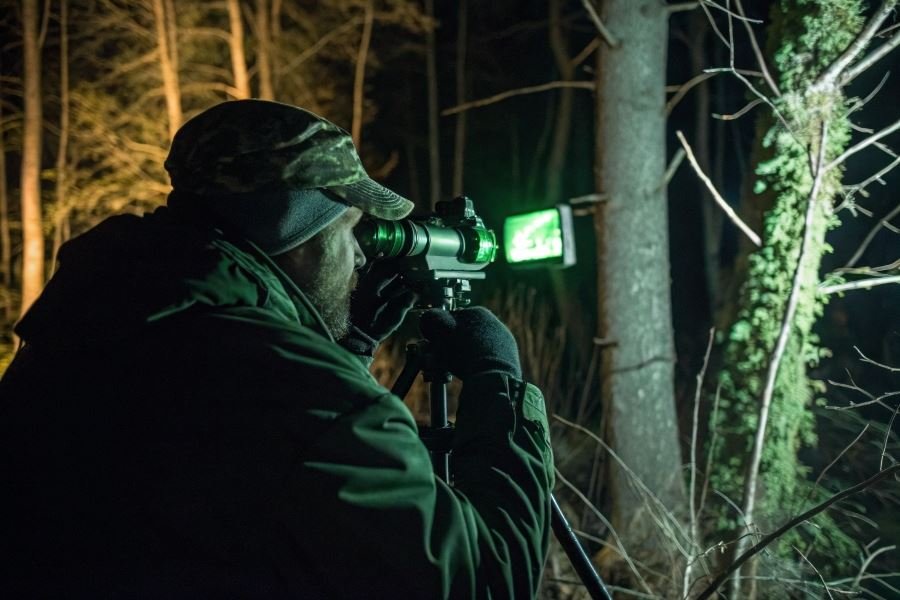
Ever stood in pitch-black woods, knowing your quarry moves freely while you’re essentially blind? That frustration ends with the right night vision technology—a game-changer that’s revolutionizing the modern hunting landscape.
When darkness falls, wildlife thrives. Deer feed more confidently, predators hunt more actively, and hogs destructively root through fields. Night vision devices transform these nocturnal hours from downtime into prime hunting opportunities, extending your season and dramatically increasing your chances of success. The technology that once belonged exclusively to military operations now fits comfortably in your hunting pack.
Evolution of night vision generations
Night vision technology has evolved through distinct generations, each offering significant improvements:
- Gen 1: Entry-level devices offering basic amplification (40-80x) with effective ranges up to 75 yards
- Gen 2: Substantial leap forward with microchannel plates delivering clearer images at 150+ yards
- Gen 3: Military-grade clarity with gallium arsenide photocathodes providing exceptional detail at 300+ yards
- Gen 4/Unfilmed: The cutting edge with unprecedented contrast and performance in extremely low light
Know before you go: Legal considerations
“Understanding regulations isn’t optional—it’s as essential as knowing your weapon’s effective range.”
Night vision hunting regulations vary dramatically by state. While Texas embraces night hunting for feral hogs, California prohibits all night vision hunting. Always verify current regulations with your state’s wildlife agency before investing in equipment or planning your hunt. Penalties for violations can include hefty fines, equipment confiscation, and even license revocation.
The Night Vision Revolution: Essential Factors for Hunting Success
When darkness falls, the right night vision device transforms an ordinary hunter into a nocturnal predator with superhuman abilities. The technology that once belonged exclusively to military operations has evolved into sophisticated tools accessible to civilian hunters, but choosing the right one requires understanding crucial technical elements.
Selecting the perfect night vision device for hunting depends on balancing performance needs with budget constraints. How to choose a night vision device for hunting involves evaluating generations, specifications, and form factors that match your specific hunting environment and target game. Let’s dive into the technical details that separate mediocre gear from game-changing equipment.
Night Vision Generations: The Evolution of Darkness Dominance
Night vision technology is categorized into distinct generations, each representing significant technological leaps:
Gen 1 devices (200−500) offer basic amplification with approximately 75 yards of visibility. They’re entry-level options with shorter battery life (around 40 hours) and some edge distortion. Perfect for stationary hunting over bait piles or in dense woods where long-range visibility isn’t critical.
Gen 2 units (1, 000−2,500) deliver dramatically improved image clarity with reduced noise and better low-light performance. Detection ranges extend to 200+ yards with battery life reaching 50+ hours. The sweet spot for most serious hunters.
Gen 3 technology (3, 000−4,000) represents military-grade performance with exceptional clarity, contrast, and up to 300+ yards of detection range. These devices feature gallium arsenide photocathodes that excel in extremely low light conditions.
Gen 4 (or “filmless” Gen 3) devices ($4,000+) offer the pinnacle of performance with unmatched clarity, contrast, and range exceeding 400 yards in ideal conditions. The removal of the ion barrier film increases sensitivity and reduces noise.
Technical Specifications That Make or Break Performance
| Specification | Why It Matters | Hunting Recommendation |
|---|---|---|
| Resolution | Determines image clarity | Minimum 64 lp/mm for Gen 2+ |
| Detection Range | Maximum distance to identify targets | 200+ yards for medium/large game |
| Field of View | Width of observable area | 40°+ for tracking moving targets |
| Signal-to-Noise Ratio | Image clarity in extreme darkness | 25+ for clean images |
| Battery Life | Operational duration | 40+ hours for extended hunts |
Resolution, measured in line pairs per millimeter (lp/mm), directly impacts your ability to distinguish between a trophy buck and a doe at distance. For serious hunters, anything below 64 lp/mm will leave you squinting and second-guessing.
Detection range varies dramatically between generations and even between models within the same generation. A quality Gen 2+ device should allow you to spot medium-sized game at 200+ yards under quarter-moon conditions.
Configuration Choices: Matching Form to Function
Monoculars dominate the hunting market for good reason. They’re lightweight (typically under 1.5 pounds), compact, and offer the best performance-to-price ratio. Perfect for scanning and spotting, they leave one eye adapted to natural darkness—a tactical advantage when moving through varied terrain.
Binoculars reduce eye strain during extended observation periods and provide better depth perception. The tradeoff comes in weight (2-3 pounds), bulk, and significantly higher cost. They excel in open terrain hunting where prolonged observation precedes the shot.
Goggles provide hands-free operation, critical for bow hunters or those navigating difficult terrain. Modern units from companies like ATN and Pulsar offer helmet mounting options with adjustable eye relief for comfortable all-night wear.
The configuration you choose should align with your hunting style—spot-and-stalk hunters benefit from lightweight monoculars, while those in fixed positions might prefer the comfort of binoculars for extended glassing sessions.
Sealing the Deal: Your Night Vision Hunting Decision
Smart budgeting for maximum performance
Let’s face it—night vision technology isn’t cheap, but neither is wasting money on equipment that doesn’t meet your needs. The sweet spot lies in understanding which features actually matter for your hunting style. Entry-level Gen 1 devices start around $300-500, while professional-grade Gen 3 units can exceed $4,000.
The budget breakthrough comes when you identify your non-negotiables. If you’re primarily hunting stationary game at moderate distances, a mid-range Gen 2 device ($1,000-2,500) often delivers the best value proposition. These units offer significantly better resolution and light amplification than Gen 1 without the premium price of military-grade options.
Remember that resolution and detection range impact your success rate far more than fancy features you’ll rarely use.
A strategic approach is investing in a slightly higher-grade base unit rather than loading up on accessories you might not need. As hunters often say:
Better to cry once when buying quality than cry every time you use something inferior.
Matching capabilities to your hunting environment
Your hunting terrain should dictate your device choice more than any other factor. Here’s how different environments demand specific capabilities:
| Environment | Recommended Technology | Key Features |
|---|---|---|
| Dense forest | Thermal imaging | Heat detection through foliage |
| Open fields | Digital night vision | Extended range, higher magnification |
| Mixed terrain | Gen 2+ hybrid systems | Balanced performance, versatility |
| Wetlands/fog | Thermal scopes | Penetrates moisture interference |
When hunting fast-moving game like coyotes or wild hogs, prioritize devices with faster refresh rates and wider fields of view. For deer stands, resolution and detection range become more critical than speed.
Weather resistance matters enormously in real-world conditions. IP67 ratings or better ensure your investment survives unexpected downpours or accidental submersion. The ATN X-Sight 4K Pro exemplifies this durability while maintaining exceptional image quality.
Maximizing your investment through care and accessories
Night vision devices require specific maintenance routines that differ from traditional optics. Proper care extends device lifespan by years and maintains optimal performance.
The battery strategy that transforms your experience: Carry lithium batteries for cold-weather hunts—they outperform alkaline options by hours in temperatures below 40°F. For extended trips, consider the Pulsar Power Bank which can recharge most units 5-6 times.
Three accessories that multiply capability:
- IR illuminators extend your effective range by 30-50% in extremely dark conditions
- Quick-detach mounts allow seamless transitions between day and night hunting
- Lens covers with built-in cleaning systems prevent damage during transport
Document your device’s performance in different conditions. This hunting journal approach helps you optimize settings for specific environments and game, turning your night vision device into a precision-tuned hunting tool rather than just expensive gear.
By balancing budget realities with your specific hunting needs and investing in proper maintenance, your night vision device becomes not just a purchase but a long-term hunting advantage that pays dividends with every successful outing.