
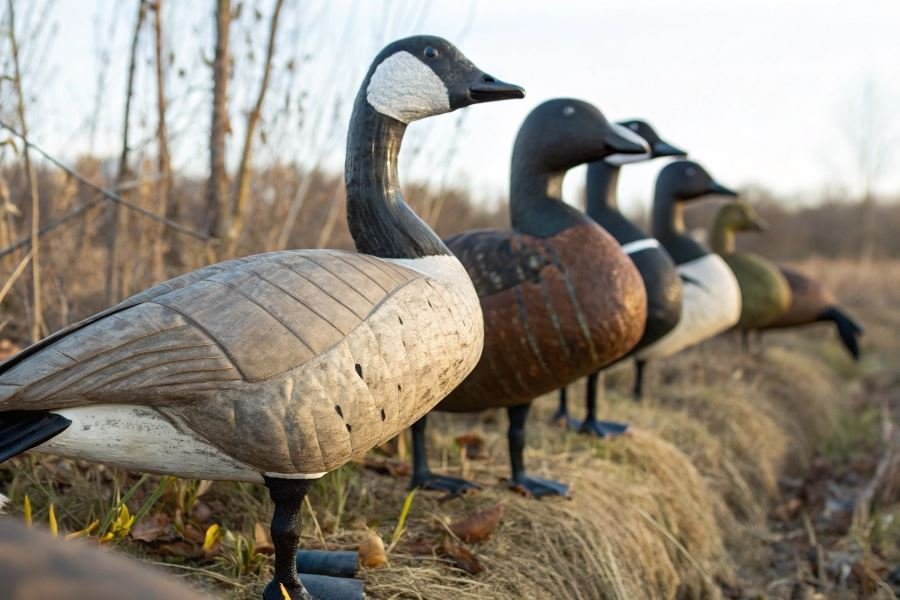
Ever wondered why some hunters consistently bag their limit while others come home empty-handed? The secret often lies not in the quality of their shotgun or their camouflage—but in how they arrange their decoys. This seemingly simple aspect of hunting preparation can make the difference between a memorable day in the field and a frustrating exercise in patience.
Strategic decoy placement isn’t just about tossing plastic birds randomly across your hunting area. It’s about creating an illusion so convincing that even the wariest waterfowl can’t resist investigating. When you properly arrange decoys while hunting, you’re essentially speaking the visual language that wild birds understand—signaling safety, food abundance, and social opportunity.
The power of strategic placement
Different hunting scenarios demand different decoy strategies. For early-season mallards in small ponds, a relaxed scattered pattern with feeding positions works wonders. Meanwhile, late-season geese in open fields might require massive spreads with distinct family groups to overcome their heightened suspicion. Coastal duck hunters often employ long strings of decoys to mimic rafting birds, while timber hunters might use just a handful of highly visible decoys in small openings.
Essential equipment for decoy mastery
Your decoy toolkit should include more than just the decoys themselves. Long-line systems allow quick deployment and retrieval in deeper waters. Decoy weights appropriate for your hunting conditions prevent frustrating drifting. Motion systems—from simple jerk cords to sophisticated electronic wings—add that crucial element of lifelike movement that can seal the deal when birds are circling overhead.
Remember: The most effective decoy spread isn’t necessarily the largest—it’s the most thoughtfully arranged.
Decoy Deployment Mastery for Hunting Success
The difference between a successful hunt and going home empty-handed often comes down to one critical skill: decoy arrangement. Top hunters don’t just randomly scatter fake birds across a field—they create strategic illusions that convince wary waterfowl to commit to their spread. The psychology behind effective decoy placement runs deeper than most realize, combining animal behavior science with tactical positioning.
When setting up for your next hunt, understanding how to properly arrange decoys while hunting transforms your chances dramatically. The most successful hunters approach decoy placement as both art and science, reading environmental conditions and adapting their spreads accordingly. This methodical approach pays dividends when those first flights appear on the horizon at dawn.
Creating Lifelike Spreads Based on Species Behavior
Different waterfowl species display distinct social behaviors that should dictate your decoy arrangement:
Mallards prefer loose, random patterns with small family groupings. Create several clusters of 3-5 decoys with natural spacing between groups.
Canada Geese typically feed in family units with sentinels posted. Position your spread in a J-hook formation with “sentinel” decoys facing outward at the edges.
Snow Geese gather in massive, tight concentrations. For these gregarious birds, use high-density spreads with minimal spacing between decoys.
Remember: Realism trumps quantity every time. A thoughtfully arranged spread of 12 quality decoys will outperform 50 carelessly positioned ones.
Wind-Responsive Positioning Techniques
Wind direction isn’t just a factor—it’s the foundation of your entire setup:
| Wind Condition | Recommended Formation | Landing Zone Position |
|---|---|---|
| Light (0-5 mph) | Scattered pods | Center of spread |
| Moderate (5-15 mph) | J-hook or U-shape | Upwind pocket |
| Strong (15+ mph) | Tight I-formation | Directly upwind |
Position your most realistic decoys upwind, as birds land into the wind. Create a distinct landing zone—an open area approximately 15-20 yards upwind of your blind where birds can commit without flying directly over decoys.
Strategic Spacing for Maximum Attraction
The spacing between your decoys communicates crucial information to passing birds:
Tight Spacing (1-2 feet apart) signals abundant food resources and comfortable feeding conditions. Use this in cold weather when birds congregate for warmth.
Medium Spacing (3-5 feet apart) mimics normal feeding patterns and works well in most hunting scenarios.
Wide Spacing (6+ feet apart) suggests relaxed, unpressured birds. This works exceptionally well in heavily hunted areas where birds have grown suspicious of tight formations.
For diving ducks like Canvasbacks or Bluebills, arrange decoys in lines perpendicular to the wind, creating “streets” that funnel birds toward your shooting position.
The terrain should influence your spread as well. On water, use the natural contours of shorelines to create realistic scenarios. In fields, position decoys on slightly elevated areas for maximum visibility to passing flocks.
By mastering these decoy arrangement principles, you’ll create setups that not only attract birds but convince them to commit fully to your spread—the ultimate goal of any successful waterfowl hunter.
Mastering the Decoy Game
Seasonal Adaptation Strategies
Successful waterfowl hunters know that static decoy spreads spell disaster. As the hunting season progresses, birds become increasingly wary of familiar patterns. Early season setups should feature larger spreads with relaxed spacing – typically 2-3 feet between decoys – mimicking the comfortable feeding patterns of unpressured birds.
Mid-season demands evolution. Reduce your spread by 30-40% and introduce more realistic postures and movement. This is when Mojo Outdoors motion decoys truly earn their keep, creating the dynamic visual cues that passing flocks expect to see.
By late season, surviving birds have seen it all. Your strategy must shift to:
- Ultra-realistic spreads with fewer decoys (8-12 maximum)
- Greater spacing (4-5 feet apart)
- Strategic “family group” clusters rather than uniform patterns
- More sleeper and rester poses showing relaxed, safe birds
The birds that survive into January aren’t the same naive creatures you hunted in October. Your decoy strategy shouldn’t be either.
Avoiding Decoy Disasters
Even veteran hunters make decoy mistakes that send ducks flaring. The most common setup errors include:
| Error | Impact | Solution |
|---|---|---|
| Unnatural spacing | Immediate suspicion | Vary distances between 2-5 feet |
| Ignoring wind direction | Poor landing zones | Position landing pocket downwind |
| Uniform facing | Looks staged | Mix directions with majority facing wind |
| Shine and flash | Spooks birds | Use matte finish decoys or aging techniques |
| Tangled lines | Restricted movement | Use Rig’Em Right tangle-free systems |
Perhaps the most overlooked mistake is failing to adjust for water depth. In shallow water, ducks create distinctive feeding patterns that differ dramatically from deeper water loafing behaviors. Your spread should reflect these natural behaviors.
Another critical error? Neglecting to create a clear landing zone. Ducks need an obvious place to commit – a landing pocket approximately 15-20 yards upwind of your blind that’s free of obstacles.
Winning Decoy Strategies
The difference between filling limits and watching empty skies often comes down to these final recommendations:
- Scout relentlessly – arrange your decoys to match exactly what local birds are doing
- Create contrast – mix species, sizes, and postures for visual authenticity
- Embrace movement – incorporate Higdon Outdoors motion stakes or water rippling devices
- Master the J-Hook – position your main group in a J formation with the hook pointing downwind toward your blind
- Less is more – quality and placement trump quantity every time
The most successful hunters maintain a decoy journal tracking weather conditions, spreads used, and results. This data becomes invaluable for making informed adjustments season after season.
Remember that decoy arrangement is both science and art. The science lies in understanding waterfowl behavior; the art comes from adapting to local conditions and reading the birds’ responses. When you nail both aspects, your decoy spread becomes an irresistible invitation rather than an obvious trap.