
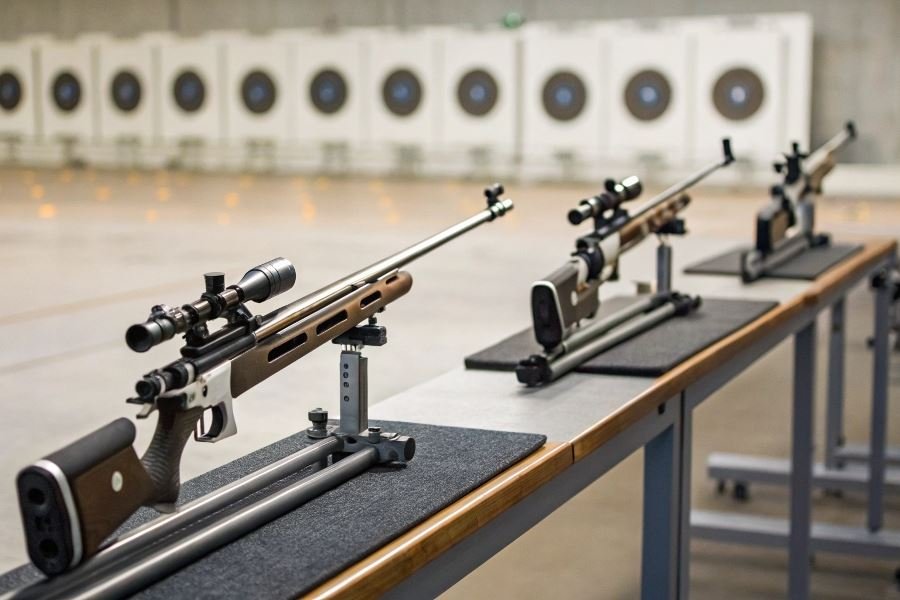
Ever wondered why some air guns pack a punch while others feel like they’re shooting cotton balls? The secret lies in the caliber – that tiny number that makes all the difference between tickling your target and knocking it clean over.
Pneumatic automatic guns represent the perfect marriage of precision engineering and compressed air technology. Unlike their firearm cousins, these weapons harness the power of pressurized air to propel projectiles downrange without the need for explosive propellants. The beauty? They deliver impressive performance while remaining accessible to enthusiasts across most states.
The science behind the shot
At their core, pneumatic automatic guns operate on a brilliantly simple principle: compressed air provides the energy to launch pellets or BBs through the barrel. When you pull the trigger, a valve releases a precise burst of pressurized air, propelling the projectile forward with remarkable consistency. The “automatic” designation refers to the gun’s ability to fire repeatedly without manual reloading between shots – a feature that transforms casual plinking into an exhilarating experience.
Caliber breakdown: Size matters
The caliber spectrum offers something for every shooter:
| Caliber | Diameter (inches) | Best suited for |
|---|---|---|
| .177 | 0.177 | Target shooting, small pests |
| .22 | 0.22 | Medium-sized pests, small game |
| .25 | 0.25 | Hunting, longer range shooting |
| .30+ | 0.30 and larger | Serious hunting, maximum impact |
The .177 caliber reigns supreme in competitive shooting circles, offering flat trajectories and pinpoint accuracy. Meanwhile, the .22 caliber has become the gold standard for backyard pest control, delivering the perfect balance of velocity and knockdown power. For those seeking serious hunting capability, the .25 caliber and larger options provide devastating terminal performance that can humanely dispatch game at impressive distances.
Choosing your caliber: Application is everything
Selecting the right caliber isn’t about bigger being better – it’s about matching the tool to the task. Target shooters benefit from the economical and accurate .177, while hunters might find the enhanced stopping power of larger calibers worth the trade-off in trajectory. Your intended use, shooting distance, and even local regulations should guide your decision.
Remember: the perfect pneumatic automatic isn’t necessarily the most powerful one – it’s the one that perfectly aligns with your shooting goals.
Air Power Showdown: Caliber Wars
Performance Metrics That Matter
When diving into the comparison of pneumatic automatic guns of different calibers, three performance factors immediately stand out: velocity, accuracy, and effective range. The .177 caliber pellets typically achieve the highest velocities—often exceeding 1,000 feet per second in high-end models like the Benjamin Marauder—making them ideal for target shooting where flat trajectories matter. Meanwhile, .22 caliber options deliver approximately 15-20% lower velocities but compensate with significantly improved knockdown power.
For precision shooters, the .177 caliber generally offers tighter groupings at distances under 35 yards. However, the .22 and .25 caliber options demonstrate superior stability in windy conditions due to their higher ballistic coefficients. The AirForce Texan in .25 caliber, for instance, maintains impressive accuracy out to 75 yards while delivering energy levels that approach small-caliber firearms.
Air Efficiency Across The Spectrum
Air consumption varies dramatically between calibers, creating significant operational differences. Smaller .177 caliber guns typically deliver 30-40% more shots per fill than their larger counterparts. A standard 3000 PSI tank might provide 60+ consistent shots with a .177 caliber Hatsan BullBoss, while the same gun in .25 caliber might only deliver 35-40 shots before requiring a refill.
This efficiency equation becomes particularly important for field use where refill opportunities are limited. The larger calibers demand more air volume to achieve optimal velocities, creating a direct trade-off between power and shot count. For competitive shooters who might fire hundreds of rounds in a session, this efficiency difference translates to fewer interruptions with smaller calibers.
The relationship between caliber and air consumption isn’t just about shot count—it’s about sustained performance throughout the pressure curve.
The Real Cost Of Ownership
Initial investment represents only part of the financial picture when comparing pneumatic automatic guns. Entry-level .177 caliber models from manufacturers like Crosman typically start around $150, while comparable .22 caliber options command a 10-15% premium. The gap widens further with .25 and larger calibers, with premium models often starting at $400-600.
However, the long-term ammunition expenses tell a different story:
| Caliber | Avg. Cost Per Pellet | Cost Per 1000 Shots | Relative Cost |
|---|---|---|---|
| .177 | $0.03 | $30 | Baseline |
| .22 | $0.05 | $50 | +67% |
| .25 | $0.08 | $80 | +167% |
| .30 | $0.15 | $150 | +400% |
These differences compound over time, especially for high-volume shooters. Additionally, specialized ammunition like hunting pellets can double these base costs across all calibers.
The accessory ecosystem also varies by caliber popularity, with .177 and .22 offering the widest selection of aftermarket options, moderators, and specialized ammunition types. This ecosystem diversity often translates to better value and more customization possibilities for the two most common calibers.
When factoring in air refill costs—whether from dive shops, personal compressors, or hand pumps—the higher consumption rates of larger calibers add another layer to the cost analysis, making smaller calibers potentially more economical for regular shooters despite their lower per-shot impact.
Finding Your Perfect Pneumatic Automatic Gun Caliber
When it comes to pneumatic automatic guns, caliber selection isn’t just about preference—it’s about purpose, performance, and legal compliance. The right caliber can transform your shooting experience from merely satisfactory to absolutely exceptional. Let’s dive into the factors that should guide your decision and explore what the future holds for this evolving technology.
Matching calibers to their ideal applications
Different caliber categories excel in specific scenarios, making your selection crucial to achieving optimal results:
.177 (4.5mm) – The lightweight champion delivers impressive velocity and flat trajectories, making it perfect for target shooting and competitive events. Its minimal recoil allows for exceptional accuracy at distances up to 50 yards, ideal for paper punching and precision work.
.22 (5.5mm) – The versatile middle-ground offers the sweet spot between speed and impact energy. This caliber shines in small game hunting and pest control situations where clean, humane shots are essential. The heavier pellet retains energy downrange while still maintaining reasonable trajectory.
.25 (6.35mm) – When stopping power matters, this heavyweight delivers. Best suited for medium-range hunting applications where terminal performance is critical. The substantial pellet creates significant impact energy, though at the cost of a more pronounced trajectory arc.
.30 and larger (7.62mm+) – These specialized calibers excel in long-range shooting and larger game hunting scenarios. Their substantial weight delivers maximum energy transfer but requires significant air volume to achieve optimal velocity.
| Caliber | Optimal Range | Best Applications | Key Advantage |
|---|---|---|---|
| .177 (4.5mm) | 10-50 yards | Target shooting, competition | Flat trajectory |
| .22 (5.5mm) | 15-45 yards | Small game, pest control | Versatility |
| .25 (6.35mm) | 20-40 yards | Hunting, serious pest control | Impact energy |
| .30+ (7.62mm+) | 25-75 yards | Larger game, long-range shooting | Maximum power |
Navigating the regulatory landscape
Pneumatic automatic gun regulations vary dramatically across jurisdictions, making compliance essential:
State-level restrictions often dictate where and how these guns can be used. While some states treat them similarly to firearms, others classify them as sporting equipment with minimal restrictions. Always verify local regulations before purchasing.
Velocity thresholds frequently determine legal classification. Many jurisdictions set specific feet-per-second (FPS) limits that, when exceeded, may reclassify your pneumatic gun under stricter regulations.
Transportation requirements vary widely. Some areas require pneumatic guns to be cased and unloaded during transport, while others have minimal restrictions.
Age restrictions typically apply to purchase and use. Most retailers require buyers to be at least 18 years old, with some jurisdictions setting the minimum age at 21 for higher-powered models.
The evolution of pneumatic automatic technology
The pneumatic automatic gun landscape continues to evolve with several exciting developments on the horizon:
Electronic regulation systems are revolutionizing consistency. These advanced systems maintain precise pressure control throughout firing sequences, delivering shot-to-shot consistency that was previously unattainable.
Hybrid power systems combining pneumatic operation with electronic components are creating more efficient platforms. These systems optimize air usage while providing enhanced user feedback through digital displays.
Advanced materials like carbon fiber and aerospace-grade aluminum are dramatically reducing weight while increasing durability. These materials allow for higher pressure ratings without adding bulk.
Modular designs are becoming increasingly popular, allowing shooters to reconfigure their pneumatic guns for different applications without purchasing multiple platforms. Quick-change barrels and adjustable regulators make caliber switching more accessible than ever.
The future of pneumatic automatic guns points toward greater efficiency, enhanced customization, and improved performance across all caliber categories. By understanding both current capabilities and emerging trends, you’ll be positioned to select the optimal caliber for your specific needs.