
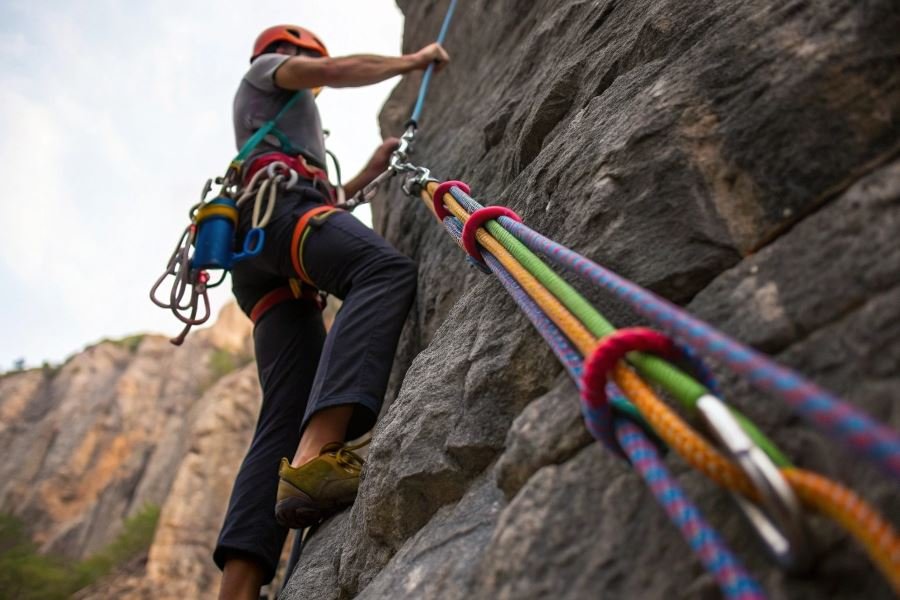
Ever dangled 80 feet up with nothing but 10mm of engineered fiber between you and gravity? That’s why rope care isn’t just maintenance—it’s survival insurance.
Your climbing rope is the most critical piece of safety equipment in your arsenal, silently performing under extreme stress while you focus on that next hold. Proper care doesn’t just extend your rope’s lifespan—it could literally save yours. The difference between a well-maintained rope and a neglected one might be the difference between catching a fall or experiencing catastrophic failure when you need protection most.
The engineering marvel in your gear bag
Modern climbing ropes are technological marvels. The typical dynamic rope features a kernmantle construction—a strong inner core (kern) of nylon fibers providing up to 80% of the rope’s strength, protected by a woven outer sheath (mantle) that shields against abrasion. This design allows ropes to stretch 25-30% during falls, absorbing impact forces that would otherwise transfer to your body.
“A climbing rope is like a living thing—it remembers every fall, every scrape against rock, and every day left baking in the sun.” — Alex Honnold
The performance equation
The math is simple: proper care = longer life + better performance. A well-maintained rope maintains its dynamic properties, handles better, and provides consistent protection. Studies show that properly stored ropes retain up to 95% of their original strength after years of use, while neglected ropes can deteriorate to dangerous levels within a single season.
When you understand what your rope endures—from UV radiation to dirt infiltration to chemical contamination—you’ll never toss it carelessly in your trunk again. Your rope’s lifespan isn’t just about saving money; it’s about preserving the integrity of your most crucial lifeline.
Essential Care Techniques for Climbing Ropes
Your climbing rope isn’t just equipment—it’s your lifeline. When you’re dangling 80 feet up a sheer rock face, that 10mm diameter cord becomes the most important thing in your world. Proper maintenance isn’t optional; it’s essential for both performance and safety.
The care and storage of climbing ropes directly impacts their lifespan, potentially doubling the functional life of your investment while ensuring maximum safety during every climb. Most climbers replace their ropes every 3-5 years, but with proper attention, you might extend that significantly—saving money and reducing waste.
Washing Away the Grit: Cleaning Protocols
Dirt is your rope’s silent enemy. Those tiny particles work between the fibers, causing internal abrasion with every flex. Clean your rope when it becomes visibly dirty or feels gritty—typically every 3-6 months for regular climbers.
The proper cleaning method:
- Fill a bathtub with lukewarm water
- Add rope-specific cleaner or mild soap (never detergent)
- Submerge and gently agitate the rope
- Rinse thoroughly until water runs clear
- Dry in loose coils away from direct sunlight
Never machine wash or dry your rope. The mechanical action and heat can severely damage the core fibers and compromise the sheath integrity.
Inspection: Your Life Depends On It
Regular inspection should become second nature. Before and after each climbing session, run the entire length through your hands, feeling for irregularities.
| Inspection Point | What to Look For | Action Required |
|---|---|---|
| Sheath | Fuzzing, cuts, abrasions | Monitor minor fuzzing; retire for significant damage |
| Core | Soft spots, hourglass pinching | Immediate retirement |
| Middle marker | Visibility | Re-mark if faded |
| Ends | Fraying, core exposure | Consider cutting back if minimal; retire if severe |
Document your inspections in a rope log, noting the date, conditions, and any areas of concern. This creates a history that helps identify patterns of wear and predicts potential failure points.
Handling Practices That Preserve Performance
How you use your rope dramatically affects its longevity. Even the most expensive Petzl or Black Diamond rope will deteriorate rapidly with poor handling.
Minimize these degradation factors:
- Sharp edges – Always pad edges and be mindful of rope path
- Dirt contamination – Use a rope tarp when climbing outdoors
- High-impact falls – Avoid unnecessary whippers; they stress fibers
- Stepping on rope – This grinds dirt particles into the sheath
Dynamic belaying techniques not only protect the climber but also reduce stress on your rope. Learn to give a soft catch by moving slightly forward as your partner falls, distributing impact force over a longer distance.
When transitioning between routes, flake your rope carefully rather than dragging it across the ground. This simple habit prevents unnecessary abrasion and dirt accumulation that would otherwise require more frequent cleaning.
Remember: your rope works hard for you—return the favor with consistent, thoughtful care.
Rope Refuge: Mastering Storage for Climbing Lifelines
Your climbing rope isn’t just equipment—it’s your lifeline. After watching it perform flawlessly on rock faces and training walls, proper storage becomes the unsung hero in extending its service life. Let’s dive into the science and art of keeping your rope ready for action, season after season.
The invisible enemies of rope integrity
Temperature fluctuations, humidity, and UV radiation form a triple threat to your climbing rope’s molecular structure. Exposure to temperatures above 140°F (60°C) can permanently weaken nylon fibers, reducing strength by up to 30% in severe cases. Even your car trunk on a summer day can reach these damaging temperatures!
Humidity presents another challenge. When stored in damp environments, ropes can develop mildew and experience hydrolysis—a chemical breakdown that compromises structural integrity. Testing by the American Alpine Club found that ropes stored in >70% humidity environments showed accelerated aging equivalent to adding a year of use in just three months.
UV radiation might be the most insidious culprit. A study published by Black Diamond revealed that continuous exposure to direct sunlight can degrade a rope’s outer sheath within weeks, not years. The damage isn’t always visible until it’s too late.
Storage solutions that save lives
Proper storage begins with proper coiling. The butterfly coil (aka mountaineer’s coil) prevents twisting and tangling while distributing stress evenly:
- Make equal-sized loops, approximately 3 feet in diameter
- Alternate the direction of each loop to prevent twisting
- Secure with a loose strap—never use the rope’s ends to tie itself
Never store your rope directly on concrete floors. Concrete leaches alkaline compounds that silently attack nylon fibers. Instead, consider these storage options:
| Storage Solution | Pros | Cons | Ideal For |
|---|---|---|---|
| Rope Bags | Portable, prevents dirt ingress | Limited ventilation | Active climbers |
| Mesh Storage Sacks | Excellent ventilation | Less protection from dust | Home storage |
| Dedicated Rope Buckets | Organization and protection | Bulky, less portable | Gym settings |
| Hanging Systems | Prevents compression, good airflow | Takes wall space | Long-term storage |
The Petzl rope bag remains an industry standard, combining durability with a built-in tarp for staging areas. For home storage, elevated mesh containers from Metolius provide optimal airflow while keeping ropes off potentially damaging surfaces.
Seasonal storage strategies
For those who hibernate during off-seasons, additional considerations apply. Before long-term storage:
- Wash your rope following manufacturer guidelines—soil contains acids that gradually weaken fibers
- Dry completely in a shaded, well-ventilated area (never use heat sources)
- Loosely coil to prevent stress points from developing
- Store in a breathable bag away from chemicals, fuels, and batteries
Climate-controlled environments between 50-70°F (10-21°C) with 40-60% humidity represent the gold standard for rope longevity. A dedicated gear closet with a small dehumidifier can create these conditions in most homes.
“Your rope remembers everything you forget about storage.” This climbing adage reminds us that today’s storage shortcuts become tomorrow’s safety concerns. With proper care, a quality climbing rope can reliably serve you for 5+ years instead of the typical 2-3—saving money while maximizing safety on every ascent.