
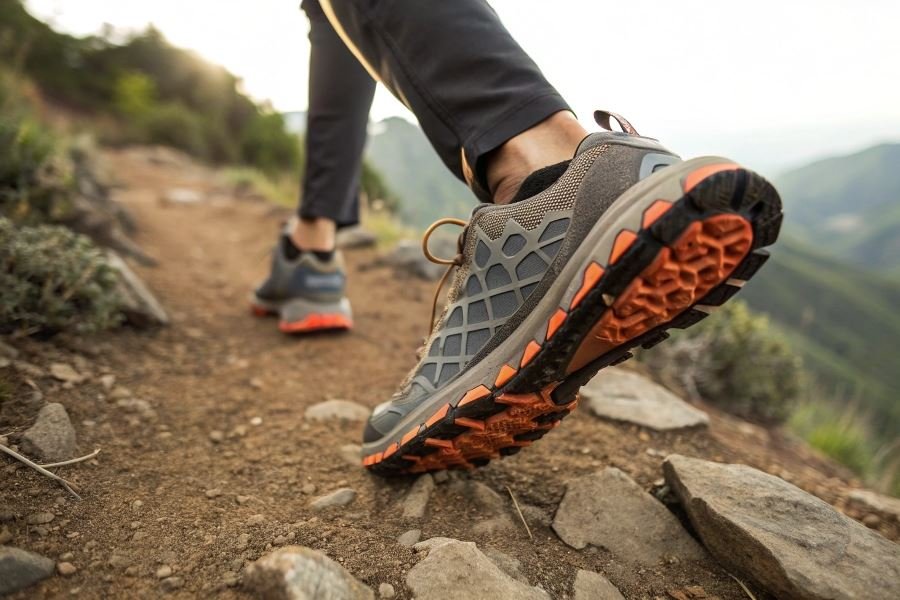
Ever wondered why your favorite road runners feel like torture devices on forest trails? Or why those chunky trail shoes that grip like mountain goats leave your feet screaming after a mile of sidewalk? The answer lies not in your feet, but in the specialized engineering that makes running shoes terrain-specific.
Women runners who transition between city streets and natural paths face a unique challenge. The perfect asphalt-to-trail crossover shoe must balance seemingly contradictory demands: cushioning for hard surfaces and stability for uneven terrain. This balancing act becomes even more critical when considering the biomechanical differences in women’s running patterns.
The science of surface adaptation
The distinction between road and trail footwear goes far beyond aesthetics. Road shoes prioritize impact absorption and energy return, with responsive midsoles that transform downward force into forward momentum. Trail variants, meanwhile, feature protective rock plates, aggressive outsole lugs, and reinforced uppers that shield against debris.
“The difference between appropriate road and trail footwear can mean the difference between personal records and physical therapy appointments.”
Female-specific engineering matters
Women’s running shoes aren’t simply smaller men’s models with feminine colorways. Research published in the Journal of Biomechanics demonstrates that women typically have wider forefoot-to-heel ratios, different Q-angles (hip-to-knee alignment), and unique pronation patterns. These distinctions demand gender-specific design considerations.
When shoes properly account for these differences, the benefits extend beyond comfort—they directly impact performance metrics and injury prevention. The right dual-surface women’s running shoe doesn’t just feel better; it fundamentally changes how safely and efficiently you can transition between environments.
Trail to Pavement: Top 3 Women’s Running Shoes for Every Surface
Finding the perfect pair of running shoes that can seamlessly transition from smooth city streets to rugged trail paths is the holy grail for versatile runners. The best women’s running shoes for asphalt and off-road combine technical innovation with practical design elements that adapt to changing terrain without missing a beat. Let’s dive into the top performers that are redefining what’s possible in cross-surface running footwear.
Versatile champions of mixed terrain
The Hoka Challenger ATR 7 stands out with its remarkable 29mm heel stack that somehow maintains agility on technical trails. The dual-density midsole provides cushioned landings on asphalt while the 4mm lugs deliver confident grip when you venture off the beaten path. At just 8.8 oz, they’re surprisingly lightweight for their protective capabilities.
The Brooks Caldera 6 offers a different approach with its nitrogen-infused DNA LOFT v3 midsole that adapts remarkably well between surfaces. The TrailTack rubber outsole provides exceptional traction on wet surfaces while remaining smooth on pavement. The balanced 6mm drop works wonders for midfoot strikers who frequently switch between road and trail.
Rounding out the top three, the Saucony Peregrine 12 delivers outstanding versatility with its PWRRUN cushioning that remains responsive after hundreds of miles. Its distinctive PWRTRAC outsole with 5mm lugs grips like claws on loose terrain yet rolls smoothly on concrete.
Built to last: Materials that go the distance
| Model | Upper Material | Outsole Durability | Weather Resistance |
|---|---|---|---|
| Hoka Challenger ATR 7 | Recycled mesh | 450+ miles | Water-repellent |
| Brooks Caldera 6 | Engineered mesh | 500+ miles | Quick-drying |
| Saucony Peregrine 12 | FORMFIT | 400+ miles | All-weather |
The durability equation for multi-surface shoes is complex. The Challenger’s recycled mesh upper balances breathability with protection, while the Caldera’s engineered mesh excels in moisture management. The Peregrine’s FORMFIT technology creates a precision fit that prevents internal movement and resulting wear patterns.
What truly separates these models is their strategic reinforcement in high-abrasion zones. The Challenger uses rubberized toe caps, the Caldera incorporates a 3D rubber print shield, and the Peregrine features a rock plate that doubles as structural support.
Performance metrics that matter
When comparing stability, weight, and responsiveness, each model presents distinct advantages:
The Challenger ATR 7 offers neutral stability with subtle guidance through its Meta-Rocker geometry. At 8.8 oz, it’s the lightest of our top three, with moderate responsiveness that favors comfort over speed.
The Caldera 6 weighs in at 9.4 oz but delivers superior stability through its wider platform and integrated GuideRails system. Its nitrogen-infused midsole provides exceptional energy return on firm surfaces while absorbing impact on technical descents.
The Peregrine 12 strikes a remarkable balance at 9.2 oz, with its PWRRUN cushioning delivering the most responsive ride of the three. Its FORMFIT upper creates a locked-in feel that enhances stability without restricting natural foot movement.
For runners seeking one shoe to handle everything from neighborhood jogs to weekend trail adventures, these three models represent the pinnacle of versatile performance, each with unique strengths that might align perfectly with your running style and terrain preferences.
Finding Your Perfect Match: The Ultimate Running Shoe Decision Guide
Personalized fit for your unique running identity
Finding running shoes that work across both asphalt and trails isn’t just about buying what looks cool—it’s about understanding your biomechanical signature. Your foot strike pattern (heel, midfoot, or forefoot) fundamentally dictates what shoe technology will serve you best. Pronators need stability features like medial posts or guide rails, while supinators benefit from neutral shoes with enhanced cushioning.
Foot width matters tremendously! Brooks and New Balance excel with wide-foot options, while Altra pioneered the foot-shaped toe box that allows natural toe splay. Stack height preference—minimal ground feel versus maximum cushioning—should align with your joint sensitivity and running distances.
The perfect cross-terrain shoe doesn’t exist in a vacuum—it exists in relationship to YOUR unique running mechanics.
For runners tackling both surfaces regularly, prioritize versatile outsole patterns with multi-directional lugs of moderate depth (4-6mm). This sweet spot provides sufficient grip for light trails without feeling awkward on pavement.
Seasonal strategies for cross-terrain champions
Your running shoes need different care depending on when and where you run. Summer demands breathable uppers with quick-drying properties—mesh-dominant designs from Saucony and Nike excel here. Winter warriors should look for water-resistant treatments or GORE-TEX membranes found in Salomon and adidas TERREX models.
Maintenance dramatically extends shoe life across seasons:
- Rotate between 2-3 pairs to allow full foam recovery
- Remove insoles after wet runs to prevent bacterial growth
- Clean trail debris from lugs using a soft brush
- Avoid machine washing or direct heat drying
Post-run care isn’t optional—it’s the difference between 300 and 500 miles of effective use.
The economics of excellence in running footwear
Quality cross-terrain running shoes typically range from 130−180, representing significant investment. However, premium models deliver superior returns through:
| Investment Factor | Budget Shoes | Premium Cross-Terrain |
|---|---|---|
| Average Lifespan | 300-350 miles | 400-600 miles |
| Injury Prevention | Basic | Advanced technologies |
| Versatility | Limited | High adaptability |
| Durability | Lower | Higher material quality |
The math is compelling—spending 30% more often yields 50% more mileage while reducing injury risk. HOKA and ASICS consistently deliver exceptional durability metrics in independent testing.
Consider the cost-per-mile calculation: A $160 shoe lasting 500 miles costs $0.32 per mile, while a $120 shoe lasting 300 miles costs $0.40 per mile—making premium options more economical long-term.
The ultimate cross-terrain shoe investment combines your anatomical needs with seasonal demands and quality construction. When these elements align, you’ll experience that magical sensation where your footwear disappears from consciousness, leaving nothing but the pure joy of running—whether on city streets or mountain paths.