
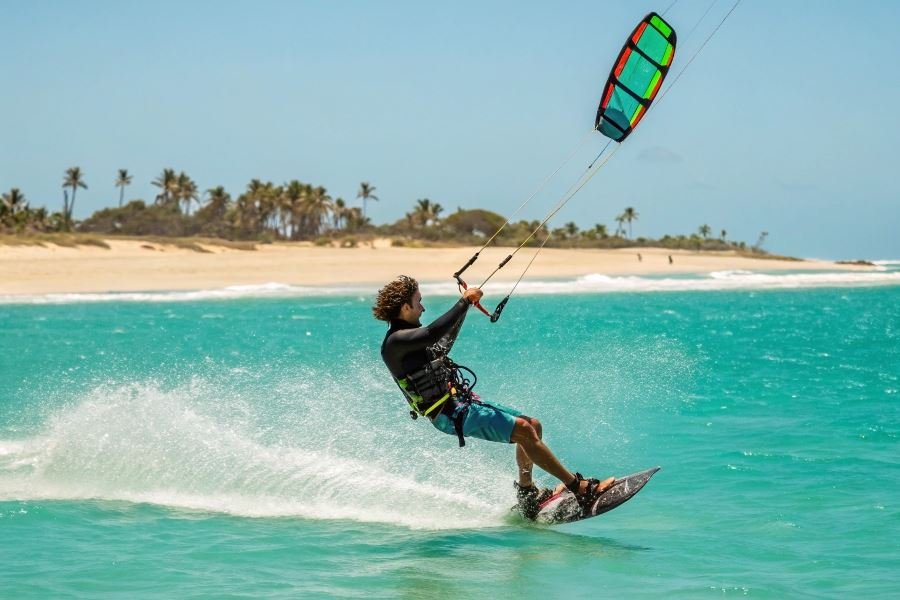
Ever watched someone gliding across water, harnessing nothing but wind power, and thought “I want that freedom”? Windsurfing offers exactly that—an exhilarating blend of surfing and sailing that puts you in direct conversation with nature’s elements.
Learning to windsurf independently is absolutely achievable with the right approach. The journey begins with understanding your equipment: a board (wider for beginners), a sail (smaller is easier to control), a mast, boom, uphaul rope, and a universal joint that connects everything together. Quality gear matters, but beginners can start with rental equipment before investing $800-1500 in their own setup.
Before hitting the water, honestly assess your physical readiness. While windsurfing doesn’t demand Olympic-level fitness, you’ll need:
- Core strength for balance and sail control
- Decent swimming abilities (you’ll fall—a lot)
- Upper body endurance for prolonged sailing sessions
“The water will be your teacher, and falling is just part of the curriculum.”
Set realistic expectations for your progress. Most self-taught windsurfers need 8-12 hours of practice to achieve basic sailing in light winds. The learning curve can be steep—you might spend your first day just standing on the board and lifting the sail. That’s normal! The progression typically follows this pattern:
- Balance and board control
- Sail handling and uphaul technique
- Steering and turning basics
Remember that even experienced windsurfers started somewhere. With patience, persistence, and these fundamentals, you’ll be harnessing the wind on your own terms before you know it.
From Land to Water: Mastering Windsurfing on Your Own
Windsurfing combines the thrill of surfing with the control of sailing, creating one of the most exhilarating water sports you can master. Learning how to learn windsurfing on your own: step-by-step instructions might seem daunting at first, but with the right approach, you’ll be harnessing the wind and gliding across the water in no time. Let’s break down this journey into manageable steps that will have you confidently riding the waves before you know it.
Find Your Balance on Dry Land First
Before you even touch water, master the fundamentals on solid ground. This crucial first step saves countless frustrating falls later.
- Position your board on flat grass or sand – Place a towel underneath to protect the fin and simulate the unstable surface of water.
- Practice stepping onto the board – Always mount from the sides, never from the ends.
- Find your sweet spot – Stand with feet shoulder-width apart, knees slightly bent, positioned across the centerline of the board.
Your stance should feel natural but secure. Spend at least 30-45 minutes practicing balance shifts, mimicking wave movements by rocking slightly from heel to toe. This muscle memory will prove invaluable once you hit the water.
Shallow Water Techniques: The Uphaul Dance
Once comfortable with board balance, it’s time to graduate to shallow water—ideally waist-deep with minimal current.
The uphaul technique is your gateway to windsurfing independence:
- Position yourself centrally on the board, feet straddling the centerline
- Grab the uphaul rope with both hands, palms facing down
- Slowly pull the sail up while maintaining your balance, using your legs as shock absorbers
- Keep your back straight and arms extended to avoid strain
The uphaul is where most beginners falter. Master this, and you’ve conquered 50% of the learning curve.
Practice your sailing position once the sail is up. Your front hand controls the mast, while your back hand manages the boom. Your body should form a counterbalance to the sail’s power—lean back slightly as the sail pulls forward.
Fundamental Steering and Control Techniques
With balance and uphaul mastered, it’s time to harness the wind and actually move.
The basic steering principle is beautifully simple:
| Action | Technique | Result |
|---|---|---|
| Turn Downwind | Tilt sail forward | Board turns away from wind |
| Turn Upwind | Pull sail back | Board turns toward wind |
| Speed Up | Sheet in (pull boom toward you) | Captures more wind power |
| Slow Down | Sheet out (push boom away) | Releases wind pressure |
Start by practicing a figure-8 pattern in shallow water. This teaches you all fundamental movements: turning upwind (close-hauled), turning downwind (running), and maintaining a steady course across the wind (reaching).
Common beginner mistakes to avoid:
- Gripping the boom too tightly – causes arm fatigue and reduces responsiveness
- Looking at your feet instead of the horizon – destabilizes your balance
- Fighting the wind rather than working with it – exhausts you unnecessarily
Remember that falling is part of learning. When (not if) you fall, always fall away from your equipment to avoid injury. Then simply climb back on and try again—each attempt builds muscle memory and instinct.
With consistent practice of these fundamental techniques, you’ll progress from wobbly first steps to confident cruising surprisingly quickly. The key is regular practice—even two hours twice a week will show remarkable improvement within a month.
Mastering the Elements: Advanced Windsurfing Progression
Conquering diverse wind conditions
Windsurfing truly comes alive when you can handle whatever Mother Nature throws your way. As you progress beyond basics, focus on adapting to different wind strengths. In light winds (5-10 knots), practice your fundamentals with larger boards (180+ liters) and bigger sails (6.0-8.0m²). When winds pick up to moderate (10-15 knots), this becomes your sweet spot for learning new techniques like the beach start and harness work.
Water environments matter just as much as wind. Flat water (lakes, sheltered bays) provides the perfect training ground for technical maneuvers, while small chop helps develop balance reflexes. Never attempt open ocean conditions until you’ve logged at least 30 hours on protected waters – the difference in difficulty is exponential, not linear.
The windsurfer who masters light wind technique will progress twice as fast when the wind picks up.
Fixing form without an instructor
Without professional eyes watching, self-correction becomes crucial. The most common beginner mistake is improper weight distribution – leaning back defensively rather than centering weight over the board. Set up your smartphone to record short sessions, then analyze your stance compared to tutorial videos from Windsurfing TV.
Another frequent error is incorrect sail handling. Remember this formula: back hand controls power, front hand controls direction. When you feel overpowered, don’t panic and pull with both hands – instead, release pressure on your back hand to depower instantly.
Common beginner mistakes and solutions:
| Mistake | Self-Correction Technique |
|---|---|
| Bent arms | Practice “locked out” position on land first |
| Looking at feet | Place bright sticker on boom to draw eyes forward |
| Hunched posture | Imagine string pulling up from center of chest |
| Sail too upright | Use horizon as reference for proper sail angle |
| Incorrect foot position | Mark optimal foot positions with waterproof tape |
Building your windsurfing knowledge network
Self-improvement thrives with resources. The Windsurfing Now forum hosts dedicated sections for beginners with video analysis services where experienced sailors review your uploaded clips. The WindSurf Magazine offers technique articles that break down complex moves into digestible steps.
For visual learners, nothing beats systematic video instruction. The “Zero to Hero” series by Peter Hart provides progressive lessons that simulate having a coach. Complement videos with physical practice immediately – watching without doing creates false confidence.
Local windsurfing communities offer invaluable support. Most coastal areas have Facebook groups where weekend warriors coordinate sessions. Join these groups to find informal mentors and safety buddies. Even experienced windsurfers remember their learning struggles and are surprisingly willing to offer tips.
Track your progress methodically. Create a windsurfing journal noting conditions, equipment used, and skills attempted. This data becomes your personalized roadmap, revealing patterns in your learning curve and highlighting which conditions accelerate your development.
Remember that plateaus are normal. When progress stalls, sometimes stepping back to perfect fundamentals provides the breakthrough needed for advanced techniques. The self-taught windsurfer develops exceptional analytical skills precisely because they must solve problems independently.