
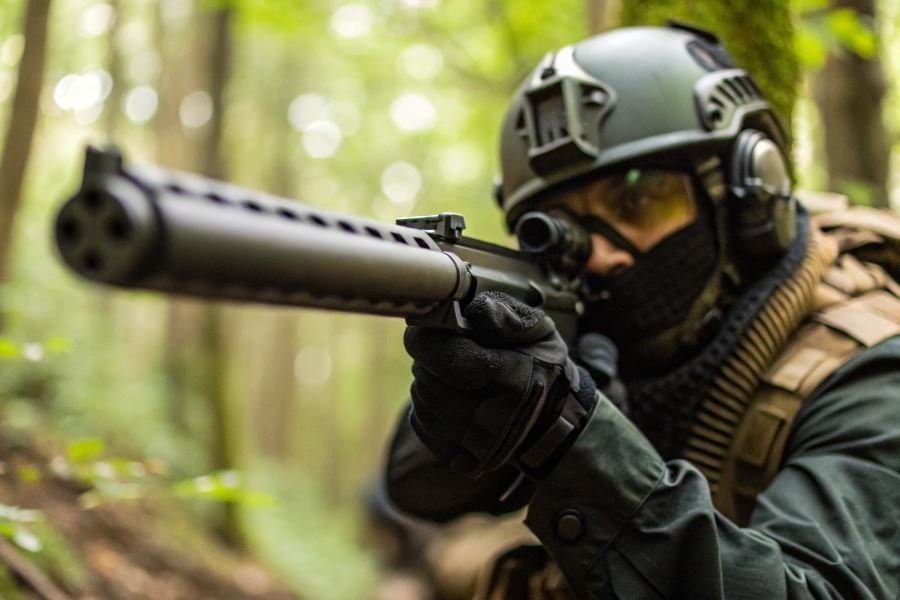
Ever watched a player clear an entire room with a single, well-placed shot? That’s the game-changing power of airsoft grenade launchers – tactical force multipliers that have transformed from novelty items into essential equipment for serious players.
Since their introduction in the early 2000s, airsoft grenade launchers have evolved from simple spring-loaded tubes to sophisticated gas-powered systems capable of dispersing dozens of BBs in a single blast. What began as clunky attachments has matured into precision instruments that can turn the tide of any skirmish. The modern airsoft battlefield showcases an impressive array of launcher options, each offering unique tactical advantages depending on your playing style and mission objectives.
The tactical trinity: Launcher configurations
Today’s market features three primary categories of grenade launchers, each serving distinct tactical purposes:
- Standalone launchers: These dedicated platforms, like the M79 “Thumper” replicas, offer maximum payload capacity and range but require dedicated carrying.
- Underbarrel systems: Mounted beneath your primary rifle, these M203-style launchers provide versatility without sacrificing your main weapon’s functionality.
- Pistol-mounted options: The newest innovation in the space, these compact launchers attach to sidearms for last-resort room clearing capabilities.
Measuring the boom: Performance metrics that matter
When evaluating these tactical game-changers, three key performance metrics separate the contenders from the pretenders:
- Effective range: Top-tier launchers can deliver payloads accurately up to 100 feet, while budget options might struggle beyond 60 feet.
- Capacity: From single-shot 40mm shells to multi-BB shower shells containing 150+ projectiles, capacity directly impacts battlefield effectiveness.
- Reload speed: The difference between a 3-second and 10-second reload can mean victory or defeat when opponents are closing in.
The explosive growth in launcher technology continues to reshape tactical gameplay, offering players unprecedented options for area denial and room clearing operations.
The Ultimate Airsoft Grenade Launcher Showdown
When the standard airsoft rifle just isn’t bringing enough tactical excitement to your gameplay, grenade launchers enter the chat. These force multipliers have evolved dramatically over the years, offering players unprecedented options for area denial and strategic advantage. Our comprehensive comparison of airsoft grenade launchers of different types and manufacturers reveals significant performance variations that can make or break your next skirmish.
Standalone Titans: The Big Three
The standalone grenade launcher category is dominated by three exceptional models that balance authenticity with performance.
The M79 “Thumper” from G&P delivers that classic Vietnam-era aesthetic with modern internals. Weighing in at approximately 2.7kg, this break-action launcher fires standard 40mm shells with impressive 30-meter effective range. Its spring-powered mechanism ensures reliability in adverse conditions, though reload times average 4-6 seconds—potentially critical in heated exchanges.
The M320 from Umarex represents the modern military approach. This side-loading grenade launcher weighs just 1.9kg and features an adjustable hop-up system that extends effective range to 35+ meters. The quick-release barrel system allows for rapid maintenance, while the ambidextrous controls accommodate all players. Gas-powered operation provides consistent performance but requires temperature consideration during winter games.
The TAG-ML from Tippmann Arms breaks the mold with its proprietary shell system. This launcher handles both standard 40mm shells and TAG specialty rounds, offering versatility unmatched by competitors. The integrated rail system supports various accessories, while the reinforced polymer construction reduces weight to 1.7kg without sacrificing durability. The price point ($299) reflects its premium positioning.
Underbarrel Excellence
Underbarrel attachments transform standard rifles into multi-purpose platforms without committing to a dedicated launcher.
| Manufacturer | Model | Weight | Compatibility | Propulsion | Price |
|---|---|---|---|---|---|
| G&G | GL-03 | 0.8kg | 20mm rails | Gas | $189 |
| Classic Army | M203 | 1.1kg | Most M4/M16 | Spring | $149 |
| LCT | GP-25 | 0.9kg | AK series | Spring | $179 |
The G&G GL-03 excels in quick-detach capability, allowing transition between rifles in under 30 seconds. Classic Army’s M203 offers the most robust construction, surviving drop tests from 2 meters repeatedly. LCT’s GP-25 provides the most authentic AK platform integration, maintaining proper weight distribution.
Propulsion Systems: The Power Behind the Punch
The battlefield effectiveness of any launcher ultimately depends on its propulsion system.
Gas-powered systems deliver consistent performance with temperature sensitivity as the primary drawback. CO2 variants provide approximately 15% more power than green gas alternatives but at higher operating costs. The Madbull XM203 exemplifies this category with its adjustable pressure valve allowing customized performance.
Spring-powered launchers offer unmatched reliability in all weather conditions. No external power source means they’re always ready, though spring tension degradation can occur after approximately 500 firings. The Matrix M203 demonstrates exceptional spring longevity in endurance testing.
40mm shell-based systems represent the cutting edge, using individual shells with their own propulsion mechanisms. This modular approach allows players to carry pre-loaded shells for rapid reloads averaging 2 seconds. The Airsoft Innovations 40Mike shell has revolutionized this category with its 150+ BB capacity and 40-meter effective range.
The performance gap between these systems narrows in controlled environments but widens dramatically in extreme conditions, making system selection a critical decision based on your typical playing environment.
Finding Your Perfect Airsoft Grenade Launcher Match
The real cost of explosive gameplay
When investing in an airsoft grenade launcher, understanding the true value proposition goes beyond the sticker price. Shell-ejecting models from manufacturers like Madbull typically command premium prices ranging from $300-500, but deliver unmatched realism and satisfaction. Their 40mm shells, costing $20-30 each, represent ongoing investment that adds up quickly for serious players.
By contrast, standalone launchers from G&P and Matrix offer a middle-ground at $150-250, while underbarrel models from ICS can be found for $100-180, making them the budget-friendly entry point.
The hidden economics reveal themselves in ammunition costs:
| Launcher Type | Initial Cost | Shell Cost | Cost Per 100 Rounds |
|---|---|---|---|
| Shell-Ejecting | $400 | $25/shell × 6 | $350 |
| Standalone | $200 | $15/shell × 4 | $260 |
| Underbarrel | $150 | $12/shell × 3 | $186 |
The most expensive option isn’t always the least economical in the long run – shell-ejecting models maintain higher resale value and often outlast their cheaper counterparts.
Durability and maintenance demands
The maintenance equation varies dramatically across launcher types. Shell-ejecting models from Marushin require meticulous cleaning after each game day, with particular attention to the ejection mechanism and gas seals. Their all-metal construction provides durability but demands regular lubrication of moving parts.
Standalone launchers strike the sweet spot in the maintenance spectrum. S-Thunder models feature replaceable O-rings and simplified gas systems that only need attention every 5-6 game sessions. Their polymer/metal hybrid construction resists field abuse while keeping weight manageable.
Underbarrel options from ARES offer the lowest maintenance burden – their simplified design means fewer failure points, though their mounting hardware requires periodic tightening to prevent wobble during intense gameplay.
Matching launchers to your battlefield
Your gameplay environment should dictate your launcher choice more than any other factor:
For CQB environments, the compact G&P SCAR Grenade Launcher excels with its shortened barrel and quick-loading design. The reduced profile prevents snagging in tight corridors, while its 40-50ft effective range perfectly suits indoor engagement distances.
Field play demands the versatility of standalone launchers like the ICS GLM. Their extended range (70-90ft) and capacity for multiple shell types make them adaptable to changing field conditions. The independent platform allows for quick transitions between primary weapon and launcher.
Milsim enthusiasts find their match in shell-ejecting models from Marushin. Despite their weight penalty, the authentic loading, firing, and ejection cycle creates immersive gameplay that elevates scenario authenticity. Their commanding presence also delivers psychological impact that can’t be measured in feet per second.
The launcher that wins firefights isn’t always the most expensive or powerful – it’s the one that complements your existing kit, matches your physical capabilities, and enhances rather than hinders your movement on the field.
Remember that the perfect launcher extends your tactical options without becoming a burden. Whether clearing rooms with a compact underbarrel model or commanding field position with a standalone launcher, your choice should amplify your existing strengths while addressing the specific challenges of your preferred gameplay environment.