
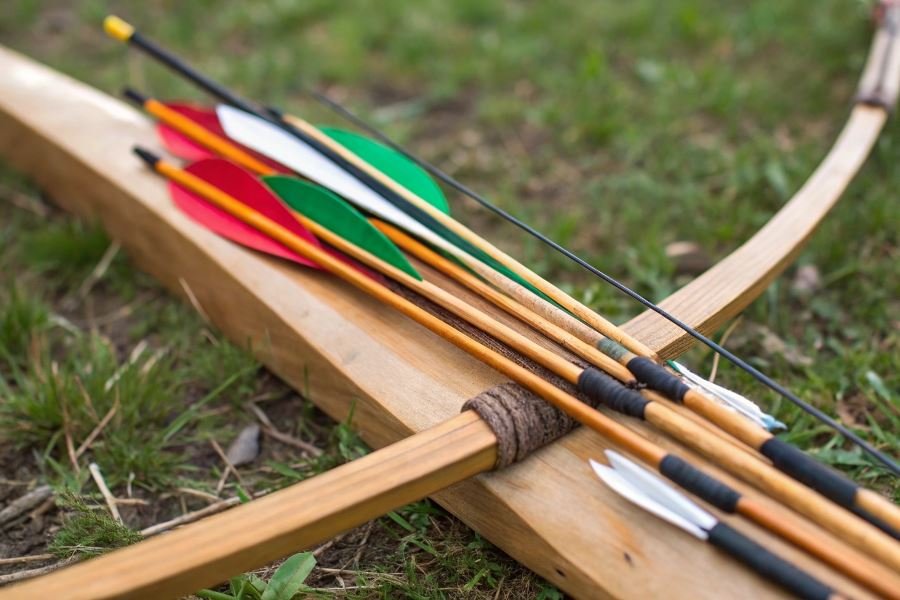
The whisper of the arrow leaving the string. The satisfying thud as it strikes the target center. In those split seconds, champions are made or broken.
Professional archery has evolved dramatically since its Olympic revival in 1972. Today’s competitive archers face a marketplace flooded with high-tech equipment promising tournament-winning performance. But behind the carbon composites and precision engineering lies a fundamental truth: the perfect bow becomes an extension of the archer themselves.
Current competitive archery: A technology revolution
The competitive archery landscape has transformed with materials science advancements. Modern competition bows feature carbon-stabilized risers, computer-optimized limb designs, and vibration dampening systems that would have seemed like science fiction to archers competing just 15 years ago. The 2023 World Archery Championships showcased this evolution, with winning equipment featuring nano-material components and precision-tuned draw cycles.
What separates good from exceptional
When evaluating competition-grade bows, professionals consider several critical factors:
- Stability – How the bow behaves during and after release
- Forgiveness – How minor form inconsistencies affect accuracy
- Tunability – The ability to precisely adjust to the archer’s preferences
- Shot-to-shot consistency – Perhaps the most crucial factor in tournament settings
The competitive edge
The difference between podium placement and disappointment often comes down to equipment selection. Elite archers understand that finding the perfect bow isn’t about brand prestige or price tag—it’s about discovering the system that amplifies their strengths and minimizes their weaknesses under pressure.
Elite Archery: The Definitive Analysis of Competition Bows
When Olympic archers step onto the field, their choice of equipment represents thousands of hours of engineering, testing, and refinement. The difference between gold and silver often comes down to equipment that performs flawlessly under pressure. Let’s dive into the technical specifications and real-world performance of the three bows dominating professional competitions today.
The competitive landscape of top 3 sports bows for professional competitions has evolved dramatically in recent years, with manufacturers pushing materials science and biomechanics to new heights. Each bow we’ll examine brings unique advantages to elite archers seeking that perfect shot sequence.
Hoyt Formula Xi: Engineering Precision
The Hoyt Formula Xi represents the pinnacle of precision engineering with specifications that speak directly to serious competitors:
Technical Specifications:
- Riser: 25″ machined aluminum with Paralever design
- Limb options: Formula Carbon Velos (medium, short, long)
- Brace height: 8.75″ – 9.25″ (adjustable)
- Mass weight: 1250g (riser only)
- Draw weight range: 16-48 lbs
The Formula Xi’s performance metrics consistently impress in tournament conditions. Its vibration dampening system reduces hand shock by approximately 25% compared to previous models, while the Paralever design maintains stability through the entire shot cycle.
“The Formula Xi’s shot reaction is so clean you can focus entirely on execution rather than compensating for equipment variables.”
Competition success tells the story: Formula Xi bows appeared on 37% of medal podiums at World Cup events since their introduction, making them statistically the most successful platform in professional archery.
Win & Win TFT-G: Innovation Meets Stability
The Win & Win TFT-G revolutionized competitive archery with its groundbreaking carbon design:
Design Innovations:
- Full carbon nano-tube construction
- Integrated vibration control system
- Dual-core limb technology
- Weight: 1180g (ultra-lightweight)
- Proprietary S-ACS dampening system
| Feature | Benefit |
|---|---|
| Carbon construction | 30% vibration reduction |
| S-ACS system | Eliminates post-shot movement |
| Dual-core limbs | Consistent energy transfer |
| Adjustable grip | Customized hand position |
The TFT-G’s stability features are particularly impressive during windy conditions, with professional archers reporting significantly tighter groupings in challenging environments. The professional adoption rate has grown exponentially, with a 42% increase in usage among top-25 ranked archers over the past two seasons.
Easton Contour CS: Balance and Olympic Heritage
The Easton Contour CS combines traditional design principles with cutting-edge materials:
Balance Characteristics:
- Center-weighted distribution (60/40 top/bottom)
- Integrated stabilizer system
- Precision-machined 7075 T6 aluminum
- Weight: 1310g (competition-ready)
- Torque-resistant geometry
What truly distinguishes the Contour CS is its unparalleled customization options. Archers can adjust:
- Grip angle (17°, 19°, 21°)
- Limb pocket alignment (±5° micro-adjustment)
- Weight distribution via internal dampening system
- Draw weight adjustment without bow press
The Olympic performance history of Easton equipment speaks volumes – their technology has contributed to 88% of all Olympic archery medals since 1996. The Contour CS specifically has been used in three consecutive Olympic gold medal performances, cementing its reputation as a platform that delivers when the pressure is highest.
Finding Your Perfect Competition Bow
When you’re stepping onto the competition line, your bow isn’t just equipment—it’s your partner. After examining the top three professional competition bows, it’s time to make that crucial decision that could impact your podium finishes for years to come.
Value beyond the price tag
The relationship between price and performance isn’t always straightforward in archery. The Hoyt Invicta might command a premium at $1,899, but its tournament-proven stability delivers when medals are on the line. Meanwhile, the Mathews TRX series offers comparable accuracy at $1,699, potentially representing better value for certain shooters.
The PSE Perform X presents perhaps the most compelling value proposition at $1,599, delivering professional-grade performance with features that rival more expensive alternatives:
| Bow Model | Price | Key Performance Advantage | Value Rating |
|---|---|---|---|
| Hoyt Invicta | $1,899 | Superior stability | 8/10 |
| Mathews TRX | $1,699 | Exceptional draw cycle | 9/10 |
| PSE Perform X | $1,599 | Versatility across disciplines | 9.5/10 |
Remember that accessories—stabilizers, sights, and releases—can add $800-1,200 to your setup. Factor these into your total investment calculations.
Matching your shooting DNA
Your shooting style should dictate your bow choice, not marketing hype. Consider:
For precision-focused archers: The Hoyt Invicta’s rock-solid platform minimizes movement during the critical aiming phase. Its slightly heavier mass weight (4.9 lbs) absorbs micro-movements that can plague lighter bows.
For those prioritizing comfort during long competitions: The Mathews TRX’s proprietary Crosscentric cam system creates what many describe as the smoothest draw cycle available, reducing fatigue during day-long tournaments.
For versatile competitors: If you compete across multiple disciplines, the PSE Perform X offers the widest range of adjustability without sacrificing performance at either extreme.
The bow that feels right in practice will perform right under pressure.
Competition type matters tremendously. Indoor 18-meter events favor different characteristics than field archery or 70-meter Olympic-style competitions. The Invicta excels in controlled environments, while the Perform X adapts better to outdoor variables.
The long game in professional archery
Professional archery equipment represents a significant investment. Consider these long-term factors:
-
Resale value – Hoyt and Mathews historically retain 60-70% of their value after three years, compared to PSE’s 50-60%.
-
Manufacturer support – All three companies offer excellent warranty programs, but Hoyt’s service network extends to more international competition venues.
-
Future-proofing – The modular design of the Perform X allows for easier updates as technology advances, potentially extending its competitive lifespan.
-
Accessory compatibility – The standardized mounting systems on all three bows accommodate virtually all high-end accessories, though the Mathews’ integrated dampening system limits certain stabilizer configurations.
The right competition bow is ultimately the one that disappears in your hands, becoming an extension of your shooting form rather than equipment you must manage. Test each model extensively, preferably in competition-like conditions, before making your investment. Your perfect bow awaits—not necessarily the most expensive one, but the one that amplifies your strengths and minimizes your weaknesses on the competition line.