
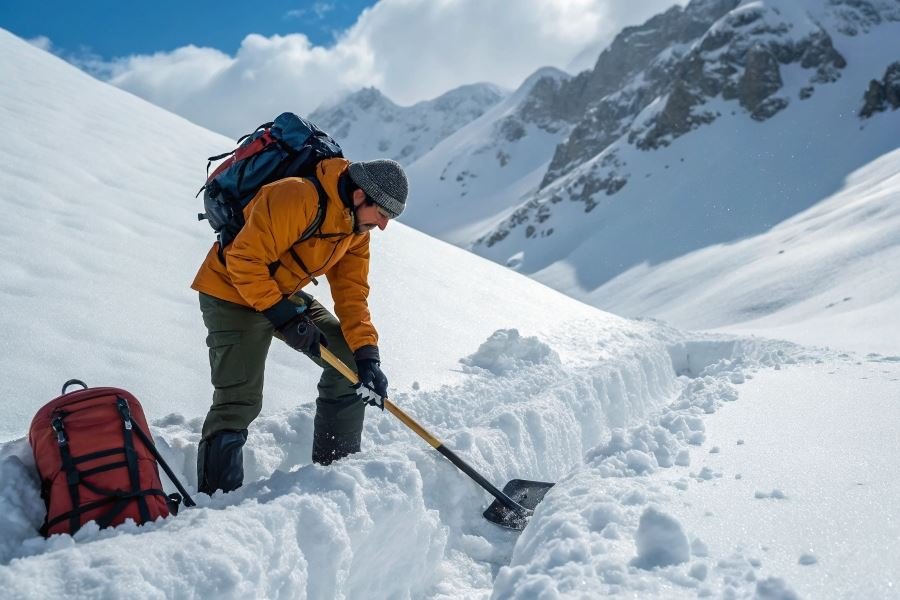
When seconds count, the right equipment isn’t just convenient—it’s the difference between life and death.
In the pristine backcountry where powder enthusiasts seek untouched snow, avalanche probes stand as silent sentinels of safety. These seemingly simple tools—collapsible poles typically ranging from 240-320cm when extended—serve as the critical second phase in avalanche rescue operations after beacon location. The probe’s purpose is elegantly straightforward yet profoundly important: to pinpoint a buried victim’s exact location before digging begins.
From bamboo to aerospace alloys
Avalanche probe technology has undergone remarkable evolution since the early days of mountain rescue. The first probes were little more than bamboo poles carried by Swiss mountain guides in the 1930s. By the 1970s, sectional aluminum probes emerged, offering improved durability and portability. Today’s modern probes feature quick-deployment systems, depth markings, and construction from carbon fiber or aircraft-grade aluminum—materials that optimize the delicate balance between strength and weight.
The stark reality of survival odds
The statistics tell a sobering story: according to the American Avalanche Association, a buried victim’s survival rate drops dramatically after just 15 minutes—from 93% to below 30%. Studies from the International Commission for Alpine Rescue demonstrate that teams using proper probing techniques locate victims an average of 7 minutes faster than those using unsystematic approaches. This time difference isn’t just significant—it’s often the margin between rescue and recovery.
When properly deployed by trained users, avalanche probes don’t just find people—they find them in time to save lives.
The Ultimate Guide to Avalanche Probe Selection
When seconds count in backcountry rescue, your avalanche probe becomes your lifeline to someone buried beneath the snow. The difference between a quality probe and a subpar one isn’t just about price—it’s about survival. Let’s dive into the technical specifications that matter most when selecting this critical piece of safety equipment.
Material Matters: Aluminum vs Carbon Fiber
The debate between aluminum and carbon fiber probes centers on the classic strength-to-weight ratio equation. Aluminum probes offer exceptional durability and typically come with a more accessible price point, making them the go-to choice for many recreational backcountry enthusiasts. When examining avalanche probes: characteristics and features of selection become critically important as you weigh your options.
Carbon fiber probes, while commanding a premium price (often $30-50 more), deliver significant weight savings—typically 20-30% lighter than their aluminum counterparts. The Black Diamond Carbon Probe exemplifies this advantage, weighing a mere 225 grams while maintaining impressive structural integrity.
Material comparison at a glance:
| Material | Weight | Durability | Price Range | Best For |
|---|---|---|---|---|
| Aluminum | 250-350g | High | $40-80 | Recreational users, guides |
| Carbon Fiber | 180-250g | Medium-High | $80-150 | Weight-conscious mountaineers |
Length: Finding Your Perfect Match
Probe length isn’t about personal preference—it’s about statistical survival odds. Standard recreational probes measure 240-270cm, while professional models extend to 300-320cm.
The average burial depth in avalanche incidents is approximately 1.3 meters, but nearly 25% of burials exceed 2 meters.
Your probe should accommodate the deepest likely burial scenario in your typical terrain. The Ortovox 240 PFA offers reliable performance for most recreational users, while professionals often opt for the BCA Stealth 300 for its extended reach.
Weight and Packability: The Backcountry Equation
When you’re miles from civilization with everything on your back, every gram counts. Modern probes have achieved remarkable packability without sacrificing deployment speed:
- Ultralight models: 180-220g, pack down to ~40cm
- Standard recreational: 220-280g, pack down to ~45cm
- Professional models: 280-350g, pack down to ~50cm
The assembly mechanism directly impacts deployment speed. The Mammut Fast Lock system allows for one-handed operation, deploying in under 3 seconds—critical when time is the enemy.
Depth Markings and Probe Tips: The Details That Save Lives
Depth markings aren’t just convenient—they’re essential communication tools during rescue operations. Look for:
- Clear centimeter markings
- High-contrast colors that remain visible in low light
- Markings that won’t wear off after repeated use
The probe tip design determines penetration efficiency through varying snow densities. Conical tips excel in softer snow, while pointed tips better penetrate ice layers and refrozen debris.
A quality probe tip should penetrate dense snow with minimal force while providing tactile feedback when contacting a buried victim.
The Pieps iProbe II takes this technology further with electronic victim detection capabilities, providing audible feedback when the probe contacts an avalanche transceiver.
When selecting your avalanche probe, remember that this isn’t gear you want to test in a real emergency for the first time. Practice deployment regularly, and invest in quality that matches your backcountry commitment level. Your life—or someone else’s—may depend on it.
Making the Right Avalanche Probe Selection for Your Backcountry Adventures
When you’re miles from civilization with nothing but pristine snow beneath your feet, your avalanche probe becomes more than just equipment—it’s your lifeline. Selecting the right probe isn’t just about checking a box on your safety checklist; it’s about making a decision that could literally save lives when minutes matter most.
Matching terrain to probe specifications
Different mountain environments demand different probe characteristics. In areas with historically deep snowpacks like the Cascades or Alaska, where burial depths can exceed 6 feet, a longer probe (300cm+) is non-negotiable. Meanwhile, in regions like Colorado’s Continental snowpack, where slides tend to be shallower but more dangerous due to persistent weak layers, a standard 240cm probe might suffice—but you’ll want exceptional durability and quick deployment features.
The snow conditions you typically encounter should directly influence your probe material choice:
| Snow Type | Recommended Material | Key Benefit |
|---|---|---|
| Dense, wet snow | Carbon fiber | Superior strength-to-weight ratio |
| Variable conditions | Aluminum | Balanced durability and weight |
| Extremely cold environments | Carbon/aluminum hybrid | Reduced cold-handling issues |
Terrain steepness matters too. If you’re frequently in high-angle terrain where every ounce counts during ascents, ultralight carbon probes from brands like Black Diamond or BCA might be worth the premium price.
Cost versus safety features balance
When it comes to avalanche safety, “budget” shouldn’t be your primary consideration—but that doesn’t mean you need the most expensive option either. The sweet spot typically falls between 60−90 for most recreational backcountry travelers, providing reliable performance without unnecessary bells and whistles.
What you absolutely shouldn’t compromise on:
- Deployment speed (under 5 seconds from pack to fully extended)
- Depth markings (clear centimeter measurements)
- Tensioning system reliability
- Cable durability
Higher-end probes ($100+) often feature quick-lock mechanisms, improved ergonomics for gloved hands, and materials that resist bending under pressure. For guides, ski patrollers, or those venturing into particularly hazardous terrain, these upgrades aren’t luxuries—they’re essentials.
Maintenance and replacement guidelines
Even the finest avalanche probe won’t perform when you need it if it’s been neglected. Establish a pre-season and post-season maintenance routine:
“The best avalanche probe is the one that deploys flawlessly when seconds count. Regular maintenance isn’t optional—it’s your responsibility to those who travel with you.”
Mandatory maintenance checks:
- Inspect cables for fraying or kinking
- Test locking mechanisms multiple times
- Verify depth markings remain legible
- Check for tube straightness and structural integrity
- Ensure sections connect smoothly without hesitation
Most manufacturers recommend replacing probes every 5-7 years, even with minimal use. Materials fatigue, technologies improve, and standards evolve. If your probe has seen significant use or has been subjected to extreme conditions, that timeline should shorten accordingly.
When to replace immediately: If your probe shows any signs of structural compromise—bent sections, damaged locking mechanisms, or significant cable wear—replace it before your next backcountry trip. The $80 you’ll spend is insignificant compared to the potential consequences of equipment failure during a rescue.
Remember that your probe is part of an integrated safety system. Its effectiveness depends not just on its quality, but on your familiarity with it. Practice deployment regularly, ideally in conditions that simulate the stress and limitations (gloves, cold, limited visibility) you might face during an actual rescue scenario.