
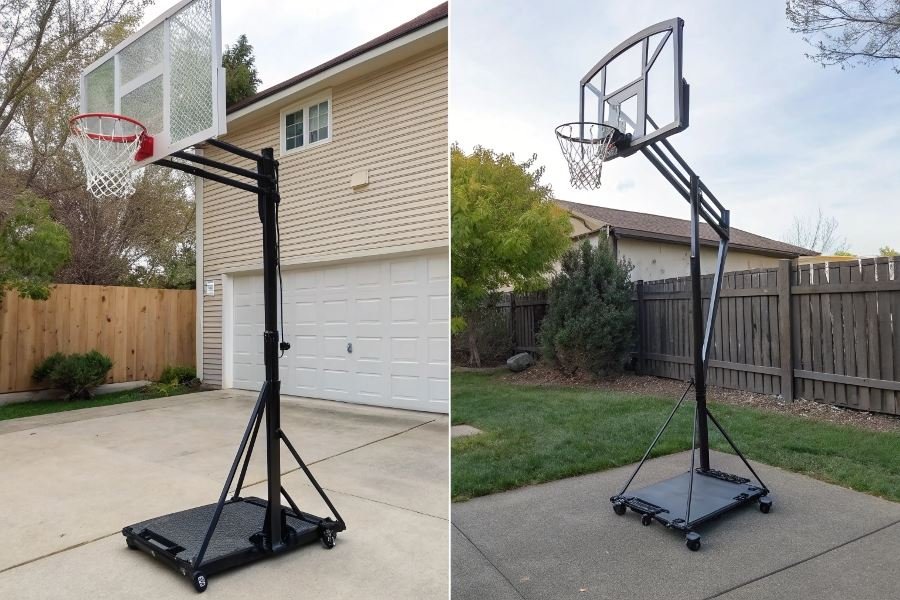
Ever watched a 6-year-old trying to shoot on a 10-foot hoop? It’s like asking them to throw a tennis ball to the moon. Adjustable basketball hoops have revolutionized how families, schools, and communities experience the game, making basketball truly accessible to players of all ages and skill levels.
Adjustable basketball hoops are exactly what they sound like—systems that allow you to modify the rim height from regulation 10 feet down to as low as 5.5 feet with simple mechanical adjustments. Unlike their fixed-height predecessors, these versatile systems grow with players, adapting to changing needs and abilities.
The journey from rigid backyard poles to sophisticated height-adjustment mechanisms spans decades of innovation. The earliest adjustable systems emerged in the 1980s with basic crank mechanisms, but today’s models feature pneumatic lifts, telescoping poles, and even smartphone-controlled height adjustments.
Why the adjustable revolution matters:
For families, a single system serves everyone from kindergarteners to adults. Young players develop proper shooting form instead of developing bad habits by heaving the ball upward. Teenagers can gradually increase height as their strength and skills improve. And rehabilitation patients find lower settings perfect for recovery training.
The benefits extend beyond convenience—they’re about inclusion. When a 5-year-old can experience the thrill of a slam dunk, or grandparents can shoot around with grandkids, basketball becomes a multi-generational activity that brings people together through the universal language of sport.
The Ultimate Adjustable Hoop Experience
Basketball isn’t just a game—it’s a passion that grows with you. The beauty of adjustable basketball hoops lies in their versatility, accommodating players of all ages and skill levels on the same court. These engineering marvels combine flexibility with performance, creating the perfect training ground for developing athletes and weekend warriors alike.
The advantages and features of adjustable basketball hoops extend far beyond simple height changes. They represent a complete ecosystem of customization that transforms your driveway into a professional-grade practice facility. From robust materials that withstand harsh weather to stability systems that keep everything secure during the most aggressive dunks, these systems are designed with the serious player in mind.
Height Adjustment Mechanisms That Transform Play
The heart of any adjustable system is its height mechanism—and not all are created equal. Three primary systems dominate the market:
Telescoping pole systems use nested poles that lock at various heights, typically offering adjustments from 7.5 to 10 feet in 6-inch increments. These provide exceptional stability but require more effort to adjust.
Crank systems utilize a handle mechanism that raises or lowers the backboard with minimal physical exertion—perfect for families with varying height needs who adjust frequently.
Pneumatic systems represent the premium option, using gas-filled cylinders that allow one-hand adjustments in seconds, some with infinite height positions rather than preset increments.
| Mechanism Type | Adjustment Range | Ease of Use | Typical Price Range |
|---|---|---|---|
| Telescoping | 7.5’-10’ | Moderate | 200−400 |
| Crank | 7.5’-10’ | Easy | 300−700 |
| Pneumatic | 7’-10’ | Very Easy | 400−1,200 |
Built to Last: Materials and Weather Resistance
The durability equation starts with the pole—typically constructed from powder-coated steel with wall thicknesses ranging from 1/8″ to 3/16″. Premium models from Spalding and Lifetime feature 3-piece pole designs with additional rust protection treatments.
Backboard brackets deserve special attention—they absorb tremendous force during play. High-end systems incorporate steel-reinforced connection points and vibration-dampening technology that extends system life by reducing metal fatigue.
Pro Tip: Look for systems with zinc-plated or galvanized hardware that resists corrosion even in coastal environments where salt air accelerates rust formation.
Weather resistance isn’t just about avoiding rust. UV-stabilized materials prevent sun damage, while proper drainage systems prevent water accumulation that can compromise structural integrity during freeze-thaw cycles.
Rock-Solid Stability and Safety Features
Nothing ruins a game faster than a wobbly hoop. Modern systems employ multiple stability technologies:
- Base ballast systems typically hold 35-40 gallons of water or sand, creating 300+ pounds of counterweight
- Four-point base designs that distribute weight more effectively than older circular bases
- Angled pole designs that direct force downward rather than creating leverage against the base
Safety considerations include breakaway rims that flex under pressure (preventing backboard damage and injuries), padded pole covers, and base padding systems that protect players during aggressive drives to the basket.
Backboard Options That Define Performance
Backboard selection dramatically impacts play quality:
Polycarbonate offers unmatched durability at budget-friendly prices (200−500) but provides less ball response.
Acrylic delivers improved rebound performance with good durability in the mid-range market (400−800).
Tempered glass provides the professional-level rebound experience serious players demand, though at premium prices (800−2,000).
Size matters too—regulation 72″ width provides authentic play experience, while 54″ and 60″ options balance performance with space and budget constraints.
The combination of these features creates a system that grows with players, withstands years of intense play, and delivers consistent performance in all conditions—the hallmark of truly exceptional basketball equipment.
Finding Your Perfect Adjustable Basketball Hoop
Matching features to your basketball lifestyle
The perfect adjustable basketball hoop isn’t just about height—it’s about how it fits your specific basketball journey. For families with growing players, a system with smooth, single-hand height adjustments between 7.5 and 10 feet offers the versatility needed for everyone from elementary schoolers to adults. Meanwhile, competitive players might prioritize professional-grade backboards with tempered glass and breakaway rims that can handle aggressive dunks.
Consider your playing style before making a decision. Do you need the authentic rebound of a glass backboard, or would the durability of polycarbonate better suit your driveway battles? Are you looking for tournament-level performance from systems like the Spalding NBA series, or is the weather resistance of a Lifetime system more important for your climate?
Your playing environment matters too. Limited space might call for a wall-mounted system with a smaller backboard, while spacious driveways can accommodate larger in-ground systems with regulation-size 72″ backboards.
Installation and maintenance essentials
Installing an adjustable basketball hoop represents a commitment—both to the sport and to your property. In-ground systems offer maximum stability but require concrete footings approximately 24″ deep and 18″ in diameter. This permanent installation typically takes 2-3 days when accounting for concrete curing time.
Portable systems provide flexibility but demand different maintenance:
| System Type | Installation Time | Tools Required | Maintenance Needs |
|---|---|---|---|
| In-ground | 2-3 days | Concrete, post-hole digger, level | Minimal; occasional bolt tightening |
| Portable | 2-3 hours | Wrench set, rubber mallet | Regular base filling, wheel lubrication |
| Wall-mounted | 3-4 hours | Drill, stud finder, level | Bracket inspection, wall integrity checks |
Seasonal maintenance extends your system’s lifespan dramatically. Before winter, check all moving parts, lubricate adjustment mechanisms, and consider a weatherproof cover for portable systems. For regions with harsh winters, some manufacturers like Goalrilla offer specific winterization kits.
The long-term value proposition
An adjustable basketball hoop represents more than equipment—it’s an investment in physical activity, skill development, and family recreation. Quality systems from reputable manufacturers typically last 10-15 years with proper maintenance, making their cost-per-use remarkably low compared to other recreational equipment.
The financial math is compelling: a premium in-ground system priced at $1,200 used three times weekly for 10 years costs less than $0.80 per playing session. Compare this to recurring costs like gym memberships or league fees, and the value becomes clear.
Beyond economics, these systems offer intangible benefits that appreciate over time:
- Skill development at your own pace, without time constraints
- Family bonding through multi-generational play
- Neighborhood social hub that builds community connections
- Property value enhancement with permanent installations
The most significant return comes from accessibility—having a quality adjustable system means basketball becomes part of daily life rather than a scheduled activity. This consistent access translates to more practice time, faster skill development, and deeper enjoyment of the game.
When selecting your system, remember that the best value isn’t necessarily the lowest price—it’s the hoop that will serve your specific needs for years while requiring minimal maintenance and delivering consistent performance through countless games.