
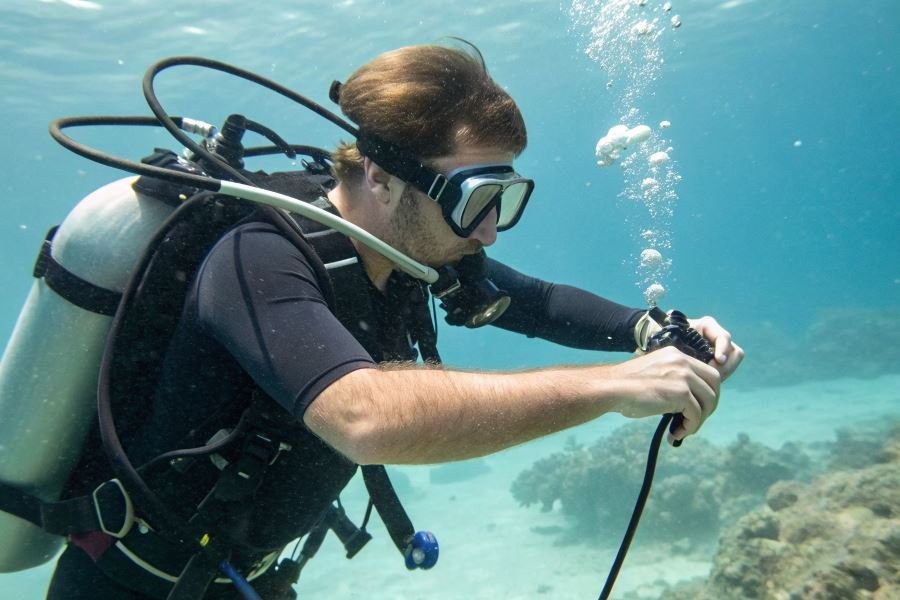
Ever felt completely disoriented underwater, where every direction looks the same and your sense of direction seems to have dissolved with the bubbles from your regulator? You’re not alone. Even experienced divers can find themselves in a navigational predicament beneath the waves.
Underwater navigation presents unique challenges that surface-dwellers rarely encounter. Water currents push you off course, visibility can drop to mere feet in seconds, and the three-dimensional environment means you’re not just moving north or south, but also up and down. Properly using a compass underwater isn’t just a nice skill to have—it’s often what stands between a relaxing dive and an emergency situation.
Why compass skills matter underwater: Unlike on land, underwater environments offer few reliable landmarks. That stunning coral formation you planned to use as a reference point? It looks remarkably similar to the dozen others nearby. The dive boat that seemed impossible to miss? It vanishes completely once you’re 30 feet down with 40 feet of visibility.
Types of underwater compasses
Underwater compasses come in three primary varieties, each with distinct advantages:
- Wrist-mounted compasses – Attached to your arm for quick reference while keeping hands free
- Console-mounted models – Integrated with your pressure gauge for consolidated instrument checking
- Digital compasses – Offering precise readings and additional features like depth integration
The best underwater compasses feature large, luminous dials that remain readable in low-visibility conditions, and fluid-filled housings that maintain accuracy under pressure changes. Many also include side-reading windows, allowing you to navigate while maintaining your swimming position.
Mastering your underwater compass isn’t just about safety—it opens up a world of exploration confidence that transforms every dive into an adventure rather than an exercise in anxiety.
Essential Underwater Compass Techniques That Work
Navigating beneath the surface demands precision and skill that surface-level compass work simply doesn’t prepare you for. The underwater environment introduces unique challenges that transform basic navigation into an art form requiring specific techniques and awareness. Let’s dive into the essential methods that will keep you oriented when visibility drops and currents threaten to push you off course.
Understanding how to properly use a compass underwater begins with mastering your body position and equipment handling. Unlike on land, where you might casually glance at your wrist, underwater navigation requires deliberate positioning and awareness of your entire body’s orientation in three-dimensional space. This fundamental difference is what separates novice divers from those who can confidently navigate complex underwater terrain regardless of conditions.
Stabilizing Your Compass Platform
Your wrist serves as the platform for your compass, and stability is paramount. Hold your compass-bearing arm extended at a 90-degree angle from your body, with your elbow tucked against your side. This creates a natural stabilizing triangle between your torso and arm.
Critical technique: Bring your other hand to support your compass wrist, creating a stable platform that minimizes wobble from currents or your breathing cycle.
Many divers using the Suunto SK8 or Cressi Compass models find that holding the compass at mid-chest level provides optimal stability while maintaining a natural swimming position. This position also allows you to maintain your streamlined profile, reducing drag and air consumption.
Never try to read your compass while swimming—always stop, stabilize, and then take your bearing.
Reading and Following Bearings Underwater
The bezel—that rotating ring around your compass—is your best friend underwater. Before submerging, set your target bearing by rotating the bezel until the direction-of-travel arrow aligns with your intended heading on the compass dial.
Once underwater, follow these steps:
- Stabilize your position in the water column
- Hold the compass in the reading position
- Rotate your body until the north-pointing needle aligns with the orienting arrow
- Follow the direction-of-travel arrow to your destination
| Compass Component | Function | Underwater Consideration |
|---|---|---|
| Direction-of-travel arrow | Shows heading | Must be visible in low light |
| Bezel | Sets course | Should be easy to grip with gloves |
| Lubber line | Reference mark | Must align with body centerline |
| Orienting arrow | Aligns with magnetic north | Check for bubbles affecting needle |
Pro tip: Practice taking reciprocal bearings (180° from your outbound course) regularly during your dive. This habit ensures you can always return to your starting point even if visibility deteriorates unexpectedly.
Mastering Navigation in Challenging Conditions
Underwater currents introduce forces that constantly work to push you off course. The technique of “swimming the course” involves intentionally angling your body slightly into the current while maintaining your compass heading.
When dealing with limited visibility:
- Reduce your swimming speed by 30-40% to maintain accuracy
- Shorten the distance between navigation points
- Increase checking frequency of your compass heading
The strongest currents typically occur at depth changes, channel entrances, and around underwater structures—anticipate these challenges in your navigation planning.
Remember that compass readings can be affected by nearby metal objects. Keep at least 12 inches of distance between your compass and your dive knife, underwater camera, or metal tank bands to ensure accurate readings.
By mastering these techniques, you’ll transform from a diver who merely survives underwater navigation to one who thrives on the challenge—regardless of what conditions the underwater world throws your way.
Mastering Advanced Underwater Compass Navigation
Underwater navigation takes on a whole new dimension when you move beyond the basics. That trusty compass on your wrist isn’t just a simple direction finder—it’s your lifeline in an environment where visibility can drop to zero and currents can push you off course without warning. Let’s dive into the advanced techniques that separate casual divers from underwater navigation experts.
Building complex route networks with checkpoints
The true power of underwater compass navigation emerges when you start creating multi-leg journeys. Unlike basic point-to-point navigation, advanced routes incorporate strategic checkpoints that function as underwater waypoints.
Checkpoint selection is critical. Choose distinctive features that remain visible in varying conditions—a unique coral formation, a dramatic depth change, or even a permanent mooring line. The best checkpoints are:
- Unmistakable even in poor visibility
- Relatively permanent (avoid seasonal features)
- Positioned to minimize dead reckoning distances
When planning complex routes, use the “rule of thirds” approach: one-third of your gas supply for the outbound journey, one-third for return, and one-third as safety reserve. This discipline ensures you never exceed your navigation capabilities.
“The difference between being lost and being temporarily disoriented underwater comes down to checkpoint discipline and precise bearing readings.”
Defeating magnetic interference from dive gear
Your sophisticated dive equipment can become your compass’s worst enemy. Modern regulators, dive computers, and especially underwater scooters generate magnetic fields that can throw off readings by 5-15 degrees—more than enough to miss your target completely.
| Equipment Type | Interference Level | Minimum Safe Distance |
|---|---|---|
| Dive Computer | Moderate | 10 inches |
| Camera Strobes | High | 18 inches |
| DPVs/Scooters | Very High | 24+ inches |
| Metal Tanks | Low-Moderate | 8 inches |
To compensate for unavoidable interference:
- Calibrate in position: Practice taking readings with your gear in the exact configuration you’ll use underwater
- Establish correction factors: If your compass consistently reads 8° off with your camera rig, document this deviation
- Create interference-free reading zones: Develop the habit of extending your compass arm away from equipment when taking critical bearings
The Suunto SK8 and Shearwater Perdix AI dive computers are designed with compass interference mitigation, but even these require proper positioning.
Maintaining razor-sharp compass proficiency
Underwater compass skills deteriorate rapidly without regular practice. The most effective maintenance program combines dry-land drills with dedicated in-water sessions.
Land-based practice techniques:
- Set up backyard navigation courses with measured distances and bearings
- Practice swimming pool grid patterns while maintaining precise headings
- Use smartphone compass apps to verify accuracy between dives
In-water proficiency exercises:
- The “square pattern” drill: Navigate a perfect square returning to your starting point
- The “out-and-back” challenge: Swim 100 feet on a bearing, then reverse course precisely
- The “eyes-closed” test: Maintain a bearing for 30 seconds without visual reference
Elite technical divers dedicate at least 15 minutes per month to compass-specific training. This investment pays enormous dividends when you’re navigating complex cave systems or conducting search patterns in zero visibility.
Remember that compass proficiency isn’t just about reading the instrument—it’s about developing an integrated awareness of your body position, kick cycles, and time elapsed while maintaining your heading. This holistic approach transforms underwater navigation from a technical skill into an intuitive extension of your diving abilities.