
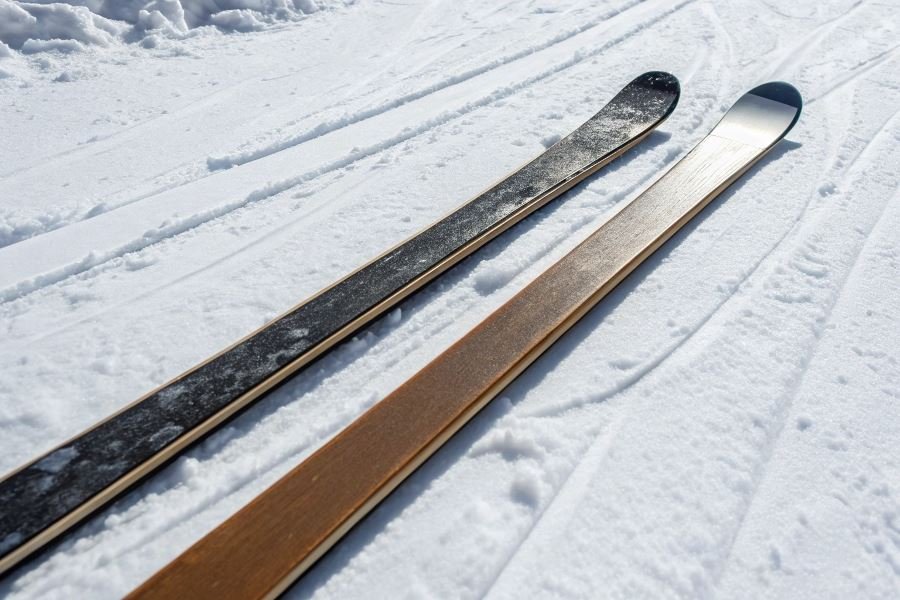
Remember your first time sliding down a snow-covered slope? The sport has come a long way since those wooden planks strapped to leather boots.
The evolution of ski technology represents one of the most dramatic equipment transformations in any sport. From the handcrafted wooden skis of the early 20th century to today’s precision-engineered marvels, skiing equipment has undergone a revolution that has fundamentally changed how we experience the mountain.
The birth of the carving era
The most significant leap forward came in the 1990s with the introduction of shaped skis—what we now call carving skis. These dramatically changed the skiing landscape with their hourglass profile, featuring a wider tip and tail with a narrower waist. This design wasn’t just a cosmetic change; it fundamentally altered how skis interact with snow.
Traditional skis, with their relatively straight edges, require skiers to use significant physical effort to initiate and hold turns. Carving skis, by contrast, naturally want to turn when placed on edge—they literally do much of the work for you.
Finding your perfect match
The difference between these ski types goes beyond mere design specifications:
| Aspect | Traditional Skis | Carving Skis |
|---|---|---|
| Turn initiation | Requires more technique | Easier, more intuitive |
| Speed stability | Excellent at high speeds | Can feel “twitchy” for beginners |
| Versatility | Better in varied conditions | Excel on groomed runs |
| Learning curve | Steeper initial learning | Faster progression for beginners |
Your skiing style should dictate your choice. Do you prefer long, sweeping turns down groomed runs? Carving skis might be your perfect match. Are you someone who ventures into powder, trees, and variable terrain? Traditional skis offer versatility that shaped skis sometimes lack.
Your ability level matters too—the right skis can either accelerate your progress or frustrate your development. The perfect skis aren’t necessarily the most expensive or newest models, but rather those that complement your unique approach to the mountain.
The Performance Showdown: Carving vs Traditional Skis
When you hit the slopes, your choice of skis fundamentally shapes your entire mountain experience. The debate between carving and traditional skis isn’t just gear talk—it’s about how you’ll connect with the mountain beneath your feet. Let’s dive into what makes these ski designs distinctly different and which might be your perfect match.
Shape and Geometry: The Foundation of Performance
Carving skis feature a pronounced hourglass shape with significant sidecut—the difference between tip/tail width and waist width. Modern carving skis typically have waist widths of 65-85mm, with dramatically wider tips and tails. This geometry creates that distinctive “hourglass” profile that makes carving turns feel almost automatic.
Traditional skis, by contrast, maintain a more conservative shape with minimal sidecut. When considering carving vs traditional skis: what to choose often comes down to this fundamental design difference. Traditional models typically measure 85-100mm underfoot with less dramatic width differences from tip to tail, resulting in a straighter edge.
The numbers tell the story:
| Feature | Carving Skis | Traditional Skis |
|---|---|---|
| Typical Waist Width | 65-85mm | 85-100mm |
| Sidecut Radius | 12-18m | 18-30m+ |
| Typical Length | Shorter (often 10-15cm below height) | Longer (often at or above height) |
| Profile | Pronounced hourglass | More straight-sided |
Turn Initiation and Control: Feel the Difference
Carving skis transform how turns happen. Their deep sidecut means that when you roll the ski onto its edge, it naturally wants to bend into an arc, following the sidecut radius. This creates that satisfying “on-rails” feeling where the ski seems to turn itself.
Traditional designs require more deliberate steering and skidding techniques. You’ll need to actively push the tails out to initiate turns rather than simply rolling onto edges. This gives you:
- More manual control over turn shape
- Greater versatility in varied terrain
- Less automatic response but more forgiveness
Speed Stability and Snow Condition Versatility
The terrain you prefer should heavily influence your choice.
Carving skis excel on:
- Groomed runs where their precision edge grip shines
- Firm snow conditions where edge hold matters
- Medium speeds where their responsive nature feels controlled
Traditional skis dominate in:
- Variable snow conditions thanks to their wider platforms
- Off-piste adventures where versatility trumps precision
- Higher speeds where their longer lengths provide stability
Snow condition adaptability might be the deciding factor for many skiers. Traditional designs, with their wider waists and less dramatic sidecuts, float better in soft snow and navigate choppy conditions with greater ease. Carving skis, while magical on perfect corduroy, can feel skittish when conditions deteriorate.
Learning Curve and Skill Development
For beginners and intermediates, modern carving skis offer an accelerated learning path. Their shape naturally guides skiers into proper technique, helping develop:
- Edge awareness
- Balance over the outside ski
- Confidence in turn completion
Traditional skis demand more technical proficiency initially but build a broader foundation of skills. They teach fundamental movements that transfer across all skiing situations, including:
- Active steering and weight shifts
- Adaptable turn shapes
- Versatile speed control techniques
The ideal progression for many skiers starts with shorter, more forgiving carving models, then gradually moves toward more traditional designs as skills and terrain preferences evolve.
Your perfect ski ultimately depends on where and how you want to ski—whether you crave the precise, carved turns of groomed perfection or the adaptable performance needed for all-mountain exploration.
The Ultimate Ski Matchmaker: Finding Your Perfect Pair
Terrain Dictates Your Ski Destiny
Your mountain playground shapes your ski selection more than anything else. Carving skis thrive on groomed, predictable surfaces where their precision-engineered edges can work their magic. With narrower waists (typically 65-85mm) and pronounced sidecuts, they transform packed corduroy into a high-speed dance floor.
Traditional skis (often called all-mountain skis) offer versatility across varied terrain. Their wider platforms (85-100mm+ underfoot) provide better flotation in soft snow and stability when conditions deteriorate.
Mountain wisdom: The more variable your skiing environment, the more you’ll appreciate traditional skis’ adaptability. The more you crave perfect arcs on groomed runs, the happier you’ll be on carvers.
Consider your typical ski day: Do you spend 80% on groomed runs seeking that perfect carved turn? Or are you constantly exploring different zones, from trees to moguls to occasional powder stashes? Your honest answer points toward your ideal ski.
Skill Level and Growth Trajectory
Beginners often benefit from shorter, more forgiving traditional skis that promote balance and confidence. However, intermediate skiers looking to perfect their technique often experience dramatic improvement on carving skis, which provide immediate feedback and reward proper form.
Advanced skiers typically maintain a quiver, but if choosing just one pair:
- Technically-minded experts who value precision and edge control gravitate toward carving skis from brands like Atomic or Völkl
- Versatile experts who ski everything the mountain offers prefer traditional/all-mountain designs from Blizzard or Nordica
Your progression goals matter too. If you’re working toward mastering carved turns and racing techniques, dedicated carving skis will accelerate your development in those specific skills.
The Showdown: Three Scenarios Compared
| Scenario | Carving Skis Excel | Traditional Skis Shine |
|---|---|---|
| Resort Conditions | Groomed runs, hardpack, ice | Variable snow, moguls, trees |
| Skiing Style | High-speed arcs, precision turns | Exploratory, all-terrain versatility |
| Physical Demands | Lower effort on groomers, higher precision required | More physical work on groomers, more forgiving overall |
Scenario 1: The Perfect Groomer Day
Carving skis are unmatched when conditions are firm and groomed. Their ability to initiate and hold turns with minimal skidding creates that addictive sensation of riding rails. Traditional skis require more deliberate edge engagement and typically produce wider, less precise turn shapes.
Scenario 2: The Unpredictable Day
When conditions vary throughout the day—morning ice giving way to afternoon slush—traditional skis provide consistent performance across changing surfaces. Carving skis can feel unstable and demanding when taken outside their comfort zone.
Scenario 3: The Skills Development Day
For skiers focused on technical progression, carving skis provide clearer feedback about weight distribution and edge control. Traditional skis forgive mistakes but might mask technical flaws that limit long-term development.
Investment Strategy for Your Feet
Quality carving skis typically start around $500 (without bindings) and can exceed $1,200 for race-inspired models. Traditional all-mountain options occupy a similar price range but offer greater versatility.
The long-term value equation depends on your skiing habits:
- Single-resort skiers who stick to groomed terrain extract maximum value from carving skis
- Multi-resort travelers encountering diverse conditions benefit from traditional skis’ adaptability
Durability consideration: Carving skis with their precise engineering often show performance degradation sooner than traditional models. Their edges and camber profiles are more susceptible to wear that affects their signature performance characteristics.
Remember that the perfect ski isn’t about following trends—it’s about matching your personal skiing reality with equipment that enhances every turn you make.