
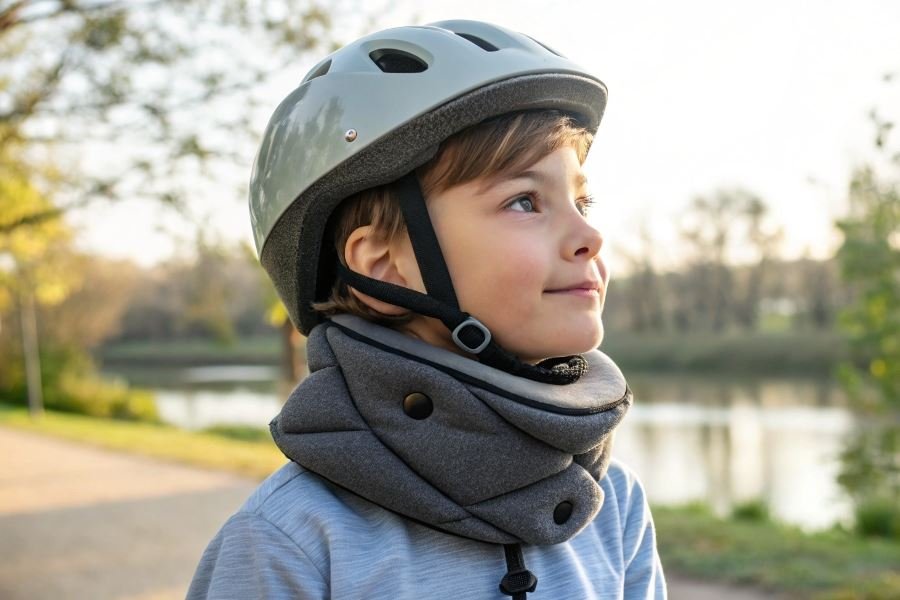
Ever wonder why a hockey player can take a 90mph slapshot to the neck and skate away unharmed? The answer might save your life.
When professional NASCAR driver Ryan Newman survived a horrific crash at the 2020 Daytona 500, his neck protection system played a crucial role in preventing what could have been a catastrophic injury. This isn’t just racing technology—it’s a wake-up call for athletes across all disciplines. Neck protection isn’t merely equipment; it’s the difference between walking away from an impact and facing life-altering consequences.
The silent epidemic in sports
The statistics are sobering: neck injuries account for approximately 10,000 emergency room visits annually among athletes in the United States alone. Sports like football see cervical spine injuries at a rate of 10.5 per 100,000 players, while activities like mountain biking report neck trauma in nearly 13% of all injuries. What’s most alarming? Many of these injuries could have been prevented or minimized with proper protection.
Material matters: The science of safeguarding your neck
Not all neck protection is created equal. The effectiveness depends on three critical factors:
- Impact absorption capacity – How well the material disperses force away from vulnerable structures
- Anatomical compatibility – How naturally it works with your body’s movement patterns
- Sport-specific design – Protection engineered for your particular activity’s risk profile
“The material that saves a motocross rider might actually increase injury risk for a lacrosse player,” explains Dr. James Thornton, sports medicine specialist at the Athletic Performance Institute.
Matching materials to movements
Different sports demand different solutions. High-velocity impact sports like motocross benefit from rigid carbon fiber or Kevlar-reinforced collars, while contact sports like football require foam composites that balance protection with mobility. For endurance athletes, lightweight materials with moisture-wicking properties prevent fatigue while still offering crucial protection.
The right neck protection doesn’t just prevent injury—it enhances performance by giving you the confidence to push your limits safely.
Material Science Meets Neck Safety: The Ultimate Comparison
When athletes push their limits, proper neck protection becomes non-negotiable. The difference between adequate and exceptional protection often comes down to material science—a field that’s revolutionizing how we approach sports safety.
The landscape of neck protection materials has evolved dramatically over the past decade, with specialized options now available for virtually every sport. A comprehensive comparison of neck protection materials: what is better for your sport depends largely on understanding the unique properties each material offers and how they perform under sport-specific conditions. Let’s dive into the material science that keeps athletes safe.
Foam-Based Protection: The Versatile Defenders
Foam-based neck protection represents the most widely used category across recreational and professional sports alike. Each foam variant brings distinct advantages:
EVA (Ethylene-Vinyl Acetate) offers exceptional shock absorption with minimal weight. This closed-cell foam maintains its protective properties even after repeated impacts, making it ideal for:
- Youth football neck rolls
- Motocross neck braces
- Wrestling headgear with integrated neck protection
Polyurethane foam delivers superior durability and consistent performance across temperature extremes. Its progressive compression characteristics mean it remains comfortable during normal movement but firms up during impact. Common applications include:
- Hockey player neck guards
- Downhill mountain biking protection
- Competitive martial arts neck supports
Memory foam technologies have transformed comfort-focused protection, conforming perfectly to individual anatomy while still offering meaningful impact resistance. These materials excel in:
- Extended-wear scenarios like endurance motorsports
- Recovery equipment for post-injury athletes
- Adaptive equipment for athletes with special needs
Rigid Protection Systems: Maximum Impact Defense
For high-velocity sports where catastrophic injuries remain a concern, rigid protection systems provide uncompromising security:
Carbon fiber constructions represent the gold standard in rigid protection, offering the highest strength-to-weight ratio of any conventional material. Its applications include:
| Sport | Carbon Fiber Application | Key Benefit |
|---|---|---|
| Formula 1 | HANS devices | Prevents basilar skull fractures |
| Downhill skiing | Integrated helmet-collar systems | Reduces whiplash in high-speed falls |
| Motorcycle racing | Neck braces | Limits excessive head movement during crashes |
Polycarbonate shields deliver exceptional impact resistance with greater flexibility than carbon fiber. This thermoplastic polymer can be molded into anatomically optimized shapes for:
- Lacrosse goalie throat protectors
- Baseball catcher’s extended masks
- Ice hockey neck guards with rigid inserts
Composite materials combine multiple protection philosophies, typically featuring a rigid exoskeleton with strategic flexibility zones. These hybrid approaches shine in:
- Professional football neck rolls
- Extreme sports protective gear
- Military and tactical athlete protection systems
Next-Generation Materials: The Protection Revolution
The cutting edge of neck protection comes from materials specifically engineered for impact management:
D3O technology represents a remarkable breakthrough with its non-Newtonian properties—flexible during normal movement but instantly hardening upon impact. This “smart material” has transformed protection in:
- Winter sports neck gaiters with integrated protection
- Competitive cycling neck braces
- Contact sport protective equipment
PORON XRD offers repeated impact protection with minimal thickness, making it ideal for low-profile applications where bulky protection would impede performance. Its applications include:
- Competitive swimming neck supports
- Ultralight trail running protection
- Combat sports training equipment
The ideal neck protection material ultimately depends on your specific sport, position, and personal risk factors. The science continues advancing, with each season bringing smarter, lighter, and more effective protection options for athletes at every level.
Sport-Specific Neck Protection Materials That Perform When It Matters
When you’re pushing your limits on the field, track, or ice, your neck protection needs to match your intensity. Different sports demand different solutions, and choosing the right material could be the difference between walking away from an impact or facing serious consequences. Let’s dive into the specifics of what works where—and why.
Contact Sports Need Specialized Support
Football, hockey, and rugby athletes face unique challenges when it comes to neck protection. The combination of high-speed collisions and unpredictable impacts requires materials that balance flexibility with fortress-like protection.
For football players, dual-density foam collars have become the gold standard. These collars typically feature a firmer outer layer of closed-cell polyethylene foam with a softer inner layer of open-cell polyurethane that conforms to the neck’s contours. The Riddell Bulwark collar system exemplifies this approach, using impact-dispersing technology that reduces force by up to 27% compared to standard foam collars.
Hockey players benefit most from composite reinforced neoprene protectors. These integrate carbon fiber or Kevlar threads within flexible neoprene to create a lightweight barrier that doesn’t restrict the constant head movement required during play. The material maintains its protective properties even at the sub-freezing temperatures of ice rinks, unlike pure foam options that can stiffen in cold conditions.
Rugby players typically opt for anatomically-shaped EVA foam protectors that provide crucial protection while maintaining the sport’s traditional aesthetic. These low-profile designs offer protection without compromising mobility or increasing heat retention during the non-stop action of a match.
| Sport | Optimal Material | Key Benefits | Typical Lifespan |
|---|---|---|---|
| Football | Dual-density foam | Impact dispersion, customized fit | 1-2 seasons |
| Hockey | Composite neoprene | Cold-resistant, lightweight | 2-3 seasons |
| Rugby | EVA foam | Low profile, maintains mobility | 1 season |
Motorsports Demand Ultimate Impact Resistance
When you’re traveling at triple-digit speeds, neck protection becomes a matter of life and death. Motorsports and high-velocity activities require materials engineered specifically for extreme impacts.
The gold standard in motorsports is the carbon fiber reinforced polymer (CFRP) collar. These ultra-rigid protectors distribute impact forces across their structure rather than allowing them to concentrate on the neck. The HANS Device revolutionized motorsport safety with this approach, becoming mandatory in Formula 1 after tragic fatalities in the early 2000s.
For motocross and mountain biking, injection-molded thermoplastic polyurethane (TPU) offers the ideal balance of rigidity and weight. These materials can absorb significant impact energy while remaining lightweight enough for extended wear during competition. Many feature progressive resistance that stiffens proportionally to impact force—remaining comfortable during normal movement but instantly hardening when needed.
Maintenance Matters More Than You Think
Even the best materials degrade over time, and knowing when to replace your neck protection can be as important as choosing the right type initially.
Foam-based protectors require the most vigilant monitoring. Check regularly for compression (areas that remain indented after pressure), cracks, or hardening of the material. Most foam neck protectors should be replaced annually for contact sports, as their protective capabilities diminish significantly after a full season of impacts.
Composite materials typically offer longer lifespans but demand careful inspection. Look for delamination (separation of layers), fiber breakage, or stress whitening (white areas in previously clear resin). These are all signs that the material’s structural integrity has been compromised.
The best neck protection is the one you’re wearing when you need it. Choose comfort without compromising safety, because uncomfortable gear often ends up unused.
For all neck protection types, immediate replacement after any significant impact is non-negotiable. Even if visible damage isn’t apparent, the internal structure may be compromised in ways that will render it ineffective during the next collision.