
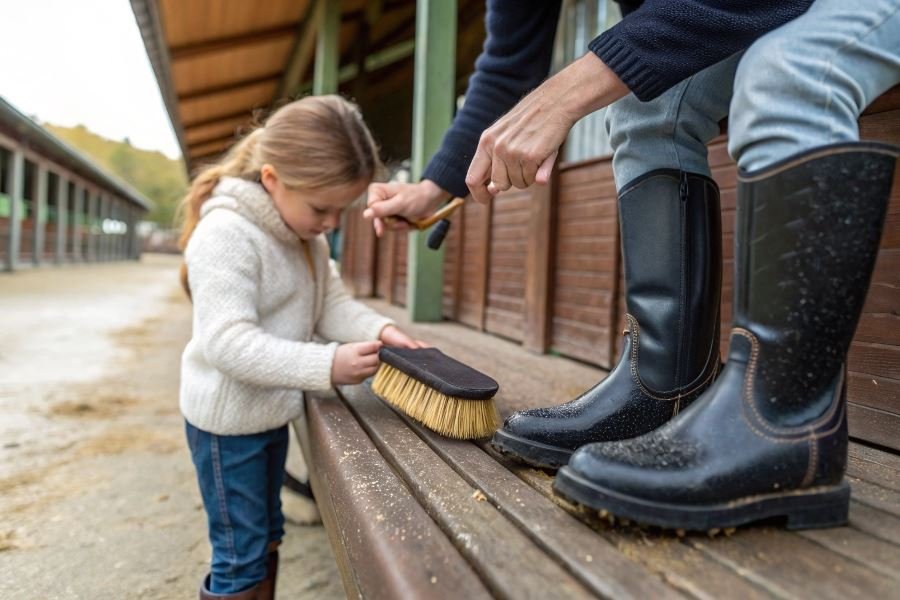
Ever watched a young rider’s face light up when they connect with their horse? That magical moment depends more on what’s on their feet than you might think. The right materials in children’s riding boots aren’t just about comfort—they’re the critical difference between confidence in the saddle and painful distractions.
When selecting riding boots for young equestrians, material choice forms the cornerstone of safety, performance, and longevity. Traditional leather options have dominated stables for generations, but modern synthetic alternatives and innovative composites are changing the landscape. Each material brings distinct advantages to the stirrup.
The safety-comfort connection
The relationship between boot materials and safety isn’t always obvious. Proper ankle support prevents dangerous twists during falls, while materials that provide adequate grip prevent slipping through stirrups—a potentially catastrophic scenario. Meanwhile, comfort isn’t merely a luxury; uncomfortable boots distract young riders from proper technique and safety awareness.
Material performance factors
Different materials respond uniquely to the demanding environment of riding:
| Material | Durability | Weather Resistance | Break-in Time |
|---|---|---|---|
| Full-grain leather | Excellent (5+ years) | Good with maintenance | Moderate |
| Synthetic leather | Good (2-3 years) | Excellent | Minimal |
| Rubber composites | Variable | Excellent | None |
The value equation extends beyond initial cost—a boot that lasts through growth spurts and multiple riding seasons ultimately delivers greater return on investment than cheaper alternatives requiring frequent replacement. The right material choice creates the foundation for young riders to develop their skills safely and comfortably.
The Ultimate Material Showdown for Young Equestrians
Full-Grain vs. The World: Leather’s Legacy
When it comes to equestrian footwear for young riders, leather remains the gold standard. Full-grain leather stands at the top of the hierarchy, offering unmatched durability and that coveted ability to mold to your child’s foot over time. This premium material retains the entire grain surface, creating a breathable, water-resistant boot that develops a beautiful patina with age. While the initial investment might make you wince at $150-300, these boots often outlast multiple growth spurts.
A comprehensive comparison of materials for children’s riding boots reveals that top-grain leather offers a more accessible price point ($100-200) while sacrificing some durability. The top layer has been sanded to remove imperfections, resulting in a thinner, more uniform material that breaks in faster but won’t last quite as long as its full-grain cousin. For weekend riders, this represents an excellent middle ground.
Synthetic leather (sometimes called PU leather) has made remarkable strides in recent years. Modern versions mimic genuine leather’s appearance while offering easier maintenance and animal-friendly credentials. At $50-120, these boots provide decent breathability and water resistance without the breaking-in period natural leathers demand. However, they typically last 1-3 years rather than the 5+ years you might get from quality full-grain options.
Rubber and PVC: Weather Warriors
Rubber boots have evolved far beyond those clunky rain galoshes. Today’s equestrian rubber boots feature reinforced ankles, cushioned insoles, and textured soles for superior grip in muddy conditions. The waterproof nature makes them ideal for young riders in rainy climates, with prices ranging from $30-80.
| Material | Waterproof Rating | Durability | Price Range | Best For |
|---|---|---|---|---|
| Full-Grain Leather | Good (with treatment) | 5+ years | $150-300 | Serious riders |
| Top-Grain Leather | Moderate | 3-5 years | $100-200 | Regular riders |
| Synthetic Leather | Fair | 1-3 years | $50-120 | Growing riders |
| Rubber | Excellent | 2-3 years | $30-80 | Wet conditions |
| PVC | Excellent | 1-2 years | $25-60 | Occasional riders |
PVC boots offer the most budget-friendly option ($25-60) while maintaining complete waterproofing. The tradeoff comes in breathability—virtually none—making them uncomfortable during extended wear or warmer weather. They’re perfect for the occasional rider or as a backup pair, but serious young equestrians will find them limiting for regular use.
Technical Fabrics: The New Contenders
The most exciting developments in children’s riding boots come from technical fabrics and composite materials. These innovative options blend the best qualities of traditional materials with modern technology.
Neoprene-lined boots provide exceptional insulation in cold weather while maintaining flexibility. The stretchy nature accommodates growing feet and calves, making them particularly valuable for rapidly developing young riders. Most designs incorporate waterproof membranes similar to those found in hiking boots, creating a dry, comfortable environment regardless of conditions.
Microfiber composites deserve special attention for their remarkable performance-to-weight ratio. These synthetics offer leather-like durability at half the weight, with superior breathability and moisture-wicking properties. Many premium options include antimicrobial treatments—a godsend for parents familiar with the unique aroma of well-used riding boots.
The latest carbon fiber reinforced boots provide exceptional ankle support and protection without the stiffness of traditional materials. While primarily found in competition boots ($150-250), this technology is gradually becoming available in training models, offering young riders professional-level performance during crucial developmental years.
When selecting materials for your young equestrian’s footwear, consider their riding frequency, local climate, and growth rate. The perfect boot balances protection, comfort, and longevity—a combination that varies widely depending on your child’s specific needs.
Making the Right Choice: Optimal Materials for Children’s Riding Boots
When it comes to equestrian footwear for young riders, material selection isn’t just about durability—it’s about safety, comfort, and supporting proper riding technique. Let’s dive into the specifics that make certain materials shine for different age groups and riding disciplines.
Material recommendations across riding disciplines
Young riders need boots that match both their age and riding style. For beginners aged 4-8, synthetic leather boots provide the perfect balance of flexibility and structure. These boots from brands like Ariat offer enough ankle support without restricting movement—crucial for developing proper form.
For intermediate riders (9-13) focusing on dressage, genuine leather becomes appropriate as they develop more refined techniques. The natural give of leather from manufacturers like Parlanti allows for subtle leg cues while maintaining necessary structure.
Teenage jumpers benefit tremendously from modern composite materials. Dublin boots featuring reinforced ankle support and shock-absorbing soles protect growing joints during landing impacts.
Discipline-specific recommendations:
- Western riding: Full-grain leather with wider toe boxes
- English disciplines: Softer calfskin or synthetic blends with narrower profiles
- Eventing: Water-resistant treated leathers or technical synthetics
Boot material maintenance requirements
Different materials demand different care routines—a critical consideration for busy families.
| Material | Cleaning Method | Frequency | Special Requirements |
|---|---|---|---|
| Full-grain leather | Saddle soap, leather conditioner | Weekly | Waterproofing every 3 months |
| Synthetic leather | Damp cloth, mild soap | After each use | UV protectant quarterly |
| Rubber/PVC | Soap and water | After muddy rides | Store away from heat sources |
| Technical fabrics | Specialized cleaners | Monthly | Reproofing treatments annually |
Synthetic materials win the low-maintenance competition, requiring simple wipe-downs rather than elaborate conditioning routines. However, premium leathers develop a protective patina over time that actually improves performance with proper care.
The most expensive boot isn’t always the best choice—the boot that gets properly maintained is.
Cost-benefit analysis for growing riders
Parents face a genuine dilemma: invest in premium materials for boots that will be outgrown, or opt for more affordable options?
For rapidly growing riders (typically ages 6-12), mid-range synthetic options from Mountain Horse provide excellent value. At $85-150, these boots deliver 80% of premium performance at half the cost of top-tier leather options.
For teenagers with more stable foot sizes, investing in quality materials becomes more justifiable. A $250-300 pair of calfskin field boots can last 3-5 years with proper care—amortizing to a reasonable annual cost.
Smart investment strategies:
- Purchase slightly larger premium boots with insoles that can be removed as feet grow
- Consider technical synthetic/leather blends that offer premium performance with less break-in time
- Look for boots with reinforced wear points (toe caps, heel counters) regardless of primary material
The ultimate value equation isn’t just about price—it’s about how long the boots remain functional and supportive. Premium materials typically maintain their structural integrity longer, even as they show cosmetic wear, making them surprisingly economical for serious young riders who practice multiple times weekly.