
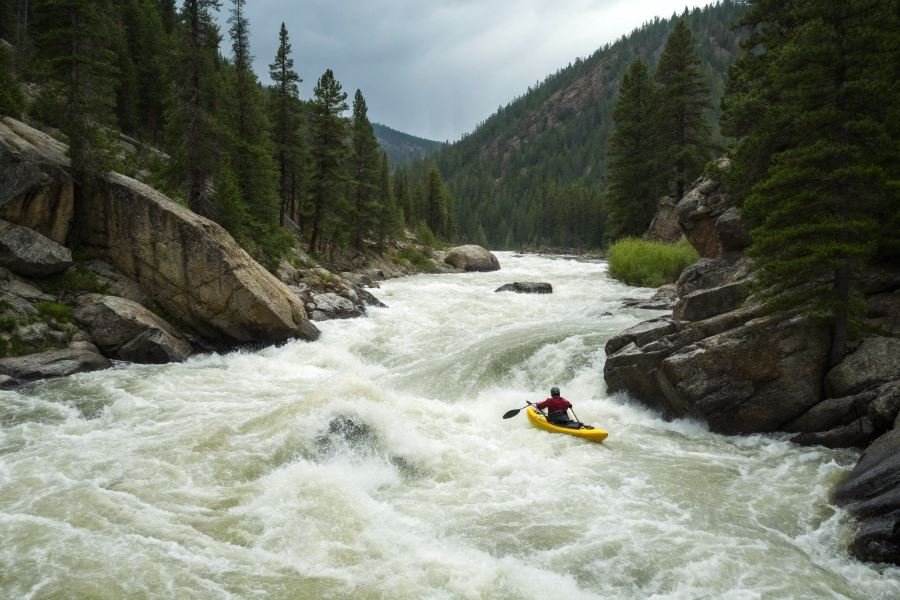
Ever stood at the edge of churning whitewater, heart pounding, wondering if your kayak is up to the challenge? The difference between an exhilarating ride and a dangerous situation often comes down to one critical decision: choosing the right kayak.
Selecting a whitewater kayak isn’t just about picking a cool color or finding a good deal. It’s about matching your vessel to both your skill level and the water you’ll be tackling. When paddlers find themselves struggling on rapids, it’s frequently because their kayak doesn’t match the conditions—a mismatch that can turn an adventure into a rescue scenario.
Whitewater is classified on an international scale from Class I (moving water with minor obstacles) to Class V+ (extremely difficult, violent water with complex hazards). Your kayak needs to align with these classifications. A boat designed for playful moves on Class II rapids will be dangerously inadequate on Class IV technical runs.
“The right kayak doesn’t just improve performance—it’s your primary safety equipment.”
The evolution of whitewater kayaks tells a fascinating story of innovation. From the 13-foot fiberglass boats of the 1970s to today’s specialized designs in rotomolded plastic, each advancement has opened new possibilities on the river. When paddlers first descended the Grand Canyon in 1869, they used wooden dories. Today’s purpose-built creek boats, playboats, and river runners are engineered for specific water conditions and paddling styles.
Understanding this evolution helps you appreciate why modern kayak design features—like planing hulls, displacement hulls, rocker profiles, and volume distribution—matter so much when you’re surrounded by powerful currents.
The Whitewater Kayak Equation: Essential Factors for the Perfect Ride
When rushing water meets raw adventure, your kayak becomes your lifeline. The difference between an exhilarating run and a frustrating swim often comes down to having the right boat under you. Selecting a whitewater kayak isn’t just about picking a pretty color – it’s about understanding how design elements translate to performance on the river.
Knowing how to choose a kayak for whitewater correctly requires understanding the technical aspects that might seem overwhelming at first but will make perfect sense once you’re carving through that first rapid. Let’s break down the critical factors that separate an adequate kayak from your perfect river companion.
Hull Design: The Foundation of Performance
The hull is your kayak’s personality on water. It dictates how your boat will behave in every situation you encounter.
Planing hulls feature flat bottoms that provide immediate stability and allow for quick, snappy moves – perfect for playboating and surfing waves. They’re forgiving for beginners but still offer the performance ceiling advanced paddlers crave.
Displacement hulls with their rounded bottoms slice through water efficiently, making them faster in a straight line and excellent for river running. They require more technical skill to edge and control.
Hybrid hulls combine elements of both designs, offering a balance that many modern creek boats utilize to handle diverse conditions.
The rocker profile – that banana-like curve from bow to stern – determines how your kayak handles drops and waves. More rocker means easier boofing (keeping the bow up over drops) and less chance of pearling (diving underwater), while less rocker translates to better tracking and speed on flatter sections.
Volume Distribution: Your Flotation Strategy
Volume isn’t just about overall boat size – it’s about where that volume sits.
| Volume Distribution | Best For | Performance Characteristics |
|---|---|---|
| High Volume Bow | Steep creeks, waterfalls | Resurfaces quickly, prevents submarining |
| Balanced Volume | All-around river running | Predictable performance in varied conditions |
| High Volume Stern | Surfing, playboating | Allows for easier stern squirts and vertical moves |
Volume-to-weight ratio is crucial – heavier paddlers need more volume to maintain proper flotation and performance. A kayak that’s too small will sit too deep in the water, making it sluggish and difficult to control in powerful currents.
Material Matters: Durability vs. Weight
The construction of your whitewater kayak represents a critical balance between durability and portability:
Rotomolded polyethylene dominates the market with excellent impact resistance. These boats can bounce off rocks all day, though they’re heavier than alternatives. Within this category, linear polyethylene offers better UV resistance while crosslinked polyethylene provides superior stiffness.
Composite constructions (fiberglass, carbon fiber, Kevlar) deliver lightweight performance but at significantly higher cost and reduced durability – rarely seen outside slalom racing.
The thickness variations throughout the boat matter too – most quality manufacturers reinforce impact zones while reducing material in less vulnerable areas.
Cockpit Configuration: Your Command Center
The cockpit isn’t just where you sit – it’s your control interface with the kayak.
Outfitting components like hip pads, thigh braces, and backbands translate your body movements into boat control. Precision fit means precise control; a sloppy fit means sloppy paddling.
Cockpit size affects ease of entry/exit (crucial for safety) and your ability to maintain proper paddling posture. Modern whitewater kayaks feature adjustable outfitting systems from manufacturers like Jackson Kayak and Dagger Kayaks that can accommodate various body types.
The knee position within the cockpit determines your leverage for edging and rolling – critical skills when things get spicy on the river.
Remember that the perfect whitewater kayak balances all these factors against your skill level, paddling style, and the specific rivers you’ll be running. The right boat amplifies your strengths while helping manage your weaknesses on the water.
Matching Your Kayak to Your Whitewater Journey
Choosing the right whitewater kayak isn’t just about picking a cool color or brand—it’s about finding that perfect extension of your body that matches both your current abilities and your paddling ambitions. The right boat can accelerate your progress, while the wrong one might leave you swimming more than paddling.
Beginner-friendly boats that build confidence
For newcomers to whitewater, stability trumps all other features. Beginner-friendly kayaks typically feature:
- Longer hulls (7.5-9 feet) providing better tracking and stability
- Rounded, forgiving edges that don’t catch on currents
- Higher volume designs with more buoyancy to prevent submarining
- Wider cockpits for easier exits during those inevitable first flips
The Dagger Mamba and Pyranha Burn series exemplify these characteristics, offering predictable handling that forgives mistakes while still allowing growth. These boats typically weigh between 40-45 pounds, making them manageable for portaging around obstacles.
The best beginner kayak isn’t necessarily the cheapest—it’s the one that keeps you upright long enough to fall in love with the sport.
Intermediate and advanced considerations
As your skills progress, your kayak needs evolve dramatically. Intermediate and advanced paddlers should focus on:
- Hull responsiveness that rewards proper technique
- Edge control for carving precise lines through complex rapids
- Volume distribution tailored to your paddling style
- Weight considerations for technical maneuvers
Advanced paddlers often prefer kayaks with sharper edges that provide immediate feedback and allow for aggressive edging techniques. The sweet spot for many experienced paddlers falls between 7-8 feet in length, balancing maneuverability with momentum.
Specialized kayaks for different disciplines
Whitewater kayaking branches into distinct disciplines, each demanding specialized equipment:
| Discipline | Key Characteristics | Ideal Length | Notable Features |
|---|---|---|---|
| River Running | Balanced volume, moderate rocker | 7.5-8.5 ft | All-around performance, comfortable outfitting |
| Creeking | High volume, pronounced rocker | 7-8.5 ft | Impact-resistant construction, safety features |
| Playboating | Low volume ends, flat hull | 5.5-6.5 ft | Lightweight design, aggressive edge profile |
River running kayaks like the Jackson Zen strike a balance between stability and playfulness, making them versatile for various water conditions.
Creek boats such as the Liquidlogic Flying Squirrel prioritize safety with reinforced construction, additional volume, and pronounced rocker to navigate steep, technical descents and boof over drops.
Playboats including the Wave Sport Project series feature stubby designs with minimal length, allowing for aerial tricks, cartwheels, and surfing river features.
Test before you invest
No amount of research substitutes for on-water experience. Before purchasing:
- Attend demo days hosted by manufacturers or local paddling shops
- Borrow boats from paddling clubs or friends to compare handling
- Test in realistic conditions similar to where you’ll paddle most often
- Consider seasonal rentals before committing to a purchase
Many experienced paddlers recommend testing at least 3-5 different models before making a decision. Pay attention to how each boat responds to your weight distribution, paddling style, and the specific features you encounter.
Remember that your ideal kayak will evolve with your skills—many paddlers maintain a quiver of boats for different water conditions and paddling objectives rather than seeking one perfect all-arounder.