
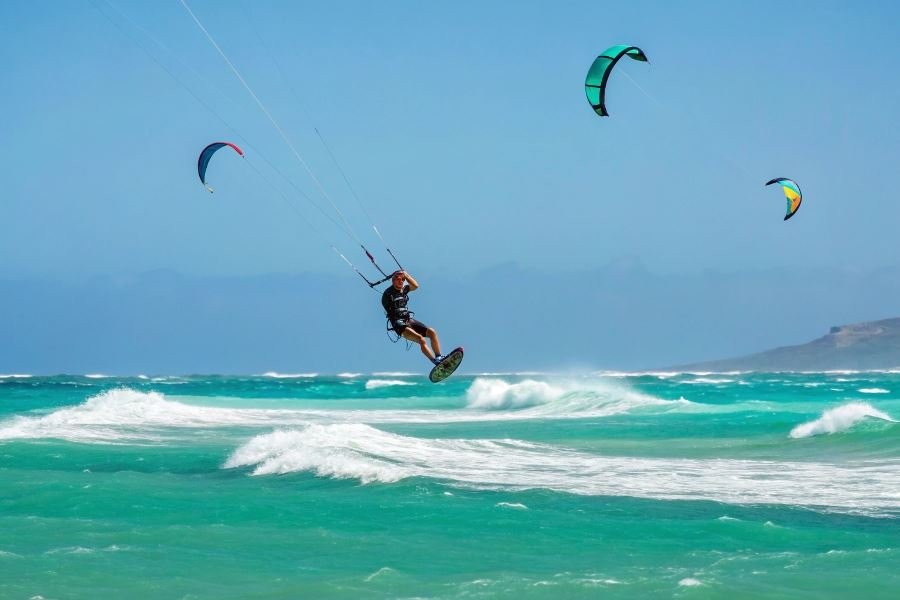
Ever stood at the shore watching colorful kites dance across the sky while windsurfers carve through waves, wondering which thrill might be yours? The choice between these two exhilarating water sports isn’t just about which looks cooler—it’s about finding your perfect match on water.
Windsurfing pioneered the wind-powered revolution when it exploded onto beaches in the 1970s, combining elements of surfing and sailing. Kitesurfing followed decades later, emerging in the 1990s as technology allowed for safer, more controllable kites. Today, both sports have evolved dramatically, with specialized equipment for everything from freestyle tricks to wave riding and long-distance adventures.
The equipment equation
Windsurfing requires a board with a sail attached via a universal joint, creating a relatively straightforward mechanical system. Kitesurfing, meanwhile, harnesses the power of a kite connected to the rider by lines and a harness, offering a different kind of freedom.
“The difference isn’t just in the gear—it’s in how you connect with the elements. Windsurfing puts the power directly in your hands, while kitesurfing creates a dance between you, the kite, and the water.” — Professional instructor with 15+ years teaching both sports
Learning curves and experiences
Windsurfing typically demands more initial physical strength but offers a more gradual progression. Kitesurfing has a steeper initial learning curve but can lead to faster advancement once basics are mastered. Most beginners can get up and riding within:
| Sport | Time to first ride | Time to comfortable independence |
|---|---|---|
| Windsurfing | 1-2 days | 2-3 weeks |
| Kitesurfing | 2-3 days | 1-2 weeks |
Your choice ultimately depends on your physical condition, local conditions, available instruction, and personal preferences—factors we’ll explore to help you make the perfect choice for your water sports journey.
Windsurfing vs Kitesurfing: The Ultimate Beginner’s Guide
When the wind calls, two sports answer with particular enthusiasm: windsurfing and kitesurfing. Both offer exhilarating experiences on the water, but they differ dramatically in almost every aspect that matters to newcomers. The decision between windsurfing vs kitesurfing: what should a beginner choose often comes down to understanding the nuances of each sport’s learning journey, physical requirements, and practical considerations.
Mastering the Learning Curve
Windsurfing typically demands more initial patience. Most beginners need 8-10 sessions before experiencing their first “planing” moment—that magical instant when the board lifts and skims across the water. The progression follows a relatively linear path:
- First 1-3 days: Basic balance and steering
- Weeks 2-4: Upwind sailing in light winds
- Months 2-3: Beginning to harness stronger winds
Kitesurfing presents a steeper initial hurdle but often rewards persistence with faster progression afterward. The critical kite control skills must be mastered before even attempting water starts:
- First 2-3 days: Kite control exercises on land
- Days 4-7: Body dragging and water relaunch techniques
- Days 8-14: First water starts and riding
“Windsurfing builds skills gradually while kitesurfing requires conquering a significant initial challenge before rapid advancement.”
Physical Requirements and Fitness Demands
| Sport | Core Strength | Upper Body | Lower Body | Endurance |
|---|---|---|---|---|
| Windsurfing | High | Very High | Medium | High |
| Kitesurfing | Medium | Medium | High | Medium |
Windsurfing places tremendous demands on upper body strength, particularly in the arms, shoulders, and back. The constant pulling of the sail (which can weigh up to 17 pounds when wet) creates a full-body workout that many find exhausting during initial sessions.
Kitesurfing, while still physically demanding, distributes effort differently. The harness transfers most kite forces to your core and legs, making it potentially more accessible for those with less upper body strength. However, the explosive movements required for jumps and transitions demand excellent leg power and coordination.
Weather and Location Dependencies
Windsurfing equipment, particularly beginner gear, functions best in steady winds between 10-18 knots. The larger boards provide stability but require deeper water, limiting suitable locations for newcomers.
Kitesurfing offers greater versatility in both wind and location:
- Functions well in winds from 12-30+ knots
- Requires less water depth (as little as knee-deep)
- Performs better in gusty conditions
This flexibility makes kitesurfing viable in more locations and throughout more of the year in many regions.
Equipment Investment Reality Check
Initial investment for basic windsurfing gear starts around $1,500-2,000 for a complete beginner package from brands like Starboard or Fanatic. The equipment tends to be bulkier, requiring roof racks and potentially a larger vehicle.
Kitesurfing starter packages from Cabrinha or Duotone typically range from $2,000-2,500, but pack down into two manageable bags. The higher initial cost is often offset by greater longevity of equipment and easier transport options.
Safety Considerations
Windsurfing offers inherent safety advantages for beginners:
- Self-limiting power: When you fall, the sail loses power
- Physical separation: You’re attached to equipment only by your hands
- Predictable hazards: Primarily limited to boom impacts and exhaustion
Kitesurfing carries more significant risks that require dedicated training:
- Persistent power: The kite remains powered even during falls
- Physical connection: You remain attached to the kite via harness
- Multiple hazards: Includes lofting (being lifted uncontrollably), line cuts, and equipment entanglement
The safety gap narrows significantly with proper instruction, but kitesurfing demands more rigorous safety protocols and awareness.
Choose the sport that aligns with your physical strengths, local conditions, and risk tolerance—both offer incredible rewards for those willing to embrace the learning process.
Personalize Your Path: Windsurfing vs Kitesurfing
When standing at the crossroads between windsurfing and kitesurfing, your personal circumstances become the ultimate deciding factor. Let’s dive into how your unique situation should guide this thrilling decision.
Match Your Athletic Background
Your existing athletic profile significantly impacts which sport might feel more natural:
Windsurfing favors:
- Sailors and paddleboarders (balance and understanding of wind dynamics)
- Weightlifters and climbers (upper body strength for sail handling)
- Skiers and snowboarders (similar stance and edge control)
Kitesurfing clicks with:
- Paragliders and skydivers (kite control intuition)
- Wakeboarders and snowboarders (similar riding stance)
- Rock climbers (body tension awareness and quick reactions)
Neither sport requires professional-level fitness, but kitesurfing typically demands less raw strength while requiring sharper reflexes.
Assess Your Local Conditions
Your home waters dramatically influence which sport makes practical sense:
| Condition | Windsurfing Suitability | Kitesurfing Suitability |
|---|---|---|
| Wind Speed | 10-35 knots optimal | 12-30 knots optimal |
| Water Space | Needs less space | Requires significant safety zone |
| Waves | Handles choppy conditions well | Prefers cleaner conditions for beginners |
| Launch Areas | Needs simple beach access | Requires unobstructed launch area |
The perfect sport is the one you can actually practice regularly where you live. The best gear collects dust if local conditions don’t support it.
If you’re blessed with consistent 15-25 knot winds and open beaches, both sports are viable. For lighter wind regions (10-15 knots), windsurfing with larger boards offers more opportunities to get on the water.
Commitment Level Reality Check
Be honest about your time and financial investment capacity:
Windsurfing typically involves:
- Longer learning curve (20-30 hours to basic competence)
- Heavier equipment (transportation considerations)
- Lower initial injury risk
- Equipment cost: $1,500-3,000 for quality beginner setup
Kitesurfing generally means:
- Steeper initial learning (10-15 hours to basic riding)
- More compact equipment (easier transport)
- Higher initial risk factor
- Equipment cost: $1,800-3,500 for complete beginner kit
Your long-term goals matter too. Windsurfing offers specialized disciplines from slalom racing to wave riding, while kitesurfing branches into freestyle, wave riding, and hydrofoiling paths.
Try Before You Buy
The smartest approach? Experience both before committing:
- Book a discovery lesson in each sport (typically $75-150)
- Attend a water sports festival where Starboard or Cabrinha might offer demo opportunities
- Join local water sports social media groups to find enthusiasts willing to introduce newcomers
- Consider a water sports vacation at destinations like Hood River or Maui where multi-sport packages are available
The sport that makes you smile most during those first awkward attempts is often your best match.
Remember that many enthusiasts eventually practice both sports, choosing based on daily conditions. Your water sports journey doesn’t have to be exclusive—it just needs a thoughtful starting point that aligns with your personal circumstances.