
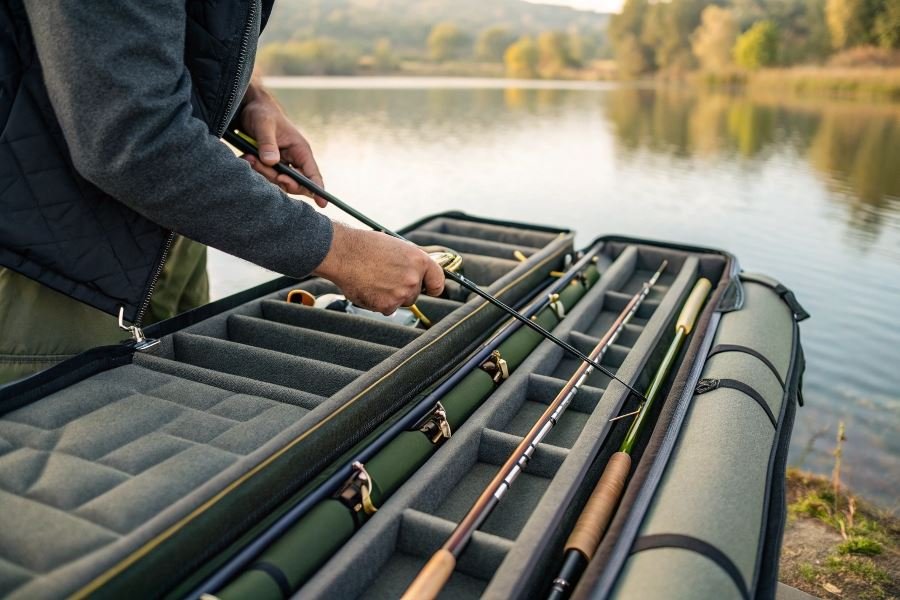
Ever watched a $500 fishing rod snap because it wasn’t properly protected during transport? That gut-wrenching moment is something no angler wants to experience.
For serious fishing enthusiasts, rod protection isn’t just an accessory—it’s essential equipment. Your fishing rod represents both a significant investment and the primary tool in your pursuit of that trophy catch. Whether you’re heading to a local lake or embarking on a cross-country fishing expedition, how you transport your gear can make or break your experience.
Hard and soft rod cases represent two fundamentally different approaches to protection. Hard cases offer fortress-like security with rigid shells typically made from molded plastic, aluminum, or fiberglass. They’re essentially armor for your fishing equipment. Soft cases, meanwhile, provide flexible protection through padded fabric materials like nylon, polyester, or canvas—think of them as a protective jacket rather than a vault.
When weighing practicality between these options, several factors come into play:
Key considerations for choosing your ideal rod case:
- Transportation method: Flying to Alaska for salmon season? A hard case might be non-negotiable. Driving to your local fishing spot? A soft case could suffice.
- Number of rods: Soft cases often accommodate multiple rods more efficiently.
- Storage space: Hard cases demand dedicated storage space when not in use.
- Weight concerns: Soft cases typically weigh significantly less.
- Environmental conditions: Extreme weather or rough handling might necessitate hard-shell protection.
The perfect rod case balances protection with convenience—finding that sweet spot depends entirely on understanding your specific fishing lifestyle and priorities.
Hard vs Soft Rod Cases: The Ultimate Protection Showdown
Fishing enthusiasts know that quality gear demands quality protection. When it comes to safeguarding your prized fishing rods, the debate between hard and soft rod cases has raged on for decades. Each option presents distinct advantages that can make or break your fishing experience depending on your specific needs.
The question of hard vs soft rod cases: which is more practical isn’t just about preference—it’s about understanding the unique demands of your fishing lifestyle. Whether you’re a weekend warrior hitting local spots or a dedicated angler traveling cross-country for that trophy catch, your choice of rod protection can significantly impact both your equipment’s longevity and your overall fishing experience.
Battle-Ready Protection
When it comes to sheer defensive capabilities, hard cases reign supreme. Constructed from high-impact plastics, fiberglass, or aluminum, these rigid fortresses offer unparalleled protection against crushing forces and impacts.
Impact resistance testing reveals hard cases can withstand forces exceeding 200 pounds of pressure without transferring damage to your rods. The Plano Airliner Telescoping Rod Case exemplifies this durability with its reinforced corners and crush-resistant design.
Soft cases, while less robust, aren’t defenseless. Premium models like the Simms Rod Vault feature semi-rigid construction with strategic padding that absorbs moderate impacts.
The difference becomes most apparent during air travel or when equipment gets stacked in vehicle trunks—scenarios where hard cases provide peace of mind that soft cases simply cannot match.
Water resistance presents another critical consideration. Hard cases typically feature rubber gaskets and sealed designs that keep moisture at bay even during downpours. Soft cases have evolved significantly, with many now incorporating hydrophobic materials and water-resistant zippers, though they rarely match the submersion protection of quality hard cases.
Portability and Convenience Factor
| Feature | Hard Cases | Soft Cases |
|---|---|---|
| Weight | 4-8 lbs empty | 1-3 lbs empty |
| Storage Footprint | Fixed dimensions | Collapsible |
| Carrying Options | Handle, sometimes wheels | Multiple straps, backpack options |
Soft cases dominate the portability category with their lightweight construction and adaptable storage options. The average soft case weighs 60-70% less than its hard counterpart, making a substantial difference during long hikes to remote fishing spots.
Transportation convenience extends beyond mere weight. Soft cases conform to available space in vehicles and can be folded when not in use. Many feature backpack straps or shoulder slings that free your hands for other gear. The Fishpond Dakota Rod and Reel Case exemplifies this versatility with its modular carrying system.
Hard cases demand dedicated storage space with their rigid dimensions, though some telescoping models have addressed this limitation. Premium options like the Orvis Carry-It-All include wheels for easier transport through airports and parking lots.
Value Proposition and Cost Analysis
Investment in protection follows a predictable pattern: hard cases typically command higher prices, ranging from $80 to $300+ for premium models. Soft cases present a more accessible entry point, with quality options starting around $40 and topping out near $150 for feature-rich designs.
The value equation extends beyond initial purchase price. Hard cases generally outlast soft cases by 3-5 years under similar use conditions. This durability factor offsets the higher upfront cost for anglers who travel frequently or fish in harsh conditions.
The practical choice ultimately depends on your specific needs. Weekend anglers making short trips might find soft cases offer sufficient protection with superior convenience. Tournament competitors and destination anglers who regularly travel with expensive equipment will likely find hard cases worth the investment despite the added bulk and cost.
Hard vs Soft Rod Cases: Making the Right Choice
Choosing between hard and soft rod cases isn’t just about preference—it’s about protecting your investment while matching your fishing lifestyle. After testing dozens of options across rivers, lakes, and coastal waters, I’ve distilled everything you need to know to make the perfect choice for your specific needs.
The Ultimate Pros and Cons Showdown
Hard cases offer fortress-like protection but come with tradeoffs, while soft cases deliver convenience with some compromise. Let’s break down the essentials:
| Feature | Hard Cases | Soft Cases |
|---|---|---|
| Protection | Superior impact resistance | Moderate protection |
| Weight | Heavier (3-8 lbs) | Lightweight (1-3 lbs) |
| Storage | Limited internal space | Multiple external pockets |
| Durability | 5-10+ years lifespan | 2-5 years with proper care |
| Cost | $80-300+ | $30-150 |
| Portability | Bulkier, rigid | Compressible, adaptable |
| Weather resistance | Excellent waterproofing | Water-resistant (not waterproof) |
The hard case from Plano might save your $800 fly rod from a baggage handler’s carelessness, but that Fishpond soft case could be your best friend during a five-mile hike to that secret fishing spot.
Matching Your Case to Your Fishing Identity
Your fishing style should dictate your case choice:
For the Weekend Warrior: If you’re fishing locally and transporting rods in your vehicle, soft cases offer the perfect balance of protection and convenience. The padding is sufficient for short trips, and you’ll appreciate the lighter weight and extra storage pockets.
For the Frequent Flyer: Air travel demands hard cases—period. The baggage handling process is notoriously rough, and that $60 saved on a soft case won’t feel like a bargain when you’re staring at a snapped rod tip in your hotel room.
For the Budget-Conscious: Quality soft cases from brands like Redington offer tremendous value around $40-60, providing adequate protection for careful anglers. If budget allows, consider a hybrid case with semi-rigid construction.
For the Gear Collector: If you’ve invested thousands in premium rods, a high-end hard case isn’t an expense—it’s insurance. The protection offered by a Simms or Sage hard case justifies the premium price tag.
When Each Case Type Truly Shines
Hard Cases Excel When:
- Flying with your gear (especially internationally)
- Storing expensive rods long-term in potentially damaging environments
- Transporting multiple setups in harsh conditions (boat spray, extreme temperatures)
Soft Cases Dominate When:
- Hiking to remote fishing locations where every ounce matters
- Quickly switching between multiple rods during a fishing session
- Storing rods in vehicles with limited space (compact cars, shared transportation)
The perfect rod case isn’t the most expensive or the most feature-packed—it’s the one that matches your specific fishing reality.
Remember that many serious anglers eventually own both types, using hard cases for travel and storage, while keeping soft cases for day trips and convenience. Your fishing journey might lead you to the same conclusion as your collection and adventures grow.