
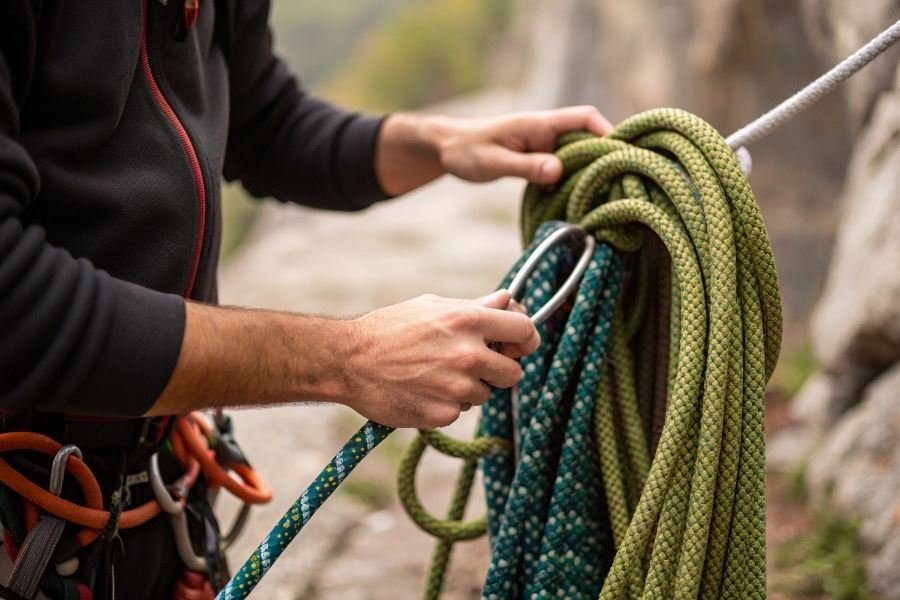
That metallic click you hear when securing a carabiner? That’s the sound of choosing life over a 100-foot fall.
When you’re suspended hundreds of feet above the ground, your entire safety system relies on components no bigger than your palm. Carabiners—those metal loops with spring-loaded gates—form the critical connections throughout your climbing setup, linking you to protection points, anchors, and ultimately, survival. A properly selected carabiner isn’t just equipment; it’s your lifeline.
The backbone of climbing safety
Carabiners serve as the fundamental connectors in every climbing safety system. They transfer loads between your harness, rope, and protection points, often bearing forces exceeding 20kN (roughly 4,500 pounds). This seemingly simple piece of hardware must perform flawlessly under extreme conditions—from freezing temperatures on alpine routes to the abrasive environments of desert crack climbing.
Beyond the basic snap
The climbing world offers a diverse array of carabiner types, each engineered for specific applications:
- Locking carabiners: Feature additional gate security mechanisms essential for critical connections like belay devices and anchor master points
- Non-locking carabiners: Lighter options primarily used for quickdraws and extending protection
- Specialized shapes: From D-shaped power-transfer designs to HMS pear-shaped options for belaying
Decision factors that matter
Selecting the right carabiner involves weighing several crucial elements:
- Gate design: Solid gates offer durability while wire gates reduce weight and freeze-up potential
- Gate action: The smoothness and resistance of opening mechanism affects handling with cold or tired hands
- Weight considerations: Shaving grams becomes significant when carrying dozens on long routes
- Material strength: Aluminum alloys balance weight and durability for most applications
Essential Factors for Climbing Carabiner Selection
Strength Ratings That Save Lives
When you’re dangling 100 feet above the ground, that small metal loop becomes your best friend. Understanding carabiner strength ratings isn’t just technical jargon—it’s your lifeline. Every legitimate climbing carabiner displays three critical numbers: major axis strength (lengthwise), minor axis strength (sideways), and open gate strength.
The process of choosing a carabiner for climbing starts with these ratings, typically measured in kilonewtons (kN). For perspective, 1kN equals about 225 pounds of force. Most climbing carabiners offer major axis ratings between 20-30kN, minor axis ratings of 7-10kN, and open gate ratings of 6-10kN. Always look for the UIAA or CE certification marks, which indicate the carabiner has passed rigorous international safety standards.
Never compromise on certification. A carabiner without proper testing documentation isn’t worth the $2 you might save—especially when your safety hangs in the balance.
Gate Designs: The Critical Connection
The gate—that movable bar that opens and closes—might seem simple, but its design dramatically affects both safety and functionality.
| Gate Type | Pros | Cons | Best Use |
|---|---|---|---|
| Straight Gate | Lightweight, simple | Can open during falls | General climbing |
| Bent Gate | Easier clipping | Slightly lower strength | Rope-end quickdraws |
| Wire Gate | Lightest, less ice buildup, reduced gate flutter | Can snag on gear | Alpine, ice climbing |
| Locking Gate | Maximum security | Heavier, requires extra steps | Belaying, anchors |
Gate flutter deserves special attention—during a fall, carabiners can vibrate against the rock face, momentarily opening the gate and reducing strength by up to 70%. This is why wire gates have become increasingly popular for lead climbing routes.
Auto-locking gates from brands like Petzl and Black Diamond offer additional security with their twist-and-pull or triple-action mechanisms, virtually eliminating accidental openings.
Material Matters: Aluminum vs. Steel
The material debate comes down to a fundamental climbing question: do you prioritize weight or durability?
Aluminum carabiners dominate recreational climbing for good reason. They typically weigh 30-60 grams, making them ideal for long routes where every ounce matters. Modern aluminum alloys offer impressive strength-to-weight ratios, with high-end models from DMM and Mammut pushing engineering boundaries.
Steel carabiners weigh approximately twice as much but offer superior durability and wear resistance. This makes them ideal for:
- High-wear applications like top-rope anchors
- Rescue operations
- Industrial climbing
- Situations where repeated metal-on-metal contact occurs
Steel models typically cost more upfront but can outlast several aluminum carabiners in high-use scenarios. For gym climbing or permanent outdoor anchors, the investment often pays off.
The carabiner you choose should match your climbing style, not just your budget. A sport climber needs different features than an alpine minimalist or big wall enthusiast.
The shape also influences functionality—D-shaped carabiners concentrate load along the spine for maximum strength, while asymmetric D-shapes offer larger gate openings for easier clipping. Oval carabiners distribute load evenly, making them ideal for aid climbing where multiple connections might share a single carabiner.
Remember that carabiners are only as strong as their weakest configuration. Even a 30kN carabiner becomes dangerously weak when loaded incorrectly or when the gate opens during a fall.
Specialized Carabiner Selection for Climbing Disciplines
When you’re hanging 200 feet up a rock face, your carabiner isn’t just gear—it’s your lifeline. Selecting the right carabiner for your climbing style isn’t just about safety; it’s about optimizing your performance and enjoying the climb to its fullest.
Matching carabiners to climbing disciplines
Different climbing styles demand different carabiner characteristics. Let’s break it down:
Sport climbing thrives on lightweight, wire-gate carabiners that minimize weight while you’re pushing your limits. The Petzl Spirit excels here with its smooth clipping action and durability.
Trad climbing requires sturdier, solid-gate carabiners that can handle diverse protection placements. The Black Diamond RockLock offers the reliability needed when placing your own protection.
Alpine climbing demands ultralight, versatile carabiners that won’t weigh you down during long approaches. The DMM Phantom shaves precious grams without sacrificing strength.
Big wall climbing calls for carabiners with high gate clearance and exceptional durability. The Metolius Gatekeeper provides the robustness needed for multi-day ascents.
Your climbing discipline should dictate your carabiner choice—not the other way around.
Weight, size and handling characteristics
The perfect carabiner balances three critical factors:
| Characteristic | Impact on Performance | Optimal Range |
|---|---|---|
| Weight | Affects fatigue and pack weight | 28-75g depending on use |
| Gate Clearance | Determines rope/gear insertion ease | 20-26mm for most uses |
| Size | Influences handling with gloves/cold hands | Small to XL based on conditions |
When selecting carabiners, consider your hand size and typical climbing conditions. Cold-weather climbers should opt for larger carabiners that can be manipulated with gloves, like the Omega Pacific Jake with its oversized gate.
The handling “feel” matters tremendously. A carabiner that’s awkward to clip in a relaxed setting becomes nearly impossible to manage when you’re pumped at your limit. Test the gate action before purchasing—it should be smooth but offer enough resistance to prevent accidental openings.
Hot tip: The lightest carabiners aren’t always the best choice. Saving 2 grams per carabiner might seem smart until you’re fumbling with tiny hardware on a difficult clip.
Maintenance requirements and longevity factors
A quality carabiner can last for years with proper care. Here’s what affects longevity:
-
Material composition – Aluminum alloys offer different strength-to-weight ratios. 7075-T6 aluminum provides exceptional durability but comes at a higher price point than 6061-T6.
-
Gate mechanism – Wire gates have fewer moving parts to fail but may deform more easily. Solid gates offer better durability but require more maintenance.
-
Anodization quality – Beyond color, anodization protects against corrosion. Deep, consistent coloring typically indicates quality treatment.
Maintain your carabiners by:
- Rinsing with fresh water after exposure to salt (ocean climbing or sweat)
- Lubricating hinges sparingly with manufacturer-recommended products
- Retiring carabiners after significant impacts or visible wear
Remember that even “bomber” carabiners have a lifespan. Inspect them regularly for hairline cracks, gate issues, or significant wear marks.
The CAMP Nano 22 exemplifies modern carabiner engineering with its 22-gram weight and 20kN major axis strength—proving that with proper materials and design, even ultralight options can offer impressive durability.
Your carabiner selection ultimately reflects your climbing priorities. Choose wisely—your send (and safety) may depend on it.