
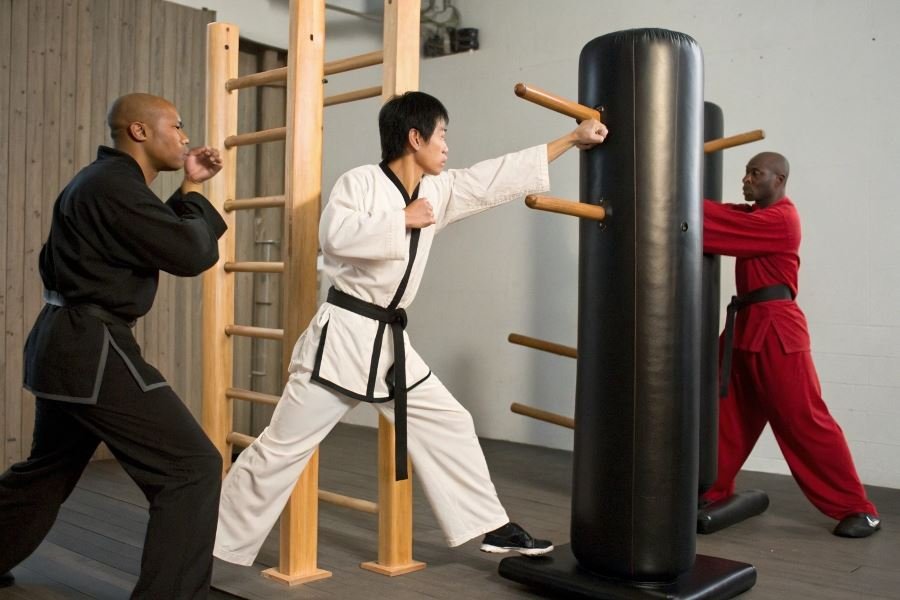
Ever watched a martial artist deliver a perfect strike and wondered how they developed such precision? Behind every powerful punch and devastating kick lies countless hours of practice—and the right training equipment makes all the difference.
When Bruce Lee famously said, “I fear not the man who has practiced 10,000 kicks once, but I fear the man who has practiced one kick 10,000 times,” he understood something fundamental: repetition builds mastery. But repetition requires the right tools. Strike dummies have revolutionized martial arts training by providing consistent, damage-free targets that simulate real combat scenarios without the need for a human partner.
The best strike dummies do more than just absorb punishment—they provide realistic feedback, help develop proper technique, and prevent injury during those crucial 10,000 repetitions. Whether you’re practicing Muay Thai’s devastating knee strikes, karate’s lightning-fast punches, or MMA’s ground-and-pound techniques, the right dummy becomes an extension of your training philosophy.
Selection criteria that matter
When evaluating the top training dummies for this guide, we focused on three critical factors:
- Durability – Can it withstand thousands of full-power strikes?
- Realistic feedback – Does it simulate human resistance appropriately?
- Versatility – Can it accommodate different striking techniques and martial arts styles?
Let’s explore the elite options that have earned their place in dojos and home gyms across America, helping practitioners transform from beginners to formidable fighters.
Strike Back: The Ultimate Dummy Showdown for Martial Artists
When it comes to honing your striking skills, having the right training partner that doesn’t hit back (or complain) is essential. The martial arts world offers various training dummies designed to absorb your most powerful techniques while providing realistic feedback. Let’s break down the top 3 dummies for practicing strikes in martial arts that have revolutionized solo training for fighters across disciplines.
Free-standing Heavy Bags: The Resilient Workhorses
Free-standing heavy bags have become the cornerstone of home and commercial gyms alike. Unlike their hanging counterparts, these sturdy companions require no ceiling attachments, making them perfect for apartments or spaces with structural limitations.
Construction Excellence: Modern free-standing bags typically feature a heavy-duty vinyl or leather exterior wrapped around dense foam padding. The base requires filling with either water (70-80 pounds) or sand (up to 270 pounds) to create stability during intense sessions.
The genius lies in the flexibility – these bags absorb impact while slightly giving way, then returning to position. This movement mimics a real opponent’s body reaction without sending the bag flying across the room.
| Feature | Water Base | Sand Base |
|---|---|---|
| Weight | 70-80 lbs | 200-270 lbs |
| Stability | Good | Excellent |
| Portability | Easier to empty/move | More difficult |
| Impact Absorption | Moderate | Superior |
Training benefits include 360-degree striking access, allowing practitioners to practice footwork while delivering combinations from any angle. The Century Wavemaster XXL and Ringside Elite models have set industry standards for durability, often lasting 5+ years of regular use.
BOB Training Dummies: Your Silent Sparring Partner
Body Opponent Bags (BOB) represent the next evolution in striking targets, offering anatomical accuracy that transforms how martial artists train.
Humanoid Design Advantage: Unlike conventional bags, BOB presents a lifelike torso and head mounted on an adjustable stand. This anatomical precision allows practitioners to target specific striking points – from liver shots to temple strikes – with unprecedented accuracy.
The realistic density variations throughout the dummy provide authentic feedback. Striking the “jaw” feels different from hitting the “sternum,” training fighters to understand the nuanced effects of their techniques on different body parts.
Versatility reigns supreme with adjustable height settings (typically 60-78 inches) accommodating practitioners of all sizes. This adaptability makes BOB suitable for various martial arts styles from Muay Thai to Krav Maga, allowing precise practice of everything from knee strikes to eye gouges.
Advanced models like the Century BOB XL include extended torsos for low-kick practice, while the Ringside BOB offers removable limbs for specialized training scenarios.
Wall-mounted Striking Pads: Maximum Impact in Minimum Space
For martial artists working with limited training areas, wall-mounted striking pads deliver exceptional value through space efficiency and resistance training benefits.
Space-saving Design: These pads attach directly to walls or sturdy support beams, requiring as little as 2-3 square feet of wall space while providing a robust striking surface. The Outslayer Wall Mount and Title Boxing Wall Pad exemplify this efficient design philosophy.
Resistance Training Advantages: Unlike free-moving bags, wall pads offer zero give-back, forcing strikers to absorb their own impact energy. This builds tremendous striking power while strengthening stabilizing muscles throughout the body.
The fixed position creates perfect conditions for practicing straight punches, front kicks, and other direct strikes with proper form. The immediate feedback helps correct technique flaws that might go unnoticed on moving targets.
Advanced practitioners appreciate the ability to mark specific target areas on these pads, creating precision-focused drills that develop pinpoint accuracy alongside raw power development.
Maximizing Your Training Impact with Strike Dummies
Extending Your Dummy’s Lifespan Through Proper Care
The relationship between a martial artist and their training dummy is sacred—and like any good relationship, it requires maintenance. Proper care doesn’t just save you money; it ensures consistent training quality for years to come.
Surface cleaning should be routine, not reactive. Wipe down your dummy after each intense session with a damp cloth to remove sweat and oils that can degrade materials over time. For vinyl and leather surfaces, specialized cleaners prevent cracking that begins invisibly but ends catastrophically.
The most overlooked maintenance aspect? Internal inspection. Every three months, check mounting hardware and internal supports. A loose bolt today becomes a collapsed dummy tomorrow—potentially during your most powerful hook.
For BOB dummies, drain and refill the base every six months to prevent water stagnation and base deterioration. Wing Chun wooden dummies benefit tremendously from occasional oiling with tung or linseed oil to prevent splitting in changing humidity conditions.
Progressive Training Strategies Across Dummy Types
Smart progression transforms good martial artists into exceptional ones. Your training evolution should match your dummy selection strategy.
Start with forgiving foam dummies to master technique without injury, then graduate to firmer surfaces as your conditioning improves. This progression isn’t just about comfort—it’s about neural adaptation and bone density development.
The three-phase approach works wonders:
- Technical mastery on foam dummies (focus on form)
- Power development on hanging heavy bags (focus on impact)
- Precision refinement on BOB or Wing Chun dummies (focus on targeting)
Many practitioners make the critical mistake of training exclusively on one dummy type. This creates blind spots in your striking arsenal that become painfully apparent in competition or self-defense situations.
Investment Considerations for Serious Practitioners
When analyzing the cost-benefit equation of strike dummies, think beyond the price tag.
| Dummy Type | Initial Investment | Lifespan (with care) | Cost Per Training Year |
|---|---|---|---|
| Basic Foam | $150-300 | 2-3 years | $50-150/year |
| Heavy Bag | $200-500 | 5-7 years | $40-100/year |
| BOB | $300-700 | 7-10 years | $30-100/year |
| Wing Chun | $700-2,000 | 20+ years | $35-100/year |
The data reveals something counterintuitive: premium dummies often offer better long-term value. The Century BOB XL might cost three times more than a basic foam dummy, but its decade-long lifespan makes it economically superior over time.
Consider training frequency when calculating value. A serious practitioner training 5+ times weekly will wear out equipment faster but extract exponentially more value from each session.
The smartest investment approach? Start with a mid-range heavy bag, add a precision dummy like BOB when technique refinement becomes priority, and consider a specialty dummy (like Wing Chun) only when your training style demands it.
Remember that the best dummy is the one you’ll actually use consistently. The $2,000 wooden masterpiece gathering dust delivers less training value than the $200 heavy bag that bears the scars of your daily dedication.