
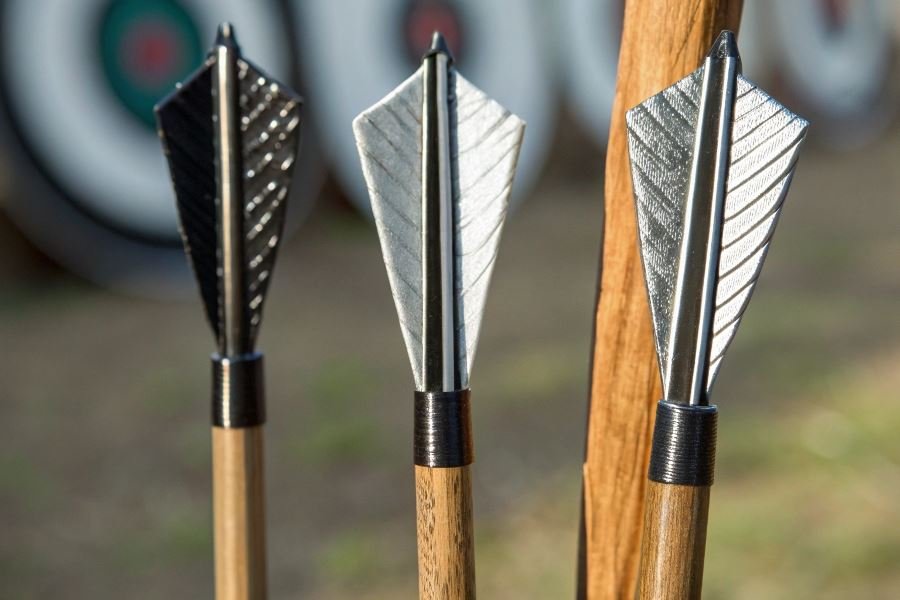
Ever wondered why Olympic archers obsess over those colorful plastic vanes on their arrows? Or why traditional bowhunters spend hours meticulously attaching turkey feathers to their shafts? The difference between hitting your target or missing by a mile often comes down to those seemingly insignificant fletches.
Feathering—the strategic attachment of stabilizing materials to an arrow’s rear—transforms an ordinary projectile into a precision instrument. Since Paleolithic hunters first attached bird feathers to their arrows around 23,000 BCE, this critical technology has evolved alongside human ingenuity. Native American tribes perfected split-feather techniques using sinew bindings, while medieval European fletchers developed specialized guild knowledge around optimal feather placement.
The magic of arrow feathering lies in basic aerodynamics. As an arrow flies, air pressure creates forces that would naturally cause it to tumble chaotically. Properly positioned fletches create drag at the rear, generating a stabilizing effect similar to how tail fins work on aircraft. This controlled resistance transforms erratic movement into predictable flight paths.
Three key components determine feathering effectiveness:
- Fletch material – From traditional turkey feathers to modern plastic vanes
- Configuration – The number, size, and spacing of fletches
- Helical orientation – The degree of twist that imparts spin
When these elements work in harmony, they create the perfect balance between stability and speed. Too much feathering creates excessive drag, reducing distance. Too little leaves the arrow vulnerable to wind drift and instability. Finding that sweet spot is where the science meets the art of archery.
Optimizing Arrow Feathering: The Science Behind Perfect Flight
When an arrow leaves your bow, its journey is a complex dance of physics and aerodynamics. The feathering of arrows: influence on accuracy and flight distance becomes immediately apparent as those small vanes at the back end make all the difference between hitting your target or missing by a mile. Let’s dive into the technical factors that can transform your archery game through proper fletching optimization.
Natural vs Synthetic Feather Materials
The debate between traditional and modern materials continues to divide archers worldwide:
Natural turkey feathers offer unmatched aesthetics and a traditional feel. They compress when passing through arrow rests, making them forgiving for traditional shooters. However, they’re susceptible to moisture damage and require more maintenance.
Synthetic vanes (typically made from plastic polymers) deliver consistent performance in all weather conditions. They’re virtually indestructible compared to natural feathers and maintain their shape through thousands of shots.
The material choice ultimately affects arrow drag, recovery speed, and durability in varying shooting environments.
| Material Type | Weather Resistance | Durability | Weight | Noise Level |
|---|---|---|---|---|
| Turkey Feathers | Poor | Moderate | Lighter | Quieter |
| Plastic Vanes | Excellent | High | Heavier | Louder |
| Mylar Vanes | Good | Moderate | Lightest | Moderate |
Configuration Factors That Determine Flight
The number, size, shape, and placement of fletching dramatically influence arrow performance:
Number of vanes: Traditional fletching uses three vanes, but some target archers prefer four smaller vanes for increased stability at the cost of some speed. Hunting setups typically stick with three vanes for optimal clearance.
Size considerations: Larger vanes (3+ inches) provide more stability but increase drag. Smaller vanes (under 2 inches) maximize speed but offer less correction for imperfect releases.
Shape matters: Shield-cut vanes provide excellent all-around performance, while parabolic shapes excel in crosswinds. Low-profile vanes minimize drag for maximum distance.
Placement precision: The spacing between vanes and their distance from the nock affects clearance and stabilization. Even 1/16-inch variations can impact groupings at distance.
Helical Patterns and Stabilization
The rotation of your arrow provides gyroscopic stability similar to a football spiral:
Straight fletching creates minimal drag but provides less correction for archer error.
Offset fletching introduces a slight angle without curving the vane, offering a middle-ground approach.
Helical fletching (right or left) creates maximum rotation and stability but reduces overall distance due to increased drag. Most compound bow hunters prefer a 2-3° right helical for broadhead accuracy.
The degree of helical twist directly correlates with stabilization power – more twist equals more correction but less distance.
Vane Dimensions for Different Conditions
The profile of your vanes should match your shooting environment:
Height considerations: Taller vanes (over 0.5 inches) catch more air for faster stabilization but create more drag. Low-profile vanes excel in windy conditions.
Length factors: Longer vanes (3+ inches) provide more steering surface but add weight to the rear of the arrow. Short vanes allow for faster arrow speeds.
Profile engineering: Modern vanes feature airfoil designs that reduce turbulence while maintaining steering capability. AAE Archery and Bohning Archery offer specialized profiles for different shooting disciplines.
The perfect fletching setup represents a calculated compromise between stability and speed. By understanding these technical factors, you can customize your arrows for your specific shooting style, equipment, and intended use – whether that’s punching paper at 90 meters or taking ethical hunting shots in variable conditions.
Practical Applications for Perfect Arrow Feathering
Target archery vs hunting feathering
The archery range and the hunting field demand fundamentally different approaches to arrow feathering. In target archery, consistency reigns supreme. Most competitive archers opt for low-profile, 2-inch plastic vanes in bright colors that slice through air with minimal drag. The AAE Max Stealth vanes have dominated Olympic competitions since their introduction in 2016, offering the perfect balance of stability without sacrificing speed.
For hunters, stealth and penetration power take priority. Larger 4-5 inch feathers, often in natural materials or muted colors, provide the stabilizing force needed when shooting broadheads. The additional surface area creates more drag, slowing arrows slightly but dramatically improving accuracy at hunting distances (typically under 40 yards).
The difference between target and hunting feathers isn’t just cosmetic—it’s the difference between winning gold and going home empty-handed from the field.
Matching feathers to your setup
Your bow’s personality should dictate your feathering choices. High-poundage compound bows (60+ pounds) can effectively push arrows with larger, more aggressive helical fletching patterns. The Blazer Vanes by Bohning have become the gold standard for compound shooters, offering remarkable durability and steering capability despite their compact 2-inch profile.
Traditional recurve and longbow shooters benefit from longer feathers that provide more correction for these less center-shot designs:
| Bow Type | Recommended Feather Length | Ideal Helical Offset |
|---|---|---|
| Compound | 2-3 inches | 2-3 degrees |
| Recurve | 3-4 inches | 3-5 degrees |
| Longbow | 4-5 inches | 5-7 degrees |
| Crossbow | 1.5-2 inches | 2-3 degrees |
Draw weight also plays a crucial role—lighter bows (under 40 pounds) need more aggressive fletching to stabilize arrows effectively, while heavier bows can often get away with more streamlined options.
Weather-proofing your fletching game
Environmental conditions can transform a perfectly tuned arrow into an unpredictable projectile. In windy conditions, lower-profile vanes suffer less drift, making them preferable for open-field shooting. However, when shooting in rain or high humidity, natural feathers can absorb moisture and become less effective—synthetic vanes from AAE or Flex-Fletch maintain consistent performance regardless of weather.
For archers in variable climates, having multiple arrow sets with different fletching configurations isn’t just smart—it’s essential for year-round consistency.
Maintenance and troubleshooting
Even the perfect fletching job will eventually require maintenance. The most common issues include:
- Feather separation: Usually caused by impact damage or adhesive failure. Re-gluing with a quality fletching adhesive like Fletch-Tite Platinum can extend arrow life.
- Warping: Natural feathers can warp with humidity changes. Steaming them gently can restore their original shape.
- Inconsistent grouping: Often indicates that one or more arrows has damaged fletching that isn’t immediately visible. Spin-testing arrows can identify these problems before they cost you points.
Pro tip: Rotate arrows in your quiver regularly to distribute wear evenly across your set, and inspect fletching before every serious practice session or competition.
The difference between adequate and exceptional arrow flight often comes down to these seemingly small fletching details—but in archery, details are everything.