
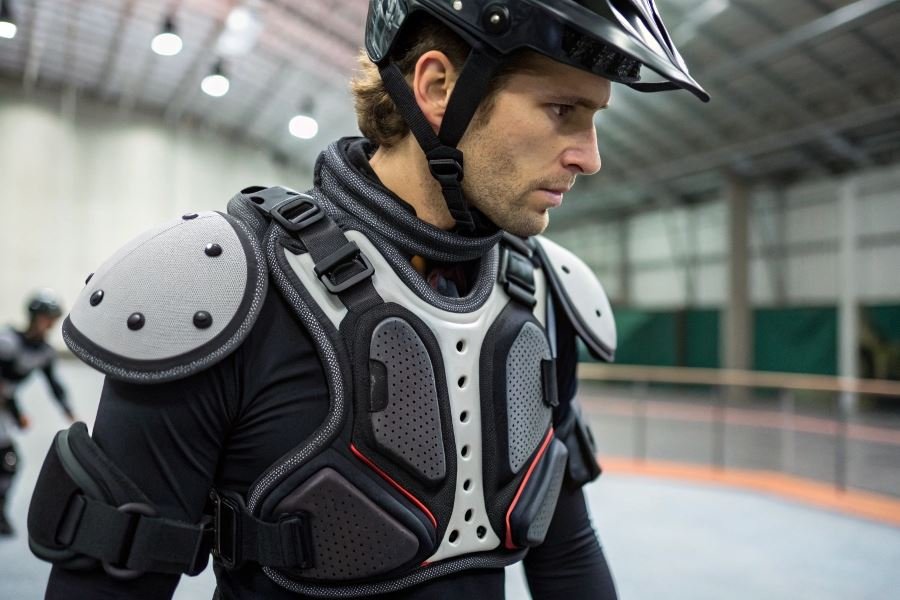
Ever watched a mountain biker crash, only to hear that sickening crack of a broken collarbone? That distinctive sound has ended seasons for countless athletes. Your clavicle—that slender, S-shaped bone connecting your sternum to your shoulder—is among the most frequently fractured bones in the human body, with over 200,000 breaks annually in the United States alone.
Proper clavicle protection isn’t just equipment—it’s insurance for your active lifestyle. Whether you’re bombing downhill trails, taking hits on the football field, or racing motorcycles, the right-sized protection creates that critical barrier between vulnerable bone and unforgiving ground.
The anatomy of vulnerability
Your collarbone sits precariously close to the skin with minimal muscle coverage—essentially nature’s equivalent of hanging a “break me first” sign on your upper body. During falls, your natural instinct to extend your arm transfers impact force directly to this vulnerable area.
“The clavicle absorbs up to 80% of the force when you fall on an outstretched hand. Without proper protection, you’re essentially playing injury roulette.” — Sports Medicine Journal
Sizing misconceptions that lead to injuries
Many athletes make the critical mistake of choosing oversized protectors, believing “more coverage equals more protection.” In reality, ill-fitting gear shifts during impact, leaving vulnerable areas exposed precisely when protection matters most. Others select undersized options for mobility, sacrificing critical coverage zones.
The perfect clavicle protector moves with you, not against you—becoming an extension of your body rather than a restrictive afterthought. Finding this balance starts with understanding proper sizing techniques that we’ll explore next.
Getting Your Clavicle Protection Measurements Right
When it comes to protecting your collarbone on the field or track, precision isn’t just preferred—it’s essential. Ill-fitting clavicle protection can leave you vulnerable exactly where you need coverage most, or restrict your movement when you need to perform. Let’s dive into the measurement process that ensures your gear works as hard as you do.
Finding the perfect fit for clavicle protection requires attention to detail and an understanding of your body’s unique proportions. The process of how to properly choose the size of clavicle protection starts with accurate measurements and ends with confidence in your equipment. Many athletes make the mistake of eyeballing their size or simply accepting whatever’s available, but this approach can compromise both protection and performance.
Measuring Chest Circumference: The Foundation
Your chest measurement forms the baseline for selecting appropriate clavicle protection. Here’s how to nail it:
- Stand naturally with arms slightly away from your sides
- Wrap a soft measuring tape around the fullest part of your chest
- Ensure the tape is parallel to the floor all the way around
- Take a normal breath and measure at mid-breath
- Record the measurement in inches for most North American sizing charts
Pro tip: Have someone help you measure for the most accurate results. If measuring solo, use a mirror to verify the tape position.
Shoulder Width and Clavicle Length Assessment
The protection that sits perfectly across your shoulders provides optimal coverage without restricting movement:
- For shoulder width, measure from the outer edge of one shoulder to the other
- For clavicle length, measure from the sternoclavicular joint (where your collarbone meets your sternum) to the acromioclavicular joint (the outer edge of your shoulder)
Remember that asymmetry is normal—many athletes have slight differences between left and right measurements. When in doubt, size for your larger side.
Accounting for Additional Gear
Your clavicle protection doesn’t exist in isolation—it needs to work harmoniously with your other equipment:
| Underlying Gear | Adjustment Needed |
|---|---|
| Compression shirt | Add 0.25-0.5 inches |
| Padded undershirt | Add 0.5-1 inch |
| Shoulder pads | Choose compatible clavicle protection |
| Nothing | Use exact measurements |
When wearing your Under Armour compression gear or other base layers, you’ll need to account for the additional bulk. Most manufacturers of quality protection like Shock Doctor provide sizing charts that factor in common gear combinations.
The Fit Test
Once you’ve selected protection based on your measurements:
- Put on all underlying gear you’d typically wear
- Apply the clavicle protection as directed
- Test range of motion in all directions
- Check for pressure points or gaps in coverage
- Ensure breathing isn’t restricted
The perfect fit should feel secure without pinching, allow full range of motion, and cover the vulnerable areas of your clavicles completely.
By taking these essential measurements and considering how your clavicle protection integrates with your other gear, you’re setting yourself up for maximum protection without compromising performance. Your collarbone will thank you—especially when you take that unexpected hit and walk away unscathed.
Sealing the Deal on Clavicle Protection Sizing
Finding the perfect clavicle protector isn’t just about brand preference or price point—it’s about securing that Goldilocks fit that feels like it was made specifically for your body. Let’s dive into those final crucial considerations that separate adequate protection from exceptional safety gear.
The Irreplaceable Try-Before-Buy Experience
There’s simply no substitute for physically trying on clavicle protection before making your purchase. While online shopping offers convenience, visiting specialty sporting goods stores provides tangible benefits:
- Immediate feedback on comfort across different positions
- Real-time adjustments with expert assistance
- Opportunity to compare multiple models simultaneously
Many retailers now offer dedicated fitting areas where you can simulate sport-specific movements. This hands-on approach has proven particularly valuable for athletes recovering from previous injuries, where proper fit directly impacts healing and confidence.
“The difference between a properly fitted clavicle protector and one that’s slightly off can mean the difference between playing with confidence and playing with constant distraction.”
Adjustability Features Worth Their Weight in Gold
The most versatile clavicle protectors incorporate multiple adjustment points that accommodate your unique physiology:
Multi-point adjustment systems allow for personalization beyond basic sizing charts. Look for:
| Adjustment Feature | Benefit | Priority Level |
|---|---|---|
| Telescoping straps | Accommodates different torso lengths | Essential |
| Lateral width adjusters | Customizes shoulder coverage | High |
| Tension control systems | Balances protection with mobility | Medium-High |
| Quick-release mechanisms | Facilitates easy removal when needed | Medium |
The evolution of adjustment technology has been remarkable since the rigid designs of the early 2000s. Today’s premium protectors from brands like McDavid and Shock Doctor feature micro-adjustment capabilities that weren’t available even five years ago.
When Custom Is the Only Answer
For some athletes, standard sizing simply won’t deliver optimal protection. Consider custom options when:
- You fall between standard sizes consistently
- You have anatomical variations that affect standard fit
- You’re competing at elite levels where marginal improvements matter
- You’re returning from a significant clavicle injury
Custom protection typically costs 30-50% more than off-the-shelf options, but this investment often pays dividends in longevity and effectiveness. Many professional teams work with specialized equipment manufacturers to create bespoke protection for their athletes.
The custom fitting process typically involves digital body mapping or physical casting to create a protection solution that mirrors your exact specifications. While this approach requires more time (usually 2-3 weeks for production), the resulting protection offers unparalleled security and comfort.
Remember that even the most perfectly sized clavicle protection requires periodic reassessment. Your body changes over time, and equipment gradually breaks in. Schedule regular fit checks, especially before high-stakes competitions or following any significant changes in your physical condition.