
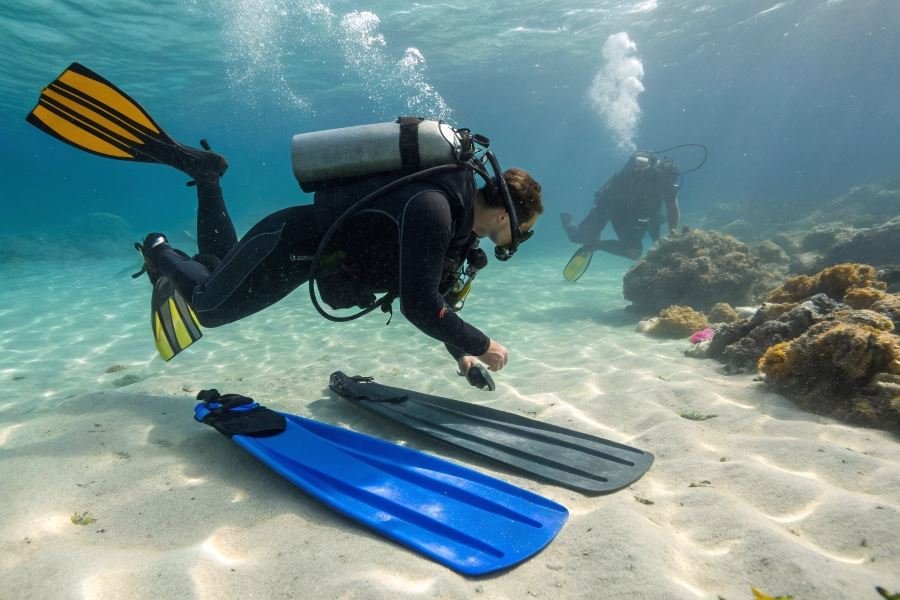
Ever wondered why some divers replace their buoyancy compensator devices (BCDs) every few years while others enjoy the same equipment for a decade or more? The difference isn’t luck—it’s maintenance. A properly maintained BC doesn’t just last longer; it could literally save your life 200 feet below the surface.
When selecting your next buoyancy compensator, understanding its maintenance requirements isn’t just a footnote—it’s a crucial factor that affects both your wallet and safety underwater. Think of your BC as the aquatic equivalent of a parachute: when you need it to work, you really need it to work.
The performance-maintenance connection
Your BC’s ability to provide precise buoyancy control deteriorates with neglect. Salt crystals silently corrode internal valves, bacteria colonize damp bladders, and O-rings gradually harden and crack. Regular maintenance doesn’t just extend your BC’s lifespan—it ensures consistent performance when you need it most.
Maintenance considerations before purchase
Different BC designs demand different maintenance commitments:
- Wing-style BCs typically have fewer moving parts but require thorough internal rinsing
- Jacket-style BCs often feature more pockets and attachment points that can trap salt and debris
- Hybrid designs may offer innovative features that require specialized servicing
Critical components requiring attention
Three areas demand your vigilance:
- Inflator mechanisms – The most failure-prone component, requiring annual professional inspection
- Bladder integrity – Microscopic leaks can develop over time, compromising buoyancy control
- Dump valves – These safety features need regular cleaning to prevent sticking or failure
Remember: the most feature-rich BC becomes worthless underwater if poorly maintained. Choose a model that balances your diving needs with your willingness to perform regular maintenance.
Keeping Your BC in Prime Condition
Your buoyancy compensator device (BCD) isn’t just another piece of dive gear—it’s your underwater life support system. The difference between a well-maintained BC and a neglected one can literally be the difference between an exhilarating dive and a dangerous situation. Understanding the maintenance and servicing of buoyancy compensators: what you need to know before buying will save you headaches, money, and potentially dangerous situations down the road.
Rinse, Dry, Repeat: Daily BC Care
After every dive—especially in saltwater—your BC needs immediate attention. Salt crystals are microscopic dive gear assassins that will corrode metal components and degrade fabrics over time.
The post-dive rinse ritual should be non-negotiable:
- Disconnect your low-pressure inflator hose
- Press the oral inflator button while holding the BC upside down under fresh water
- Fill the bladder partially with fresh water through the oral inflator
- Shake vigorously to distribute water throughout internal chambers
- Drain completely by pressing both dump valves
- Repeat 2-3 times until water runs clear
Proper drying is equally crucial. Never store a damp BC—that’s an engraved invitation for mold and mildew. Hang it partially inflated in a shaded, well-ventilated area away from direct sunlight, which can degrade materials and fade colors.
For storage between dive seasons, keep your BC partially inflated to prevent the bladder walls from sticking together. Store in a cool, dry place away from sharp objects, excessive heat, and chemical exposure.
Annual Professional Servicing: The Deep Dive
Even with religious daily maintenance, your BC requires professional attention annually. Professional servicing typically includes:
- Complete disassembly and inspection of all components
- Replacement of worn O-rings and valve seats
- Pressure testing of the bladder and inflation mechanisms
- Lubrication of moving parts with dive-safe lubricants
- Thorough cleaning of internal bladders unreachable during normal rinsing
The cost for professional servicing ranges from $75-150 depending on your BC model and dive shop rates. While this might seem steep, it’s significantly cheaper than replacing a $400-800 Scubapro or Aqualung BC prematurely.
DIY vs. Pro: Know Your Limits
| Maintenance Task | DIY Safe? | Frequency | Tools Required |
|---|---|---|---|
| External rinsing | Yes | After every dive | Fresh water |
| Internal bladder rinse | Yes | After every dive | Fresh water |
| Visual inspection | Yes | Before every dive | None |
| O-ring replacement | Sometimes | As needed | O-ring kit |
| Valve servicing | No | Annually | Specialized tools |
| Bladder repair | No | As needed | Specialized tools |
While daily maintenance falls squarely in the DIY category, there’s a clear line where amateur efforts should stop and professional expertise begins. You can safely handle external cleaning, visual inspections, and basic care, but internal mechanisms require specialized knowledge.
Warning signs that demand professional attention include:
- Air leaks from any valve or seam
- Sticky or difficult inflation/deflation mechanisms
- Visible damage to bladder material
- Corroded metal components
- Cracked plastic parts
Remember that your BC is part of your life support equipment. When in doubt, defer to professionals. The Divers Alert Network recommends professional servicing before using any BC that’s been stored for more than six months.
By establishing a consistent maintenance routine and respecting the need for professional servicing, you’ll extend your BC’s lifespan significantly—turning what could be a three-year investment into a decade-long diving companion.
Making the Smart BC Investment: Maintenance Factors That Matter
When you’re about to drop several hundred dollars on a buoyancy compensator, the purchase price is just the beginning of your relationship with this critical piece of dive gear. The savviest divers know that long-term maintenance considerations can make or break your BC experience. Let’s dive into what separates a maintenance nightmare from a keeper.
Warranty warriors and service heroes
The difference between a good manufacturer and a great one often comes down to their after-sale support. Scubapro and Aqualung have built reputations on robust warranty programs that typically cover material and workmanship defects for limited periods, with some premium models offering lifetime warranties on specific components.
The gold standard isn’t just length—it’s accessibility. A lifetime warranty means nothing if you’re required to ship your BC across the country for every minor issue.
What truly matters is the service network. Mares maintains over 200 authorized service centers in North America alone, while some boutique brands might have just a handful. Before purchasing, map the nearest authorized service centers for your shortlisted brands—you’ll thank yourself during your next pre-dive emergency.
The maintenance spectrum across designs
Not all BCs are created equal when it comes to maintenance requirements:
| BC Type | Maintenance Frequency | DIY Friendly? | Average Annual Maintenance Cost |
|---|---|---|---|
| Back-inflation | Annual professional service | Moderate | $50-75 |
| Jacket-style | Annual professional service | High | $40-60 |
| Wing systems | Bi-annual professional service | Low | $75-100 |
| Hybrid designs | Annual professional service | Moderate | $60-80 |
Jacket-style BCs from Cressi typically feature simpler designs with fewer moving parts, making them more DIY-friendly for basic maintenance. Contrast this with technical wing systems from Halcyon, which offer superior buoyancy control but often require specialized knowledge for proper servicing.
The accessibility of the inflator mechanism varies dramatically between models. Some designs allow for quick field disassembly with basic tools, while others require specialized equipment to access internal components.
The long game: ownership beyond the honeymoon
The true test of a BC purchase comes years down the road when parts availability becomes crucial. Industry veterans know that standardized parts are worth their weight in gold.
Parts availability timelines vary significantly between manufacturers:
- Industry leaders (Aqualung, Scubapro): Typically maintain parts availability for 7-10 years after model discontinuation
- Mid-tier manufacturers: Usually 5-7 years of parts support
- Budget brands: Often as little as 3-5 years before parts become unavailable
This becomes particularly important with proprietary components. When Oceanic introduced their patented BioFlex bladder material in 2012, it revolutionized comfort—but created a replacement challenge for early adopters as the technology evolved.
Consider also the modularity factor. Hollis and DiveRite have embraced modular designs where components can be individually replaced rather than requiring complete system overhauls.
The smartest BC investment balances initial cost against these long-term factors. A BC that costs $100 less upfront but requires specialized servicing or has poor parts availability can easily become the more expensive option over its lifespan. Your perfect BC isn’t just the one that fits today—it’s the one that will still be serving you reliably on your 500th dive.