
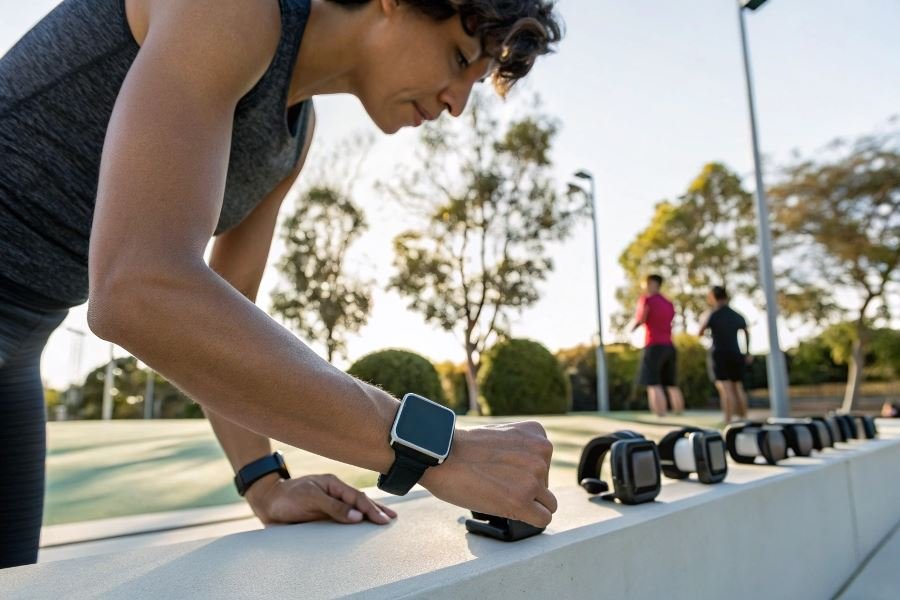
Your heart beats 100,000 times daily. Are you tracking each one that matters?
When Olympic gold medalist Katie Ledecky shaved seconds off her personal best in 2016, her training secret wasn’t just in the pool—it was strapped to her wrist. Elite athletes have long understood what fitness enthusiasts are now discovering: precise heart rate monitoring transforms random exercise into strategic training. The difference between plateauing and breaking through often lies in understanding your cardiac response during different intensity zones.
Heart rate monitors have undergone a remarkable evolution since the clunky chest straps of the 1980s. Today’s technology spans from basic $30 fingertip pulse readers to sophisticated $500+ multisport watches that track everything from sleep quality to running dynamics. The optical sensor technology that once required medical-grade equipment now fits comfortably on your wrist, delivering accuracy that rivals clinical standards.
The health-fitness connection
Your heart rate isn’t just a fitness metric—it’s a vital health indicator. Resting heart rate can signal cardiovascular health improvements, while recovery rates offer insights into overall fitness levels. Modern monitors don’t just count beats; they interpret them, transforming raw data into actionable training guidance.
Technology that transforms training
The technological leap in heart rate monitoring has been extraordinary. Early monitors simply displayed beats per minute, while today’s advanced models offer:
- Real-time zone alerts that vibrate when you’re training too hard or not hard enough
- Continuous tracking that identifies anomalies that might indicate health concerns
- Recovery time calculations based on workout intensity and personal fitness level
Choosing your perfect match
When comparing heart rate monitors across price categories, consider these critical factors:
| Feature | Budget ($30-100) | Mid-range ($100-250) | Premium ($250+) |
|---|---|---|---|
| Accuracy | Basic | Good | Excellent |
| Battery life | 1-7 days | 7-14 days | 14+ days |
| Data analysis | Minimal | Moderate | Comprehensive |
| Connectivity | Limited | Bluetooth/ANT+ | Multiple protocols |
The right monitor aligns with both your fitness goals and technological comfort level. Whether you’re tracking morning jogs or training for ultramarathons, understanding these differences ensures your investment delivers meaningful insights rather than just another number on your wrist.
Finding Your Perfect Beat: Heart Rate Monitors Across Price Points
When tracking your fitness journey, heart rate data provides the roadmap to progress. The market offers a staggering array of options, with price points that reflect vastly different capabilities. Let’s dive into what separates a basic tracker from a cardiac command center.
The comparison of heart rate monitors of different price categories reveals not just price gaps but fundamental differences in accuracy, durability, and functionality that can make or break your training goals. Whether you’re a weekend warrior or preparing for your tenth marathon, understanding these distinctions helps you invest wisely.
Entry-level champions (30−100)
These budget-friendly options deliver the essentials without emptying your wallet. Most use optical sensors that measure blood flow through your wrist to calculate heart rate.
Key features typically include:
- Basic heart rate tracking during activity
- Simple zone notifications
- Battery life ranging from 5-7 days
- Water resistance (not full waterproofing)
- Smartphone connectivity for data review
The Wahoo TICKR FIT and Polar H9 represent the higher end of this bracket, offering reliability that punches above their price class. The H9 uses chest strap technology, delivering accuracy comparable to devices twice its price.
Limitations become apparent during high-intensity intervals or when ambient temperatures affect blood flow to extremities.
Mid-range marvels (100−250)
This sweet spot balances advanced features with reasonable investment, making these monitors ideal for dedicated fitness enthusiasts.
| Feature | Entry-level | Mid-range |
|---|---|---|
| Accuracy | ±5-10 BPM | ±2-3 BPM |
| Battery life | 5-7 days | 7-14 days |
| Data metrics | Basic HR, calories | HR, HRV, VO2 max estimates |
| Training analysis | Minimal | Detailed recovery metrics |
The Garmin Forerunner 55 and Polar Ignite 2 exemplify this category’s strengths. They introduce training load monitoring, sleep quality analysis, and recovery recommendations based on heart rate variability (HRV).
Game-changing mid-range features:
- Continuous heart rate monitoring 24/7
- Stress tracking based on HRV
- Guided breathing exercises
- Advanced sleep stage analysis
- Customizable training zones
Premium powerhouses ($250+)
For those who treat data like oxygen, premium monitors deliver laboratory-grade insights.
The Apple Watch Ultra and Garmin Fenix 7 represent the pinnacle of consumer heart monitoring technology. These devices don’t just track—they interpret, predict, and guide.
What justifies the premium price tag? Precision that approaches medical-grade monitoring.
Premium monitors offer:
- Multi-LED array sensors for unprecedented accuracy
- ECG capabilities for rhythm abnormality detection
- Blood oxygen saturation monitoring
- Altitude acclimation guidance
- Recovery time predictions based on complex algorithms
- Training effect calculations (aerobic and anaerobic)
- Dual-frequency GPS for precise pace calculations
The cutting edge: The latest premium models incorporate machine learning to detect patterns in your heart rate data, identifying potential overtraining before symptoms appear.
Your choice ultimately depends on your fitness goals and data needs. Entry-level monitors serve casual exercisers perfectly, while serious athletes and data enthusiasts will find the premium features indispensable for optimizing performance and recovery.
Finding Your Perfect Heart Rate Monitor Match
Aligning Features With Your Fitness Journey
The heart rate monitor that transforms your training isn’t necessarily the most expensive—it’s the one that speaks directly to your fitness language. Marathon runners need different data than CrossFit enthusiasts or weekend warriors tracking their recovery.
For endurance athletes, prioritize devices with exceptional battery life and detailed metrics like VO2 max and recovery time. The Garmin Forerunner 955 delivers up to 15 days of battery life and training readiness scores that help prevent overtraining.
If strength training dominates your routine, look for monitors that track heart rate variability (HRV) and offer rep counting. The WHOOP 4.0 excels here, providing strain scores that quantify workout intensity regardless of movement type.
For casual fitness enthusiasts, user-friendly interfaces and basic metrics might suffice. The Fitbit Charge 6 balances accessibility with enough data to guide improvement without overwhelming you.
The best heart rate monitor isn’t the one with the most features—it’s the one you’ll actually use consistently.
Investment Value Beyond The Price Tag
When evaluating heart rate monitors across price categories, consider the total cost of ownership rather than just the initial purchase:
| Price Category | Initial Cost | Subscription Fees | Expected Lifespan | Total 3-Year Cost |
|---|---|---|---|---|
| Budget | $50-100 | Usually none | 1-2 years | $50-200 |
| Mid-range | $150-250 | Sometimes ($5-10/month) | 2-3 years | $150-610 |
| Premium | $300-500+ | Often ($10-40/month) | 3-5 years | $300-1940 |
Premium devices typically offer firmware updates that add new features over time, effectively giving you a “new” device periodically. The Apple Watch Ultra 2 received significant running metrics updates in 2023, adding value long after purchase.
Consider also the ecosystem compatibility—devices that integrate with your existing apps and equipment provide additional value by centralizing your fitness data.
Top Performers For Every Budget
After testing dozens of heart rate monitors across price points, these three stand out for delivering exceptional value relative to their cost:
Best Budget Option: Polar H10 Chest Strap ($89.95)
This no-frills chest strap delivers medical-grade accuracy without breaking the bank. It connects to virtually any fitness app and offers 400 hours of battery life from a single coin cell. Perfect for data-focused athletes who don’t need a display.
Best Mid-Range Option: Coros Pace 3 ($229)
This GPS watch delivers premium features at a mid-range price point with no subscription fees. With 38-hour GPS battery life, running power metrics, and multisport tracking, it outperforms watches costing twice as much.
Best Premium Option: Garmin Fenix 7 ($699)
For serious athletes tracking multiple activities, the Fenix 7’s comprehensive metrics, mapping capabilities, and 18-day battery life justify its premium price. Its sapphire crystal display and titanium construction ensure it will outlast cheaper alternatives by years.
The right heart rate monitor transforms raw data into actionable insights that improve performance. By matching features to your specific needs and considering long-term value, you’ll find a monitor that becomes an indispensable training partner—regardless of price category.