
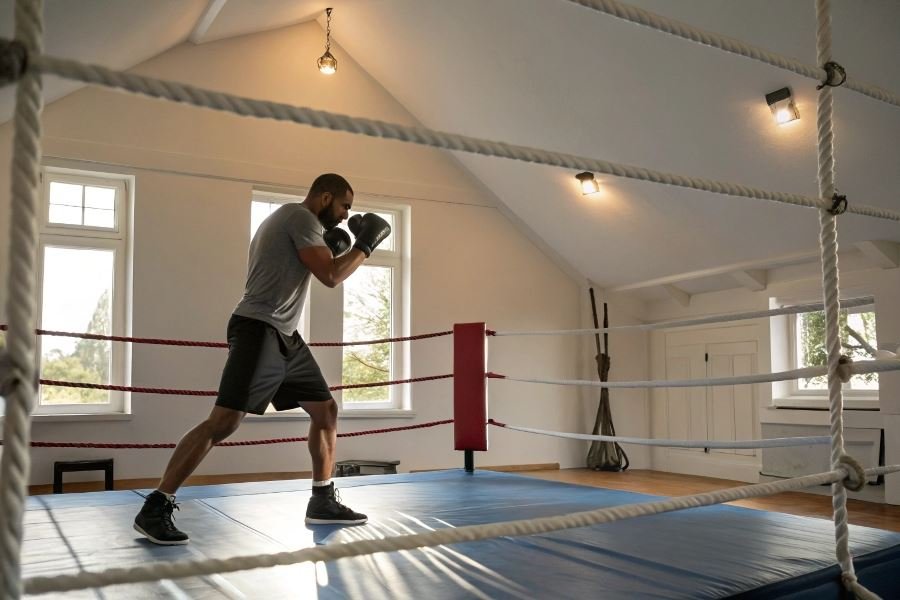
Ever watched a professional boxer dance around the ring with lightning-fast footwork and wondered if you could capture that same magic at home? The difference between shadow boxing in your living room and training in a proper ring isn’t just aesthetic—it’s transformative.
When serious boxers talk about their “office,” they’re referring to the ring—those sacred squared circles where legends are made. Having your own boxing ring at home isn’t just a luxury; it’s a commitment to authentic training that develops proper technique, footwork, and spatial awareness that simply can’t be replicated elsewhere.
Selecting the right home boxing ring involves navigating several crucial factors. Size matters tremendously—a regulation ring measures 16-20 feet inside the ropes, but most homes accommodate smaller 12-14 foot versions. The flooring system is equally critical; professional-grade canvas over foam padding provides the ideal balance of stability and shock absorption to protect your joints during those high-intensity sessions.
The benefits extend far beyond the physical. A dedicated home ring creates a psychological boundary between everyday life and training mode. Step through those ropes, and you’re no longer in your basement or garage—you’re in your arena. This mental shift intensifies focus and commitment, turning casual workouts into purposeful training sessions.
Beyond solo practice, a home ring transforms social workouts. Invite training partners over for sparring sessions that build community while developing skills that simply can’t be honed hitting a bag alone.
Essential Factors for Your Home Boxing Ring
Setting up a boxing ring at home transforms your training experience from casual to professional-grade. The right ring creates an authentic environment where footwork, ring awareness, and technique can flourish. When selecting a boxing ring for home training, several critical factors determine whether your investment will enhance your training or become an expensive disappointment.
Space planning comes first in how to choose a boxing ring for home training. Before falling in love with a specific model, grab a measuring tape and assess your available area. Remember to account for clearance space around the ring—you’ll need at least 2-3 feet of buffer zone on all sides for safety and accessibility. Ceiling height is equally crucial; ensure you have a minimum of 8 feet clearance to accommodate jumping, movement, and potential installation of overhead lighting.
Size options that make sense for homes
Standard professional rings measure 16×16 to 20×20 feet, but most home environments benefit from more compact options:
| Ring Size | Training Capability | Ideal For |
|---|---|---|
| 12×12 ft | Solo training, pad work | Small spaces, beginners |
| 14×14 ft | Limited sparring, technique work | Intermediate boxers |
| 16×16 ft | Full movement, proper sparring | Serious enthusiasts |
The sweet spot for most home gyms is 14×14 feet, offering enough space for meaningful training without consuming your entire available area. Anything smaller restricts movement too severely, while larger rings may overwhelm residential spaces.
Construction that stands up to punishment
Ring durability directly correlates with construction materials. Look for:
- Steel framework with at least 2-inch diameter posts
- Galvanized or powder-coated finishes to prevent rust
- Corner connections with reinforced brackets, not simple welds
- Rope tension systems that maintain proper boundary definition
Ringside and Title Boxing offer home-friendly models with commercial-grade construction that withstand years of training without compromise.
Safety underfoot
The flooring system might be the most critical safety component of your ring. Professional-grade rings feature:
The padding beneath your feet determines whether you bounce back from a fall or end up injured. Never compromise on floor quality.
A proper floor system includes:
- Base layer of 3/4-inch plywood for structural support
- Middle layer of high-density foam (at least 1.5 inches)
- Top canvas layer with proper tension and secure attachment
Zebra Mats produces excellent boxing-specific flooring that balances cushioning with stability—essential for footwork development.
Installation realities
Even the most perfectly sized ring becomes a burden if assembly proves impossible. Consider:
- Modular designs that allow piece-by-piece assembly through standard doorways
- Weight of components (some posts exceed 50 pounds each)
- Need for specialized tools or multiple helpers
- Permanent versus temporary installation options
Most home rings require 4-8 hours for initial assembly. ProBoxing Supplies offers excellent video tutorials for their home models, making the process significantly more manageable.
By prioritizing these essential factors, your home boxing ring will deliver professional-quality training without compromising your space or safety. The right ring doesn’t just sit in your home—it transforms it into a legitimate training facility.
Top 3 Boxing Ring Styles for Home Training
Let’s face it—nothing transforms a home gym quite like a boxing ring. It’s not just equipment; it’s the centerpiece that turns casual workouts into professional-grade training sessions. But which style fits your space and training needs? Let’s break down the three main contenders that are dominating home setups in 2025.
Freestanding rings that pack a punch
Freestanding boxing rings are the gold standard for serious home trainers. These standalone structures don’t require wall attachments, making them perfect for dedicated training spaces like garages or basements.
The heavyweight advantages:
- Complete 360° movement around the ring
- Professional feel with proper ropes and turnbuckles
- Stability that mimics commercial gym rings
A quality freestanding ring like the Ringside Elite typically measures between 12×12 and 16×16 feet, with proper canvas flooring and tension ropes. The padding underneath—usually 1-2 inches of high-density foam—provides crucial impact absorption during footwork drills.
The catch? You’ll need approximately 20×20 feet of clear space to accommodate the ring plus movement area around it.
| Feature | Specification | Why It Matters |
|---|---|---|
| Platform Height | 16-24 inches | Higher platforms improve visibility and stance training |
| Rope Tension | Adjustable | Customizable bounce for different training styles |
| Canvas Material | 18oz vinyl-coated | Durability and proper foot traction |
Wall-mounted and corner solutions for space wizards
When square footage is at a premium but you refuse to compromise on training quality, wall-mounted and corner boxing rings deliver impressive functionality.
Space-saving brilliance:
- Utilizes existing wall structure for support
- Typically extends only 8-12 feet from the wall
- Can be installed in corners to maximize unused space
The Title Boxing Corner Unit exemplifies this category with its L-shaped design that fits snugly into room corners. These setups typically feature 2-3 sides of ropes with the wall serving as the “fourth rope.”
Most wall-mounted options can be installed with standard mounting hardware, though reinforcement is recommended for drywall installations.
Portable and collapsible rings for training nomads
The newest innovation in home boxing is the portable ring—perfect for trainers who need flexibility or have multi-purpose spaces.
Flexibility champions:
- Setup and breakdown in under 30 minutes
- Storage footprint as small as 4×4 feet when collapsed
- Transportable for outdoor training sessions
Modern portable rings like the Everlast Omniflex use aircraft-grade aluminum frames that weigh under 200 pounds total yet support full training sessions. The canvas platforms typically attach with industrial-strength velcro and tension systems.
Pro tip: Look for quick-release mechanisms on the rope connectors—they’re game-changers when you’re setting up solo.
| Ring Type | Setup Time | Weight Capacity | Price Range |
|---|---|---|---|
| Freestanding | Permanent | 800-1000 lbs | $1,500-3,000 |
| Wall-mounted | Permanent | 600-800 lbs | $800-1,500 |
| Portable | 20-30 mins | 400-600 lbs | $600-1,200 |
The best choice ultimately depends on your training style, available space, and whether you need to share that space with other activities. Whichever style you choose, a proper ring elevates home training from casual to championship-caliber.