
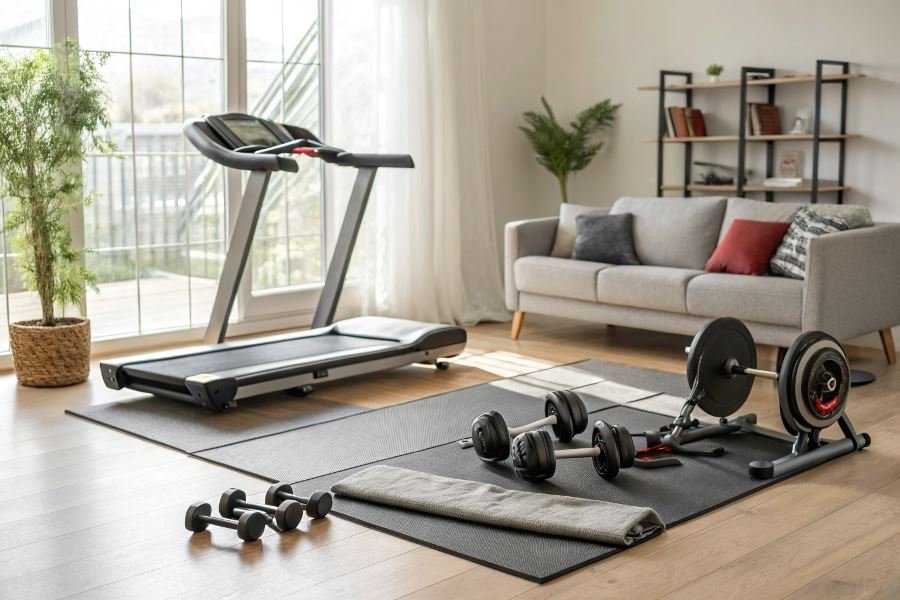
Ever stood in front of a wall of gleaming fitness machines, feeling completely overwhelmed? You’re not alone. The difference between a treadmill that becomes your trusted training partner and one that transforms into an expensive clothes rack often comes down to making informed choices before purchase.
Home fitness equipment has evolved dramatically since the basic stationary bikes of the 1980s. Today’s machines offer everything from live-streamed classes to virtual reality trails that make you forget you’re exercising in your spare bedroom. But with this evolution comes complexity in making the right selection.
Three critical factors should guide your decision: your fitness goals, available space, and budget constraints. A marathon runner needs different equipment than someone focusing on strength training. Similarly, a compact apartment demands different solutions than a dedicated home gym space.
The true power of having the right fitness machine at home extends beyond convenience:
- Consistency becomes effortless when your workout is just steps away
- Weather and scheduling obstacles vanish completely
- Privacy allows for distraction-free focus on proper form
- Long-term cost savings compared to gym memberships
Remember that the “perfect” machine isn’t necessarily the most expensive or feature-laden option—it’s the one you’ll actually use consistently. The equipment gathering dust in the corner provides zero fitness benefits, regardless of its technical specifications or price tag.
Essential Considerations for Your Home Fitness Setup
Finding the perfect fitness machine for your home isn’t just about scrolling through online catalogs and clicking “buy now.” The right equipment transforms unused corners into personal fitness sanctuaries where real progress happens. Let’s dive into what truly matters when making this investment.
Space: The Final Frontier
Your available space dictates everything. Before falling in love with that commercial-grade Peloton treadmill, grab a measuring tape and get real about your dimensions.
Minimum clearance requirements matter. Treadmills typically need about 30 square feet of dedicated space, while ellipticals require roughly 25 square feet. Rowing machines need a 9’ x 4’ footprint but can often be stored vertically when not in use.
When evaluating how to choose a fitness machine for home workouts, smart spatial planning becomes your first exercise. Consider ceiling height too—especially if you’re eyeing a treadmill with incline features or planning to position equipment in a basement with low clearance.
Equipment with folding capabilities can be lifesavers in compact spaces. Many modern treadmills from brands like NordicTrack feature hydraulic folding systems that reduce their footprint by up to 40% when not in use.
Matching Machines to Your Fitness Mission
Fitness equipment isn’t one-size-fits-all because fitness goals aren’t either.
| Fitness Goal | Recommended Equipment | Key Benefits |
|---|---|---|
| Weight Loss | Cardio machines (treadmill, elliptical) | Higher calorie burn, sustained heart rate |
| Muscle Building | Multi-gym systems, smart resistance machines | Progressive resistance, targeted muscle work |
| Endurance | Rowing machines, air bikes | Full-body engagement, cardiovascular conditioning |
| Low-Impact Fitness | Ellipticals, recumbent bikes | Joint protection, accessibility |
Be brutally honest about your fitness personality. If you hate running outdoors, a treadmill probably won’t magically change that. Choose equipment that aligns with activities you genuinely enjoy.
Consider progression pathways too. The Concept2 RowErg might seem basic compared to screen-laden alternatives, but its performance metrics and durability make it the gold standard for serious rowers from beginners to Olympians.
Budget Reality Check
Home fitness equipment represents a spectrum from $200 entry-level machines to $5,000+ commercial-grade powerhouses.
The true cost extends beyond the price tag. Factor in:
- Delivery and assembly fees (often $100-250)
- Extended warranties (typically 15-20% of purchase price)
- Maintenance costs (belt replacements, lubrication)
- Potential electrical requirements (dedicated circuits for higher-powered machines)
Value isn’t always visible in the specs. A $1,200 Sole Fitness elliptical might outperform and outlast a $2,000 model with flashier features but inferior mechanical components.
Consider the cost-per-use equation. That $3,000 Life Fitness bike might seem expensive until you calculate the three-year cost compared to gym memberships or boutique cycling classes.
Remember: The most expensive machine gathering dust has infinitely less value than a moderately priced one you actually use consistently. Choose equipment that balances quality, functionality, and your realistic commitment level.
The Ultimate Fitness Machine Showdown for Home Workouts
Let’s cut to the chase—your home gym deserves equipment that delivers results. Whether you’re looking to torch calories, build strength, or improve overall fitness, the right machine can transform your workout space from a forgotten corner into your personal performance zone.
Cardio machines that keep your heart pumping
Cardio equipment forms the backbone of most home gyms, and for good reason. These machines deliver consistent calorie-burning workouts regardless of weather or time constraints.
Treadmills remain the gold standard for cardiovascular training. Modern models from brands like NordicTrack offer everything from cushioned decks that reduce joint impact to immersive training programs that simulate global running routes. The ability to control incline and speed makes treadmills adaptable for walkers and sprinters alike.
Ellipticals provide a lower-impact alternative that engages both upper and lower body. The fluid, oval motion reduces stress on joints while still delivering an intense workout. Many users report feeling like they’re working less hard on ellipticals despite burning similar calories to treadmill workouts.
The average person burns between 270-400 calories in 30 minutes on a quality stationary bike—comparable to running without the joint stress.
Stationary bikes have experienced a renaissance thanks to connected fitness. From upright models to recumbents that support your back, these space-efficient machines offer adjustable resistance levels perfect for interval training. Bikes excel at providing consistent workouts that can be as gentle or challenging as needed.
Strength training equipment for muscle building
Building muscle requires progressive resistance—and these machines deliver exactly that.
Multi-gyms pack numerous exercises into a single footprint. These all-in-one stations typically feature press stations, leg developers, and cable systems that allow for dozens of exercises. While they require more space than other options, they eliminate the need for multiple pieces of equipment.
Free weights provide unparalleled versatility for strength training. A quality adjustable dumbbell set from Bowflex or PowerBlock can replace an entire rack of traditional dumbbells while taking up minimal space. Add a bench, and you’ve got hundreds of possible exercises.
Resistance machines target specific muscle groups with guided movements that reduce injury risk. Smith machines and cable systems allow for controlled lifting with adjustable resistance, making them ideal for both beginners and experienced lifters working out alone.
Versatile options that maximize space and results
Some equipment defies simple categorization, offering full-body workouts in compact packages.
Rowing machines deliver perhaps the most complete workout of any single piece of equipment. They engage 86% of your muscles while providing both cardiovascular and strength benefits. Modern rowers from Concept2 feature performance monitors that track everything from split times to heart rate.
Functional trainers use adjustable cable systems to create resistance from multiple angles. This versatility allows you to perform hundreds of exercises that mimic real-world movements. Their adjustability makes them suitable for users of all fitness levels.
Suspension systems like TRX represent the ultimate in space efficiency. Using just your body weight and adjustable straps, these systems develop strength, balance, and core stability simultaneously. They can be mounted permanently or stored in a drawer between workouts.
The best home fitness machine ultimately depends on your specific goals, available space, and budget. Many fitness enthusiasts find that combining a primary cardio machine with versatile strength options creates the ideal home gym setup that keeps workouts fresh and results coming.