
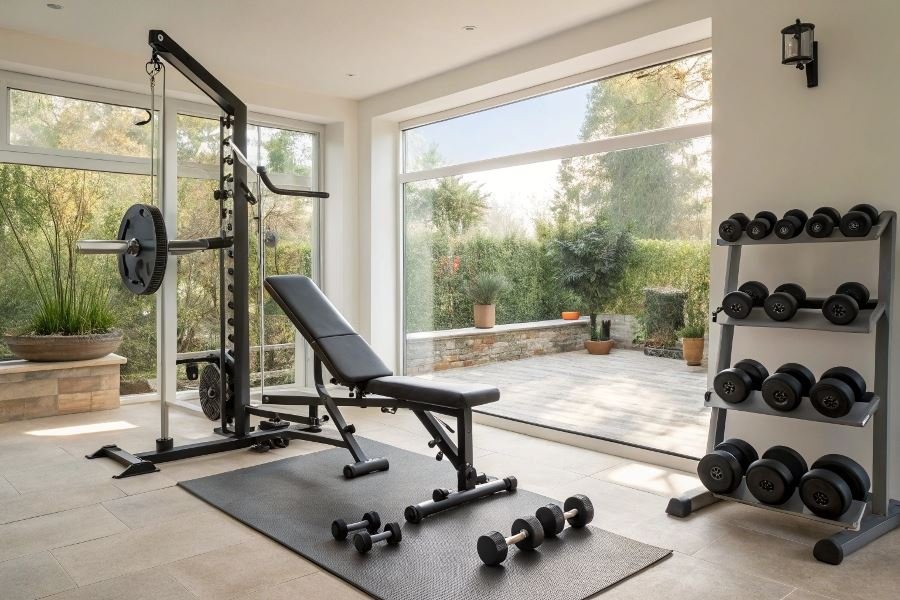
Ever wondered why some home gyms look like Swiss Army knives with weights attached? Welcome to the world of multifunctional power benches—the shape-shifting heroes of modern fitness that can transform from flat benches to incline stations to leg developers faster than you can say “superset.”
Multifunctional power benches are adjustable workout stations designed to support diverse strength training exercises in a single compact unit. Unlike their single-purpose ancestors, today’s power benches combine multiple training stations—often including barbell racks, leg developers, preacher curl pads, and cable systems—all engineered to maximize workout variety while minimizing space requirements.
The evolution has been remarkable. The humble flat bench of the 1960s has morphed into sophisticated training systems with aircraft-grade materials and biomechanically optimized designs. Modern benches feature quick-adjust mechanisms, allowing seamless transitions between exercises—a far cry from the clunky, time-consuming adjustments of earlier generations.
“The best multifunctional bench isn’t necessarily the one with the most attachments, but the one that best supports your specific fitness goals.”
Today’s market offers options spanning from basic adjustable benches starting around $150 to commercial-grade power stations exceeding 2, 000.Mid − rangeoptions(300-700) typically deliver the sweet spot of durability, functionality, and value for serious home fitness enthusiasts. Premium models boast higher weight capacities, smoother adjustments, and additional attachment compatibility—investments that pay dividends in workout quality and equipment longevity.
The beauty of these fitness chameleons lies in their adaptability: they grow with your strength journey, accommodating beginners and advanced lifters alike with equal confidence.
The Triple Threat: Why Multifunctional Power Benches Dominate Home Gyms
Space-saving champions for the modern fitness enthusiast
When square footage comes at a premium, multifunctional power benches deliver an impressive solution. These engineering marvels typically occupy just 15-20 square feet yet replace equipment that would otherwise consume 100+ square feet of precious home gym space. The beauty of these versatile fitness stations lies in their ability to transform from flat benches to incline positions, decline setups, and sometimes even full rack systems with a few quick adjustments.
The ongoing evolution of multifunctional power benches: advantages and disadvantages continues to reshape how fitness enthusiasts approach home training. While traditional home gyms required dedicated rooms with multiple bulky machines, today’s space-efficient options allow even apartment dwellers to create comprehensive workout environments in spare bedrooms or garage corners.
Real-world space efficiency: The Bowflex SelectTech 5.1S bench, for example, offers seven adjustment angles while folding to just 52″ x 23″ for storage—smaller than many coffee tables! This versatility means you can transition from chest presses to ab work to shoulder exercises without rearranging your entire living space.
Financial fitness: One bench, multiple savings
The economics of multifunctional benches present a compelling case for budget-conscious fitness enthusiasts:
| Equipment Type | Average Cost | Space Required |
|---|---|---|
| Multifunctional Bench | $300-800 | 15-20 sq ft |
| Separate Specialized Equipment | $1,500-3,000+ | 100+ sq ft |
When comparing the investment required for a quality multifunctional bench against purchasing individual specialized pieces (flat bench, incline bench, preacher curl station, leg developer, etc.), the savings typically range from $700-2,200. The Fitness Reality 1000 Super Max bench, priced around $200, offers 12 position adjustments and 800lb weight capacity—delivering commercial-grade versatility at a fraction of commercial gym membership costs.
Beyond the initial purchase savings, these versatile stations eliminate recurring membership fees that average $600-1,200 annually at commercial gyms.
Muscle-building versatility that keeps workouts fresh
The true power of multifunctional benches lies in their exercise diversity. Premium models like the Rep Fitness AB-5200 offer adjustment capabilities that enable users to target:
- Primary muscle groups: Chest, back, shoulders, legs
- Secondary muscles: Biceps, triceps, forearms, abdominals
- Stabilizer muscles: Core, rotator cuff, lower back
This versatility translates to 30+ distinct exercises from a single piece of equipment. Advanced users particularly appreciate how these benches facilitate progressive overload techniques through position adjustments that modify leverage and resistance profiles.
The training variety prevents the plateau effect common with limited equipment setups. By simply adjusting bench angles, adding attachments, or modifying grip positions, users can continuously challenge muscles from new vectors—a principle sports scientists identify as crucial for continued strength development.
For those serious about comprehensive fitness development, the ability to seamlessly transition between compound movements (bench press variations) and isolation exercises (preacher curls, leg extensions) without equipment changes maintains workout intensity and maximizes training efficiency.
The Hidden Costs of All-in-One Power Benches
When shopping for home gym equipment, those gleaming multifunctional power benches can seem like the perfect solution. But before you swipe your card, let’s talk about what the glossy brochures don’t emphasize. Even the most versatile fitness stations come with tradeoffs that might impact your long-term training success.
When stability becomes a liability
Specialized power racks and benches are built with a singular purpose—to handle serious weight under specific conditions. Multifunctional benches, by design, incorporate compromises to accommodate their versatility.
Most all-in-one units feature adjustable components and connection points that create potential weak spots. During heavy bench presses or squats, these junction points can develop subtle wobbles that specialized equipment simply doesn’t have.
Reality check: A dedicated power rack rated for 1000+ pounds will always outperform a multifunctional system rated at 600-800 pounds when it comes to stability under heavy loads.
The stability difference becomes particularly noticeable when you’re pushing your limits. That slight wobble might seem minor during light workouts but becomes a significant safety concern when you’re testing your one-rep max.
Exercise customization limitations
While manufacturers boast about the “50+ exercises” possible on their multifunctional benches, the reality often falls short of specialized equipment in several key areas:
Range of motion restrictions: The fixed paths of cable systems and attachment points can limit natural movement patterns that free weights allow.
Incremental progression challenges: Many all-in-one systems use weight stacks with predetermined increments (typically 10-15 pounds), making micro-progression difficult compared to plate-loaded systems.
| Feature | Multifunctional Bench | Specialized Equipment |
|---|---|---|
| Weight increments | Fixed (typically 10-15 lbs) | As small as 1.25 lbs |
| Movement paths | Often fixed or guided | Unrestricted |
| Exercise variations | Limited by attachment points | Limited only by creativity |
| Setup time | Minimal between exercises | Longer transitions |
For beginners, these limitations might go unnoticed. For intermediate and advanced lifters, they can become frustrating barriers to continued progress.
Making the right selection for your goals
Despite these drawbacks, multifunctional benches remain excellent options for many fitness enthusiasts—when selected properly.
For general fitness maintenance, prioritize models from established brands like Bowflex or Body-Solid that offer at least a 300-pound weight capacity and multiple adjustment angles.
For serious strength training, look for commercial-grade options with:
- Frame constructed from 11-gauge steel or thicker
- Weight capacity exceeding 800 pounds
- Minimal “play” at adjustment points
- Compatibility with Olympic-sized plates
Space-conscious athletes should consider wall-mounted folding racks with adjustable benches rather than all-in-one stations, providing better stability while maintaining a small footprint.
The ideal solution often isn’t choosing between specialized or multifunctional equipment, but determining which exercises demand specialized tools and which can be effectively performed on a quality multifunctional bench. This hybrid approach delivers the best balance of versatility, performance, and value for most serious fitness enthusiasts.