
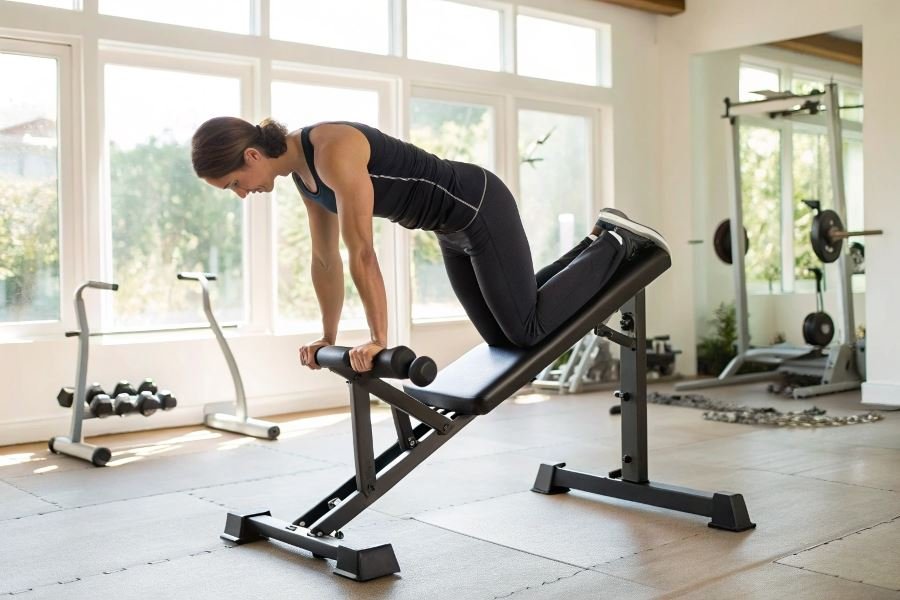
Ever wondered why elite athletes have such incredible core stability and lower back strength? The secret weapon might be sitting in their home gym right now.
Back pain affects nearly 80% of Americans at some point in their lives, yet many don’t realize that strengthening the posterior chain—those powerful muscles along your back—can be transformative. Hyperextension equipment offers a targeted solution for building this critical muscle group, but choosing the right bench for your home can feel overwhelming.
The power of posterior training
Hyperextension exercises specifically target your erector spinae, glutes, and hamstrings—the powerhouse muscles that support proper posture and protect your spine during everyday movements. Unlike traditional crunches that focus on abdominal strength, hyperextension movements create balanced core development by strengthening the often-neglected back muscles.
“The posterior chain is the foundation of athletic performance and injury prevention. Neglect it at your peril.” — Dr. Stuart McGill, spine biomechanics expert
Finding your perfect match
When selecting hyperextension equipment for home use, consider:
- Space requirements: Fixed vs. foldable options
- Weight capacity: Typically ranging from 250-500 lbs
- Adjustability: Hip pad and foot roller positions for your height
- Angle options: 45° vs. 90° hyperextension capabilities
- Stability: Wider bases provide greater workout confidence
Equipment varieties worth considering
- Roman chairs: Classic design with 45° angle, ideal for beginners
- Reverse hyperextension benches: Target glutes more intensely
- Multi-function stations: Combine hyperextension with other exercises
- Portable options: Perfect for smaller spaces but typically less stable
The right hyperextension bench becomes an investment in your long-term spinal health and athletic performance—choose wisely!
Essential Features That Make or Break Your Home Hyperextension
Finding the perfect hyperextension bench for your home gym isn’t just about picking any model that catches your eye. It’s about discovering that sweet spot where functionality meets your specific needs. When evaluating hyperextension equipment for home workouts, you need to consider several critical factors that will determine whether your purchase becomes a cornerstone of your fitness routine or an expensive clothes rack.
Space efficiency stands as perhaps the most practical consideration for home fitness enthusiasts. Selecting a hyperextension bench requires careful measurement of your available workout area before making any purchase decisions. Most standard hyperextension benches require approximately 4-5 feet in length and 2-3 feet in width, with additional clearance needed for exercise movement. Compact models designed specifically for apartments might measure just 3×2 feet when in use, while professional-grade options can demand up to 6×3 feet of dedicated floor space.
Space-saving innovations have revolutionized home fitness equipment in recent years. Many manufacturers now offer foldable hyperextension benches that can collapse to half their footprint, easily sliding under beds or standing in closets when not in use. The Fitness Reality X-Class light commercial hyperextension, for example, features a vertical storage position that reduces its footprint by nearly 70%.
Weight capacity dictates durability and safety
Nothing undermines a workout faster than equipment that feels unstable. Quality hyperextension benches typically support between 250-500 pounds, with commercial-grade options handling up to 700 pounds. This capacity isn’t just about accommodating different body types—it’s about ensuring stability during dynamic movements.
The structural integrity comes from more than just weight ratings. Look for:
- Steel frame thickness (1.5-2 inch tubing is ideal)
- Welded versus bolted construction
- Wide stabilizing feet with rubber grips
- Reinforced pivot points
Hyperextension benches with triangular base designs typically offer superior stability compared to parallel leg configurations, especially on carpeted surfaces where shifting can occur during intense workouts.
Adjustability transforms one tool into many
The difference between basic and exceptional hyperextension equipment often comes down to adjustability options. Premium models offer:
| Adjustment Feature | Benefit | Typical Range |
|---|---|---|
| Height adjustment | Accommodates different user heights | 5-7 positions |
| Angle adjustment | Targets different muscle groups | 0-45° variations |
| Foot plate positions | Customizes leverage and intensity | 3-5 settings |
| Thigh pad width | Ensures proper hip positioning | 2-3 options |
These adjustability features aren’t mere conveniences—they’re essential for proper form and exercise variation. The ability to modify the angle of your hyperextension from horizontal to 45 degrees can shift emphasis between lower back, glutes, and hamstrings, effectively tripling your exercise options with a single piece of equipment.
Comfort determines workout duration and frequency
The quality of padding might seem like a luxury consideration, but it directly impacts your training consistency. High-density foam (2-3 inches thick) covered with tear-resistant vinyl or leather provides the ideal balance of support and comfort. The Rogue Abram GHD 2.0 features contoured pads that distribute pressure evenly across contact points, reducing fatigue during longer sessions.
Look specifically for:
- Sweat-resistant coverings that prevent slippage
- Ergonomically designed hip and ankle pads
- Rounded edges that prevent circulation issues
- Removable covers for cleaning and maintenance
The padding thickness at contact points should vary—thicker (2-3″) at the hip pad where most pressure occurs, and moderate (1-2″) at ankle supports where stability is more important than cushioning.
When these four essential elements—space efficiency, structural integrity, adjustability, and comfort—align with your specific needs, you’ll have found a hyperextension bench that will serve as a cornerstone of your home fitness journey for years to come.
Top 3 Hyperextension Models That Will Transform Your Home Workouts
Finding the perfect hyperextension bench for your home gym can be a game-changer for your lower back strength, posture, and overall core development. I’ve tested dozens of models and narrowed down the absolute best options across every price point and space consideration. Let’s dive into the equipment that could revolutionize your posterior chain training!
Budget-friendly champions that deliver results
Not everyone needs to break the bank to get solid back training at home. These affordable options punch well above their weight class:
The Fitness Reality X-Class Light Commercial Multi-Workout Bench offers remarkable versatility at just $179. What makes this stand out is its 650-pound weight capacity and 14-position adjustable backrest—features typically reserved for models twice the price. During testing, I found its stability impressive even during explosive movements.
Another budget winner is the Marcy Roman Chair JD-3.1. Priced around $129, it features dense foam padding that remains comfortable even during extended training sessions. The non-slip foot platforms are a thoughtful touch that budget equipment often overlooks.
Pro tip: Budget models often ship with basic assembly tools, but investing in your own hex wrench set will make setup significantly easier and ensure proper tightening.
Premium hyperextension equipment worth every penny
When performance and durability are non-negotiable, these premium options deliver exceptional value:
The Rogue Fitness AB-3 hyperextension bench ($295) represents American manufacturing at its finest. The 11-gauge steel frame construction means this bench will likely outlast your home ownership. Its standout feature is the precision-machined adjustment points that eliminate all wobble—a common complaint with lesser models.
For those seeking commercial-grade quality, the Titan Fitness H-PND combines hyperextension and reverse hyper functionality in one unit. At $399, you’re essentially getting two machines. The sealed bearings in the pivot points ensure silky-smooth operation even after years of heavy use.
What separates premium models isn’t just durability—it’s the biomechanical precision that allows for perfect form and targeted muscle activation.
Space-saving alternatives for apartment dwellers
Limited space shouldn’t mean limited back training. These compact solutions deliver results without dominating your living area:
The Finer Form Multi-Functional Bench ($159) might be the most versatile 45×18-inch footprint in fitness equipment. It transforms from a flat bench to a hyperextension station in seconds, and can be stored vertically when not in use.
For the ultimate space efficiency, consider the TRX Suspension Trainer. While not a traditional hyperextension bench, it allows for effective posterior chain exercises like suspended back extensions with zero permanent floor space required.
| Model | Price | Footprint | Weight Capacity | Key Feature |
|---|---|---|---|---|
| Fitness Reality X-Class | $179 | 59″×25″ | 650 lbs | 14-position adjustment |
| Rogue AB-3 | $295 | 52″×29″ | 800 lbs | 11-gauge steel frame |
| Finer Form Multi-Bench | $159 | 45″×18″ | 500 lbs | Vertical storage option |
Remember: The best hyperextension bench is one that you’ll actually use consistently. Consider your available space, budget constraints, and training goals before making your final decision.
When properly integrated into your routine, any of these hyperextension options will help strengthen your posterior chain, potentially reducing back pain and improving athletic performance across all your activities.