
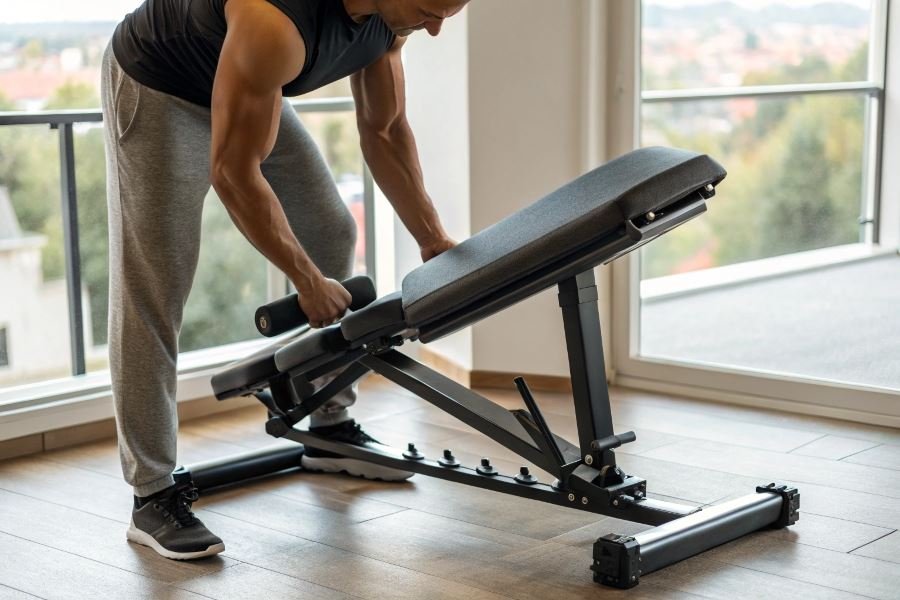
Ever stood in front of a wall of identical-looking workout benches wondering which one won’t collapse under your max effort? You’re not alone.
When building a home gym, nothing impacts your training potential quite like the humble power bench. It’s not just another piece of equipment—it’s the foundation that either elevates your fitness journey or becomes the limiting factor in your progress. The right bench transforms a corner of your home into a complete strength training sanctuary.
The backbone of your strength training
A quality power bench serves as the command center for over 30 different exercises targeting every major muscle group. Beyond the obvious bench press, it enables everything from Bulgarian split squats to incline flyes and decline crunches. This versatility makes it arguably the highest ROI piece in any home gym setup.
When evaluating power benches, focus on these critical factors:
- Weight capacity: Should exceed your body weight plus your maximum lift by at least 20%
- Stability: Zero wobble during explosive movements
- Adjustability: Multiple back and seat positions unlock different exercise variations
- Padding density: Firm enough for support, cushioned enough for comfort
- Footprint: Compact enough for your space without sacrificing functionality
Matching your bench to your fitness vision
Your ideal power bench depends entirely on your training style and goals. Powerlifters need rock-solid flat benches with minimal gap between seat and back pad. Bodybuilders benefit from highly adjustable FID (flat/incline/decline) models. HIIT enthusiasts should prioritize quick adjustment mechanisms and mobility.
The right bench doesn’t just support your body—it supports your ambitions, turning ordinary workouts into extraordinary results.
Essential Factors for Your Perfect Power Bench
Finding the right power bench for your home gym isn’t just about picking any bench that fits your budget. It’s about creating the foundation for your entire strength training journey! When evaluating how to choose a power bench for home use, several critical factors will determine whether your investment becomes your fitness cornerstone or a glorified laundry rack.
Weight Capacity That Won’t Let You Down
The structural integrity of your power bench is non-negotiable. Most quality benches offer weight capacities between 600-1,500 pounds, which includes both your body weight and the weight you’re lifting.
Pro tip: Always choose a bench rated for at least 2-3 times your current max lift. Why? Because your strength will increase, and that 300-pound capacity bench won’t cut it when you’re pushing serious weight six months from now.
Look for frames constructed from 11-14 gauge steel with reinforced welds at stress points. The Rogue Fitness Monster Utility Bench, for example, features a 3×3-inch 11-gauge steel frame that can handle a whopping 1,000+ pounds.
Space Efficiency Without Compromise
| Bench Type | Typical Footprint | Height | Storage Needs |
|---|---|---|---|
| Flat Bench | 50″L x 20″W | 17-18″ | Minimal |
| FID Bench | 55-60″L x 26″W | 17-50″ | Moderate |
| Olympic Bench | 65-80″L x 60″W | 48-55″ | Substantial |
Your available workout space dictates your options. Standard flat benches require about 50″ x 20″ of floor space, while adjustable FID (Flat/Incline/Decline) benches need closer to 60″ x 26″. For compact spaces, consider foldable designs like the FLYBIRD Adjustable Bench that can be stored vertically against a wall or under a bed.
Adjustability That Adapts To Your Workouts
The versatility of your bench directly impacts the variety of exercises you can perform. Modern adjustable benches typically offer:
- Seat positions: 2-5 adjustment angles
- Backrest positions: 5-7 adjustment angles (typically -20° to 85°)
- Height adjustments: Fixed or 2-3 options
The difference between a basic bench and a premium model often comes down to the smoothness and stability of these adjustments. Look for benches with laser-cut adjustment ladders rather than pop-pins, which tend to wear out faster.
Comfort That Sustains Your Longest Sets
Don’t underestimate upholstery quality! The padding thickness should be 2-3 inches of high-density foam that strikes the perfect balance:
- Too soft: Creates instability during heavy lifts
- Too firm: Uncomfortable during longer sessions
- Just right: Supportive yet comfortable
The Rep Fitness AB-5200 features a grippy vinyl covering that prevents sliding during bench presses while remaining easy to clean after those sweaty sessions.
Attachments That Expand Your Exercise Library
The best power benches grow with your fitness journey through modular attachments:
- Leg developers for quad/hamstring isolation
- Preacher curl attachments for targeted bicep work
- Dip station attachments for tricep/chest development
- Band pegs for accommodating resistance
Value multiplier: Each attachment effectively adds 3-5 new exercises to your repertoire without requiring additional floor space.
Remember that a quality power bench isn’t just equipment—it’s the command center of your home gym that will either limit or expand your fitness potential for years to come. Choose wisely, and your future self will thank you after every successful PR!
Sealing the Deal on Your Perfect Power Bench
Smart budgeting without sacrificing quality
Let’s face it—your wallet and your fitness goals often pull in opposite directions. The power bench market spans from $150 budget options to professional-grade $1,000+ monsters. The sweet spot? Most home gym enthusiasts find exceptional value in the $300-500 range where durability meets functionality without breaking the bank.
Don’t fall for the cheapest option available. Those $100 benches might look tempting, but they typically use thinner steel, lower weight capacities, and padding that flattens faster than your motivation on Monday mornings. Instead, consider this approach:
The difference between a $200 bench that needs replacement in 18 months and a $350 bench that lasts 5+ years makes the pricier option more economical in the long run.
If budget constraints are real (and when aren’t they?), prioritize these non-negotiables:
- Minimum 600-pound weight capacity
- 2×2-inch steel frame (minimum)
- High-density foam padding (at least 2 inches thick)
Matching bench features to your workout DNA
Your power bench should complement your fitness personality, not fight against it. Consider how these workout styles align with bench features:
| Workout Style | Ideal Bench Features |
|---|---|
| Powerlifting focus | Flat bench with wide pad, minimal gap, IPF height standards |
| Bodybuilding/hypertrophy | FID capability (flat/incline/decline), leg rollers, multiple angle settings |
| General fitness | Adjustable bench with 5+ positions, moderate weight capacity (500+ lbs) |
| Small space dwellers | Foldable design, transport wheels, compact footprint |
The Rogue Fitness AB-3 might be perfect for someone chasing hypertrophy with its multiple angles, while a pure powerlifter might prefer the stability of the Rep Fitness FB-5000.
Test your most common exercises mentally before purchasing. If you primarily do flat bench press with occasional incline work, a simple adjustable bench might serve you better than a complex FID model with attachments you’ll never use.
Longevity and maintenance reality check
A quality power bench should outlast several of your fitness phases. Maintenance requirements vary dramatically based on construction:
Vinyl upholstery requires regular wipedowns with mild soap to prevent cracking, especially if you’re a heavy sweater. Leather or premium materials last longer but demand proper care with appropriate cleaners.
Moving parts create maintenance needs. Each adjustment mechanism, hinge, and bolt represents a potential failure point. Simple flat benches might last 10+ years with zero maintenance, while complex adjustable models benefit from quarterly bolt checks and occasional lubrication.
Consider these longevity factors:
- Powder-coated finishes resist rust better than painted surfaces
- Welded frames outlast bolt-together designs
- Single-piece pads resist tearing longer than multi-section designs
The warranty tells you how much the manufacturer believes in their product. A 10-year frame warranty from companies like Titan Fitness signals confidence in construction quality.
Remember that your power bench is the foundation of countless workouts to come. Balance your immediate budget constraints against the long-term value of durability, match the features to your actual exercise patterns, and prepare for reasonable maintenance. Your future self—stronger, more defined, and injury-free—will thank you for making this decision with both care and foresight.