
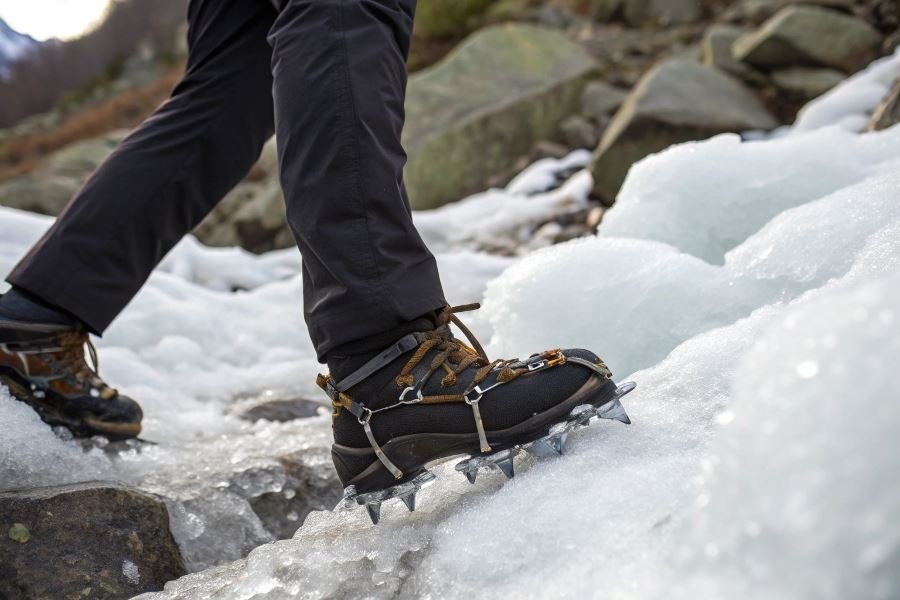
Ever stood on a knife-edge ridge at 14,000 feet, trusting your entire body weight to twelve metal points strapped to your boots? That’s the reality of alpine climbing, where your crampon material choice isn’t just about performance—it’s about survival.
When ice climbers and mountaineers debate steel versus aluminum crampons, they’re not just splitting hairs. The material underfoot can determine whether you confidently ascend that vertical ice wall or find yourself in a precarious situation when metal fails at the worst possible moment.
Steel and aluminum have emerged as the two titans in crampon construction, each bringing distinct advantages to different climbing scenarios. Steel delivers unmatched durability and penetration power, while aluminum offers significant weight savings that can reduce fatigue during long approaches.
“Choose your crampon material like you’d choose your climbing partner—with careful consideration of where you’re going and what you’ll face.”
The evolution of crampon materials tells a fascinating story of mountaineering innovation. Early climbers in the Alps during the 1800s used rudimentary steel spikes, but it wasn’t until 1908 when Oscar Eckenstein revolutionized the design with the 10-point crampon. By the 1960s, manufacturers began experimenting with lightweight aluminum alternatives as technical climbing pushed into more extreme terrain.
Today’s climbers benefit from this materials science evolution, with hybrid designs incorporating both metals for specialized applications. The steel vs. aluminum decision remains one of the most critical equipment choices you’ll make before heading into the vertical world.
The Battle of Materials: Steel vs Aluminum Crampons
When you’re scaling icy peaks or traversing glaciers, your crampons become your most trusted allies. The material choice between steel and aluminum isn’t just a matter of preference—it’s a decision that directly impacts your climbing experience, safety, and performance. Let’s dig into the nitty-gritty of these materials to help you make an informed choice for your next vertical adventure.
Steel Crampons: The Rugged Workhorses
Steel crampons have earned their reputation as the industry standard for serious mountaineering and ice climbing. The comparison of materials of climbing crampons between steel and aluminum often starts with durability, and steel unquestionably takes the crown here.
Durability Factor: Chromoly steel crampons, like those from Petzl or Black Diamond, can withstand repeated contact with rock and ice without significant wear. Most high-end models maintain their points even after seasons of abuse.
Weight Considerations: The trade-off comes in weight—steel crampons typically weigh between 800-1100 grams per pair. This additional heft translates to:
- Greater stability on technical terrain
- More confident placement in hard ice
- Less bounce-out when front-pointing
Performance Profile: Steel excels in mixed climbing environments where you’ll encounter both ice and rock. The material’s inherent stiffness provides exceptional power transfer, allowing for precise foot placements when every move counts.
Aluminum Crampons: The Featherweight Specialists
Aluminum has carved out its niche for specific applications where weight savings trump absolute durability.
The weight difference is striking—aluminum crampons typically weigh 40-60% less than their steel counterparts, often coming in under 500 grams per pair.
Ideal Applications:
- Ski mountaineering
- Glacier travel
- Alpine approaches
- Ultralight expeditions
Limitation Landscape: Aluminum’s softness means these crampons wear down significantly faster when used on rock or hard ice. The points dull quickly, and the frames can bend under extreme forces.
User Profile: These are perfect for the weight-conscious climber who primarily sticks to snow slopes and moderate terrain. Many competitive ski mountaineers and speed alpinists swear by models from CAMP and Grivel.
Technical Material Showdown
| Property | Steel | Aluminum | Winner |
|---|---|---|---|
| Hardness (Rockwell) | 55-58 HRC | 15-20 HRB | Steel |
| Weight (avg. pair) | 900g | 450g | Aluminum |
| Lifespan | 5-10+ years | 1-3 years | Steel |
| Corrosion Resistance | Moderate (needs maintenance) | High | Aluminum |
| Flex/Rigidity | High rigidity | More flexible | Depends on use |
| Price | $150-200 | $120-180 | Aluminum |
Hardness Dynamics: Steel’s superior hardness (typically 3-4 times harder than aluminum) means points stay sharper longer and penetrate ice more effectively. This becomes crucial on technical ice where secure placements determine success—and sometimes safety.
Flexibility Factors: Aluminum’s greater flexibility can be both advantage and disadvantage. It absorbs shock better but may not provide the precision needed for technical climbing. Steel’s rigidity translates to better power transfer from boot to ice.
Corrosion Considerations: While aluminum naturally forms a protective oxide layer, steel requires more maintenance to prevent rust. Many manufacturers now use stainless steel or apply anti-corrosion treatments to mitigate this issue.
The ultimate choice between steel and aluminum crampons comes down to your specific climbing objectives. For technical ice and mixed routes, steel remains the gold standard. For fast-and-light missions where every gram counts, aluminum offers compelling advantages despite its limitations.
Making the Right Crampon Choice: Your Ultimate Material Guide
The decision matrix for crampon selection
Choosing between steel and aluminum crampons doesn’t have to feel like solving a complex equation. The decision boils down to three critical factors: your climbing environment, performance requirements, and weight considerations.
For technical ice climbing and mixed terrain, steel remains the gold standard. The durability and penetration power of chromoly steel crampons from brands like Petzl and Black Diamond provide the confidence needed when every placement matters. Their front points maintain sharpness through multiple seasons of hard use.
Conversely, aluminum shines in pure alpine and ski mountaineering scenarios where weight savings translate directly to reduced fatigue. When you’re covering significant distances or elevation gain, those 200-300 gram differences per foot become meaningful advantages.
Consider this simplified decision framework:
| Activity | Terrain | Recommended Material | Key Benefit |
|---|---|---|---|
| Technical ice climbing | Vertical ice, mixed | Steel | Durability, precision |
| Alpine climbing | Moderate snow/ice | Aluminum | Weight savings |
| Expedition climbing | Variable conditions | Steel | Reliability |
| Ski mountaineering | Snow slopes, glacier travel | Aluminum | Lightweight efficiency |
| Winter hiking | Packed snow, light ice | Aluminum | Comfort for long distances |
Beyond the binary: hybrid solutions
The crampon world isn’t limited to a simple steel-or-aluminum choice anymore. Manufacturers have developed innovative hybrid solutions that capitalize on the strengths of both materials.
The evolution of crampon technology has accelerated dramatically in recent years, with materials science pushing boundaries we once thought fixed.
Modular systems now allow climbers to swap front sections based on objectives. CAMP offers crampons with aluminum bodies and replaceable steel front points—delivering durability where it matters most while reducing overall weight.
Emerging materials include:
- Titanium alloys: Offering an impressive strength-to-weight ratio between steel and aluminum, though at premium price points
- Carbon fiber reinforced frames: Providing structural rigidity while reducing weight in non-contact areas
- Specialized steel alloys: Delivering improved corrosion resistance and edge retention
These innovations address the traditional compromises climbers have faced, though they typically command higher prices than single-material options.
Maintaining your investment
The longevity of your crampons depends significantly on proper maintenance—which varies by material.
Steel crampon maintenance focuses primarily on preventing rust. After use, thoroughly dry your crampons and apply a light coat of protective oil to prevent oxidation. Regular sharpening with a file maintains optimal performance, with attention to preserving the original angles of the points.
Aluminum crampon care centers on preventing structural damage. These softer crampons require more careful handling:
- Avoid walking on rock or concrete
- Inspect frequently for cracks or deformation
- Replace points when worn, as resharpening removes more material than with steel
All crampons benefit from proper storage in a dry environment, away from corrosive substances and with point protectors installed.
The investment in proper maintenance pays dividends in both safety and longevity, regardless of your material choice. Your crampons are life-critical equipment—treat them accordingly, and they’ll perform when you need them most.