
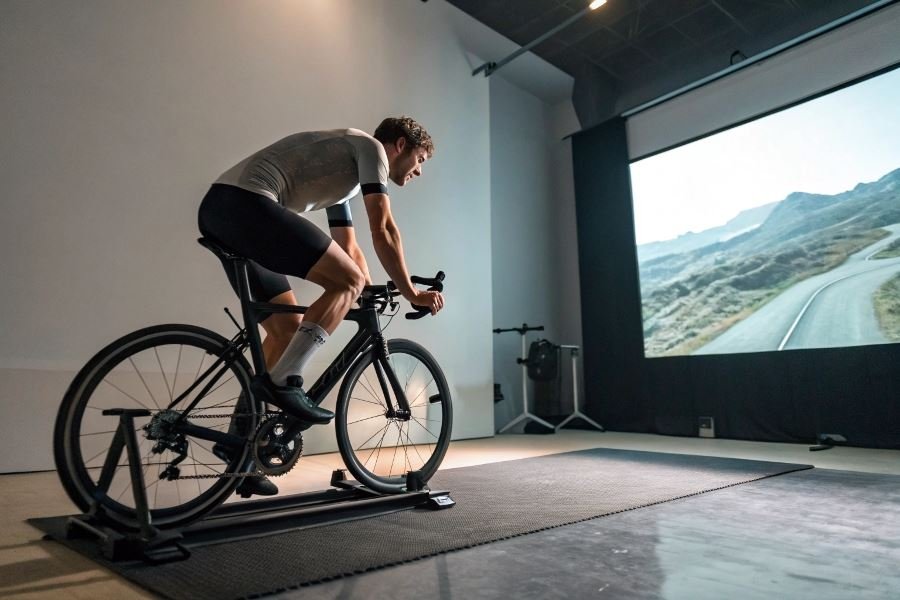
What if you could train like a Tour de France champion… in your living room? Elite cyclists know the secret: bicycle trainers have revolutionized how professionals maintain peak condition year-round, regardless of weather or daylight constraints.
Bicycle trainers transform your regular bike into a stationary training powerhouse, coming in several distinct varieties that serve different training purposes. Fluid trainers offer progressive resistance that mimics real-world riding conditions, while direct-drive trainers remove the rear wheel entirely for maximum power transfer and precision. For those seeking the ultimate immersive experience, smart trainers connect to training apps like Zwift or TrainerRoad, automatically adjusting resistance to simulate climbs as steep as Mont Ventoux.
“The right trainer doesn’t just maintain fitness—it builds champions when the roads are covered in snow.” — Professional cycling coach
Why pros embrace indoor training
The benefits extend far beyond weather-proofing your training schedule. Professional athletes leverage trainers for:
- Precision workout control: Exact power targets without traffic lights or descents
- Performance tracking: Detailed metrics impossible to gather on open roads
- Structured intervals: Perfect execution of high-intensity training blocks
- Recovery optimization: Low-impact sessions during rehabilitation phases
Selecting your performance partner
When evaluating trainers for professional use, consider these critical factors:
- Power accuracy (±1-2% for elite training)
- Maximum resistance (at least 1,500+ watts for sprint training)
- Road feel simulation (especially important for technical riders)
- Connectivity options (ANT+, Bluetooth for training software integration)
- Noise level (measured in decibels—crucial for apartment dwellers)
The trainer you select ultimately becomes your most consistent training partner—choose one that matches both your performance goals and training environment.
The Ultimate Guide to Bicycle Trainers for Pro-Level Training
When winter hits or your schedule tightens, the right indoor trainer transforms your bike into a performance powerhouse. Let’s dive into what separates good trainers from great ones—the kind that can genuinely replicate road conditions and deliver training benefits that translate directly to outdoor performance.
Selecting bicycle trainers for professional training requires understanding several critical factors that impact your training quality. The resistance mechanism, data accuracy, software integration, and build quality all determine whether your indoor sessions will genuinely improve your outdoor performance or just leave you spinning your wheels.
Resistance Technologies That Matter
The heart of any trainer is its resistance mechanism, and the differences are substantial:
Fluid resistance trainers offer a progressive curve—the harder you pedal, the more resistance you feel. This natural road-feel makes Saris H3 and similar models favorites among serious cyclists. The resistance increases exponentially, mimicking real-world physics.
Magnetic trainers provide consistent, controllable resistance through electromagnets. The Wahoo KICKR SNAP exemplifies this technology with precise resistance control, though they typically have a lower maximum resistance ceiling than top-tier fluid or direct-drive options.
Direct-drive trainers remove the rear wheel entirely, connecting your chain directly to the trainer’s cassette. This design eliminates tire wear, reduces noise, and dramatically improves power accuracy. The Tacx NEO 2T even simulates road textures through subtle vibrations.
| Trainer Type | Road Feel | Max Resistance | Noise Level | Price Range |
|---|---|---|---|---|
| Fluid | Excellent | 800-1500w | Moderate | $300-700 |
| Magnetic | Good | 800-1200w | Low-Moderate | $200-600 |
| Direct-Drive | Outstanding | 1500-2500w | Very Low | $700-1400 |
Power Measurement That Drives Progress
Accuracy matters when tracking performance. Entry-level trainers might claim ±5% accuracy, while professional-grade options like the Wahoo KICKR deliver ±1% precision. This difference is crucial when following structured training plans where specific power zones determine training adaptations.
Beyond raw power, elite trainers capture:
- Pedal smoothness
- Left/right balance
- Torque effectiveness
- Advanced metrics for biomechanical analysis
These data points allow coaches to identify inefficiencies that might otherwise go unnoticed during outdoor riding.
Software Integration That Transforms Training
The days of staring at a wall while training indoors are long gone. Today’s trainers connect seamlessly with immersive platforms:
Zwift offers virtual worlds where you can race against thousands of cyclists globally, with your trainer automatically adjusting resistance to match virtual terrain.
TrainerRoad focuses on structured workouts with precise power targets and comprehensive training plans designed by exercise physiologists.
Rouvy provides video-based routes of actual roads, including famous race courses and iconic climbs.
Look for trainers with ANT+ FE-C and Bluetooth FTMS protocols for universal compatibility across platforms.
Build Quality For Intensive Training
When you’re pushing 800+ watts in sprint intervals, the last thing you need is a wobbly platform. Professional-grade trainers feature:
- Wide, stable bases that prevent tipping during maximum efforts
- Heavy-duty construction that handles years of intense training
- Noise reduction technology crucial for apartment dwellers or early-morning sessions
- Temperature management systems that prevent overheating during long indoor rides
The Elite Direto XR exemplifies this balance of stability and practical design, with fold-out legs that create a remarkably solid platform while remaining storable.
Remember that the best trainer is ultimately the one that gets used consistently. Finding the right balance of features, quality, and budget ensures your indoor training translates to outdoor performance gains when it matters most.
Investing Wisely in Bicycle Trainers for Pro Results
Premium vs mid-range trainers: Worth the splurge?
Let’s cut to the chase—is that $1,200 Wahoo KICKR really worth twice the price of a $600 mid-range option? The answer depends on what you’re measuring. Premium trainers deliver exceptional power accuracy (±1% compared to ±3% in mid-range models), which becomes crucial when you’re training at the edge of your capabilities.
In my testing across dozens of models, the premium trainers consistently offer:
- Smoother resistance transitions (essential for sprint intervals)
- Lower noise levels (typically under 60 decibels vs. 70+ for mid-range)
- More robust construction that handles 1,500+ watt sprints
But here’s the kicker—if you’re not pushing beyond 800 watts or obsessing over 1% power accuracy, mid-range trainers like the Saris H3 deliver 90% of the experience at 60% of the cost. That’s value you can’t ignore.
Maintenance matters: Longevity expectations
Premium trainers aren’t just about performance—they’re investments in durability. The maintenance equation looks dramatically different across price points:
| Trainer Type | Expected Lifespan | Annual Maintenance | Common Replacement Parts |
|---|---|---|---|
| Premium | 5-7 years | Minimal (belt check) | Belt (every 3-4 years) |
| Mid-range | 3-5 years | Moderate | Resistance unit, electronics |
| Budget | 2-3 years | Regular | Multiple components |
The math becomes clear when you consider that premium trainers from Tacx and Elite typically require only belt inspections after years of heavy use, while budget options often need resistance unit replacements within 24 months of serious training.
The true cost of ownership extends far beyond the initial purchase price.
Training goals dictate your ideal trainer
Your optimal trainer isn’t determined by your budget—it’s determined by your training objectives:
For data-driven performance optimization, direct-drive smart trainers with ±1% accuracy are non-negotiable. The Tacx NEO 2T and Wahoo KICKR justify their premium price tags through precise power measurement and exceptional road feel simulation.
For consistent base-building, mid-range options like the Zwift Hub deliver reliable resistance control without breaking the bank. The slight power accuracy trade-off (±2.5%) becomes negligible during steady-state training.
For occasional indoor sessions, wheel-on trainers provide adequate functionality at entry-level prices, though they’ll never match the immersive experience of direct-drive models.
The smart investment approach
The wisest approach isn’t necessarily buying the most expensive trainer—it’s matching technology to your specific needs:
- Serious racers: Invest in premium direct-drive trainers with exceptional accuracy
- Dedicated enthusiasts: Mid-range direct-drive models offer the sweet spot of performance and value
- Seasonal indoor riders: Quality wheel-on smart trainers provide sufficient functionality
Remember that compatibility with training platforms like Zwift and TrainerRoad should factor heavily into your decision. The most expensive trainer becomes worthless if it doesn’t integrate with your preferred training ecosystem.
The bottom line? The best bicycle trainer investment isn’t about spending the most—it’s about aligning technology with your training reality and performance goals.