
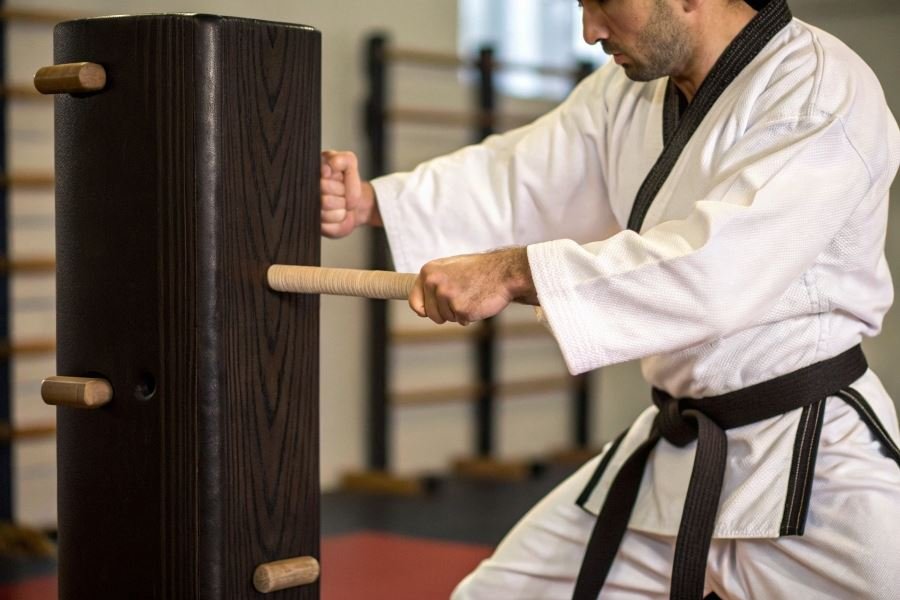
What if the secret to devastating karate strikes has been hiding in plain sight for centuries? The humble makiwara—a simple wooden striking post—remains one of traditional karate’s most misunderstood yet transformative training tools.
Dating back to Okinawa in the 18th century, the makiwara emerged during a time when martial artists had to develop powerful strikes without modern equipment. These practitioners discovered that repeatedly striking a flexible wooden post wrapped in rice straw not only conditioned their hands but fundamentally transformed their striking mechanics. Master Gichin Funakoshi, who introduced karate to mainland Japan in 1922, considered makiwara training so essential that he declared: “The makiwara is to karate what the tetsubo (iron bar) is to swordsmanship.”
The modern relevance of ancient wisdom
Today’s practitioners are rediscovering what the old masters knew—makiwara training develops qualities that bag work alone cannot match:
- Bone density and joint alignment improve through progressive conditioning
- Striking precision becomes second nature as the narrow target demands accuracy
- The feedback mechanism teaches proper follow-through and energy transfer
Choosing your perfect striking partner
Selecting the right makiwara depends largely on your experience level and training goals:
For beginners:
- Start with a more flexible post (typically pine)
- Choose padding that offers protection while providing feedback
- Consider height adjustability to match your striking position
For advanced practitioners:
- Harder woods like oak provide greater resistance
- Thinner padding allows for more direct feedback
- Custom dimensions match your specific body mechanics
The makiwara doesn’t just build stronger strikes—it builds smarter ones. By revealing flaws in technique through immediate feedback, it transforms good karateka into exceptional ones, connecting modern practitioners to centuries of martial wisdom through the simple act of striking wood.
Essential Makiwaras: The Backbone of Karate Impact Training
The humble makiwara stands as perhaps the most misunderstood training tool in traditional karate. This striking post—literally “wrapped straw” in Japanese—has shaped the knuckles and techniques of karateka for centuries. Yet choosing the right one can mean the difference between developing devastating power and nursing chronic injuries.
When evaluating makiwaras for karate, selection criteria for effective training should focus on construction quality, appropriate materials, and progressive resistance. The right makiwara doesn’t just absorb impacts—it teaches your body the perfect balance between force generation and control while providing crucial feedback with every strike.
Traditional Craftsmanship vs. Modern Engineering
Traditional makiwaras feature a tapered wooden post anchored firmly in the ground or floor, with a striking pad at the optimal height. These designs have remained largely unchanged since the early days of Okinawan karate, offering authentic feedback that modern alternatives sometimes miss.
Modern variations include:
- Wall-mounted designs with adjustable tension springs
- Free-standing models with weighted bases
- Portable options with quick-assembly components
The training implications differ significantly. Traditional posts develop what old masters called “kime”—focus of power—through their consistent resistance pattern. Modern spring-loaded versions better simulate human targets by absorbing and returning energy, but may not build the same bone density and structural alignment.
The choice ultimately depends on your training goals: competition preparation favors modern designs, while traditional posts excel at developing fundamental striking mechanics.
Wood Selection: The Foundation of Feedback
| Wood Type | Flexibility | Durability | Feedback Quality |
|---|---|---|---|
| Red Oak | Moderate | Excellent | Sharp, immediate |
| Yellow Pine | High | Good | Gradual, forgiving |
| Ash | Moderate-High | Excellent | Balanced response |
| Bamboo | Very High | Variable | Whip-like return |
The optimal wood for your makiwara depends on your experience level. Beginners benefit from more flexible woods like yellow pine that forgive technical imperfections, while advanced practitioners often prefer the uncompromising feedback of dense hardwoods like oak.
Material properties to consider:
- Grain direction affects both durability and flex pattern
- Moisture content determines how the wood responds to impacts
- Age of the wood influences its resistance to splitting
Striking Surface: The Interface Between Technique and Tool
The striking surface represents your most direct connection to the makiwara, and deserves careful consideration.
For progressive conditioning, consider this approach:
- Begin with thicker padding (½-inch closed-cell foam)
- Gradually transition to thinner materials (¼-inch leather)
- Advanced practitioners may use minimal padding (canvas wrap)
Never rush this progression—bone conditioning requires months, not weeks.
Different padding options create distinct training experiences:
- Leather wrapping provides excellent feedback while protecting knuckles
- Canvas offers minimal cushioning for advanced conditioning
- Modern foam composites from brands like Revgear balance protection with realistic feedback
The most effective makiwara setups allow for interchangeable striking surfaces, enabling you to adjust resistance as your conditioning improves. This progressive approach—gradually reducing padding while increasing striking force—builds both physical toughness and technical precision without unnecessary injury risk.
Elevate Your Karate with Advanced Makiwara Selection
Tailoring to your training goals
The makiwara isn’t just a striking post—it’s your silent training partner that evolves with your journey. Selecting the right specifications directly impacts your development as a karateka.
Beginners should start with softer, more forgiving surfaces—typically a makiwara with thicker padding or a more flexible striking board. This reduces the risk of injury while building proper technique. The standard 5-foot height works well for most practitioners, but height customization matters significantly for proper alignment.
Intermediate practitioners benefit from gradually reducing padding and increasing resistance. This progression mirrors the natural development of bone density and striking power that occurs with consistent training.
For advanced karateka, specialized makiwaras with variable resistance settings allow for targeted development. Some elite practitioners use multiple striking surfaces on a single unit:
| Skill Level | Recommended Thickness | Material | Training Focus |
|---|---|---|---|
| Beginner | 1-1.5 inches | Pine with padding | Form and alignment |
| Intermediate | 0.75-1 inch | Oak or maple | Power development |
| Advanced | 0.5-0.75 inches | White oak or hickory | Speed and precision |
The difference between proper and improper makiwara specifications isn’t just about comfort—it’s about preventing training plateaus that can stall your progress for months.
Fixed vs portable: choosing your battleground
Your training environment dictates whether a fixed or portable makiwara makes more sense, with each offering distinct advantages.
Fixed makiwaras deliver unmatched stability and feedback. Traditionally installed by burying approximately one-third of the post underground, they require:
- Concrete foundation (12-18 inches deep) for maximum stability
- Proper drainage to prevent wood rot
- Sufficient clearance (minimum 3 feet) on all sides
The Shureido traditional floor-mounted makiwara represents the gold standard for serious practitioners with dedicated training spaces.
Portable options have evolved dramatically, offering legitimate training value while accommodating modern living situations:
- Wall-mounted designs with quick-release brackets
- Free-standing units with weighted bases
- Door-frame attachments for apartment dwellers
Portable doesn’t necessarily mean compromised—today’s engineered solutions can deliver 80-90% of the training benefit of traditional installations when properly designed.
Maintenance and investment considerations
A quality makiwara represents a significant investment that can last decades with proper care. The economics actually favor higher-quality materials upfront:
White oak makiwaras from Kamikaze Karate might cost $150-200 initially, but their 10+ year lifespan makes them more economical than replacing cheaper $50-70 pine versions every 2-3 years.
Maintenance requirements vary by material:
- Hardwoods require occasional sanding and oiling (twice yearly)
- Padding elements need replacement every 1-2 years depending on training frequency
- Mounting hardware should be checked monthly for loosening
Weather exposure accelerates deterioration dramatically. Indoor installation extends lifespan by 300-400% compared to outdoor placement without protection.
The most overlooked aspect of makiwara investment? Adaptability. Systems that allow for adjusting resistance as your skills progress deliver substantially more long-term value than fixed-resistance options.
Your makiwara should grow with you—from your first tentative strikes to the focused power of decades of practice.