
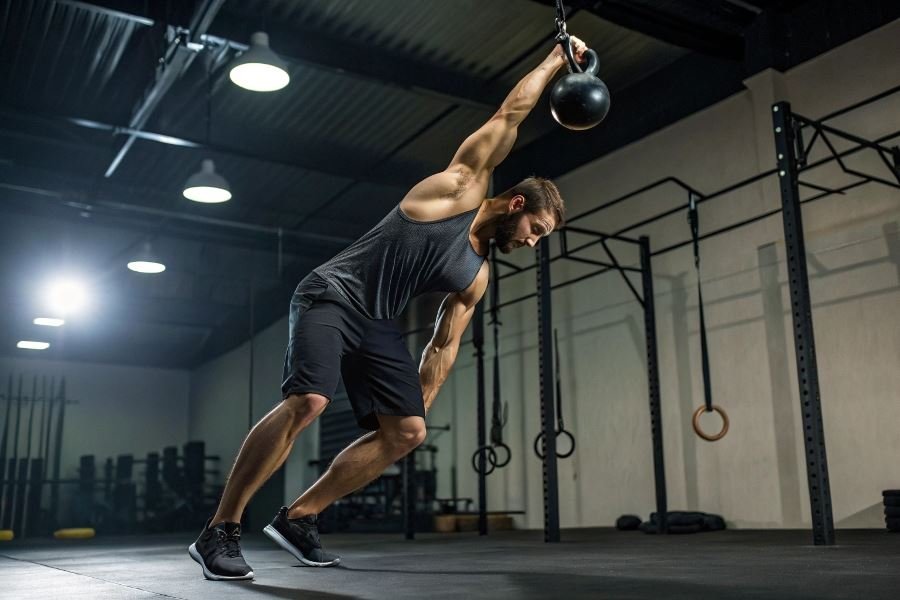
What if I told you that a single piece of equipment could transform your entire fitness routine? Kettlebells—those cannonball-shaped weights with handles—have been sculpting powerful physiques since they emerged from Russia in the 18th century. Today, they’re revolutionizing how we think about efficient, full-body workouts.
The magic of kettlebell training lies in its biomechanical brilliance. Unlike traditional weights that move in predictable paths, kettlebells create an offset center of gravity that forces your body to recruit stabilizing muscles throughout every movement. This means your core, shoulders, and hips work overtime even during the simplest exercises. Research published in the Journal of Strength and Conditioning Research demonstrates that kettlebell workouts can burn up to 20 calories per minute—comparable to running a 6-minute mile!
The science behind full-body transformation
When you perform compound kettlebell movements, you’re essentially creating a metabolic storm in your body. These exercises simultaneously:
- Engage multiple muscle groups across different planes of motion
- Elevate heart rate for cardiovascular benefits
- Improve coordination between your nervous system and muscles
- Enhance functional strength that translates to real-world activities
Equipment essentials and safety first
Before diving into kettlebell training, proper equipment selection is crucial. For beginners, women typically start with 8-12kg (18-26lb) kettlebells, while men often begin with 12-16kg (26-35lb) models. Quality matters—look for kettlebells with seamless handles and stable bases.
Remember: proper form prevents injury. Keep your core engaged, spine neutral, and movements controlled. Start light, master technique, and progress gradually to heavier weights as your proficiency improves.
Unleash Full-Body Power with These Kettlebell Titans
The humble kettlebell—that cannonball with a handle—has revolutionized strength training across America’s fitness landscape. Unlike isolated machine exercises, kettlebell training demands full-body engagement, creating functional strength that translates to real-world activities. When properly executed, these top 3 kettlebell exercises for the whole body deliver an efficient workout that builds strength, endurance, and mobility simultaneously—perfect for busy professionals and athletes alike.
The Kettlebell Swing: Your Power Generator
The kettlebell swing stands as the cornerstone of kettlebell training, and for good reason. This explosive movement primarily targets the posterior chain—hamstrings, glutes, and lower back—while engaging your core, shoulders, and grip as stabilizers.
Proper Technique:
- Stand with feet shoulder-width apart
- Hinge at the hips (not a squat!)
- Grip the kettlebell with both hands
- Swing the weight between your legs, then drive hips forward
- Let the kettlebell float to chest height through hip power, not arms
The swing isn’t about lifting with your shoulders—it’s about harnessing hip drive to generate explosive power.
Variations to Master:
- Two-handed swing (beginner-friendly)
- One-handed swing (challenges core stability)
- American swing (overhead finish, greater range of motion)
The beauty of the swing lies in its scalability. Whether you’re using a 15-pound bell or swinging 70+ pounds, the movement pattern remains consistent while the intensity adapts to your fitness level.
The Turkish Get-Up: Movement Mastery
If there were a desert island kettlebell exercise, the Turkish get-up (TGU) might be it. This multi-stage movement takes you from lying flat on your back to standing tall—all while stabilizing a kettlebell overhead.
Step-by-Step Execution:
- Start lying down, kettlebell pressed in one hand
- Roll to elbow, then hand
- Sweep rear leg through to half-kneeling position
- Stand up while maintaining overhead stability
- Reverse the sequence to return to starting position
Progression Tips:
- Begin with no weight or a shoe balanced on fist
- Master each transition point before adding weight
- Focus on shoulder stability throughout the movement
- Start with 3 reps per side, gradually building to 5
The TGU isn’t merely an exercise—it’s a diagnostic tool revealing mobility limitations and asymmetries between sides.
The Kettlebell Clean and Press: Strength Integration
The clean and press combines explosive power with grinding strength, making it a metabolic juggernaut that builds shoulder stability, core strength, and hip power simultaneously.
Form Fundamentals:
- Start in athletic stance, kettlebell between feet
- Hinge and grip the bell with one hand
- “Pull” the kettlebell up along your centerline
- Allow the bell to rotate around your wrist (the “clean”)
- Press the kettlebell overhead with locked elbow
- Reverse the movement with control
Common Mistakes to Avoid:
- Banging the kettlebell against the wrist/forearm
- Using excessive back arch during the press
- Allowing the shoulder to shrug during overhead position
- Rushing the descent phase
The clean and press demands technical precision. Start with a lighter kettlebell than you think necessary—form breakdown with heavy weights can lead to shoulder impingement or wrist injuries.
When programmed intelligently, these three movements create a comprehensive training system that builds strength, endurance, and mobility. The beauty lies in their simplicity: just one kettlebell can deliver a transformative full-body workout in under 30 minutes—perfect for today’s time-constrained fitness enthusiasts.
Transform Your Fitness with Kettlebell Mastery
Ready to turn those kettlebell exercises into a game-changing fitness routine? Let’s dive into how you can implement the Turkish get-up, kettlebell swing, and goblet squat into structured workouts that deliver results. No more guesswork—just pure, efficient training that works.
Workout Blueprints for Every Level
Beginner’s Gateway Routine
- 2 sessions per week
- 3 sets of 5 Turkish get-ups (each side)
- 3 sets of 15 kettlebell swings
- 3 sets of 10 goblet squats
- Rest 90 seconds between sets
Start with a lighter kettlebell—women typically begin with 8-12kg, men with 12-16kg. Focus on form over everything else. The magic happens when you move correctly, not when you lift heavy.
Intermediate Power Circuit
- 3 sessions per week
- Circuit format: Complete all exercises before resting
- 5 Turkish get-ups each side
- 20 kettlebell swings
- 15 goblet squats
- Rest 2 minutes, repeat 3-4 times
The intermediate routine creates a cardiovascular challenge while building strength—the perfect combination for whole-body transformation.
Advanced Performance Protocol
- 4 sessions per week
- Complex format (no putting the kettlebell down):
- 3 goblet squats → 5 swings → 1 Turkish get-up (each side)
- Rest 2-3 minutes
- Complete 5 rounds
- Add a second heavier kettlebell day for swing variations
| Level | Weekly Sessions | Total Sets | Recovery Between Sets | Kettlebell Weight Range |
|---|---|---|---|---|
| Beginner | 2 | 9 | 90 seconds | Women: 8-12kg / Men: 12-16kg |
| Intermediate | 3 | 12-16 | 2 minutes | Women: 12-16kg / Men: 16-24kg |
| Advanced | 4 | 15-20 | 2-3 minutes | Women: 16-24kg / Men: 24-32kg |
Recovery Strategies That Maximize Results
Active recovery between sessions is crucial. Implement light mobility work, walking, or swimming on rest days to promote blood flow without taxing your system.
For optimal training frequency, follow this pattern:
- Beginners: Allow 48-72 hours between sessions
- Intermediates: Alternate between upper and lower body emphasis days
- Advanced: Implement one heavy, one moderate, and one light day per movement pattern weekly
Nutrition timing matters too. Consume protein within 30 minutes post-workout—about 20-30g for most adults—to support muscle recovery. Hydration is non-negotiable; aim for at least 3 liters daily when training with kettlebells.
The quality of your recovery determines the quality of your next performance. Never underestimate the power of proper sleep, nutrition, and active recovery.
Tracking Progress Like a Pro
Establish clear metrics to monitor your kettlebell journey:
Performance Markers:
- Turkish get-up: Track both weight and technical proficiency
- Kettlebell swing: Measure power endurance (how many proper reps at a given weight)
- Goblet squat: Monitor depth, weight, and stability
Use a training journal or app like Strong to record your workouts. Take progress photos monthly—visual evidence often reveals improvements that numbers miss.
Set SMART goals for your kettlebell practice:
- Short-term (4 weeks): Master proper form in all three movements
- Medium-term (12 weeks): Increase kettlebell weight by 20-30%
- Long-term (6 months): Complete advanced workout protocols with perfect form
Remember that consistency trumps intensity. A sustainable approach—gradually increasing volume and weight while prioritizing recovery—will yield far better results than sporadic all-out efforts that lead to burnout or injury.