
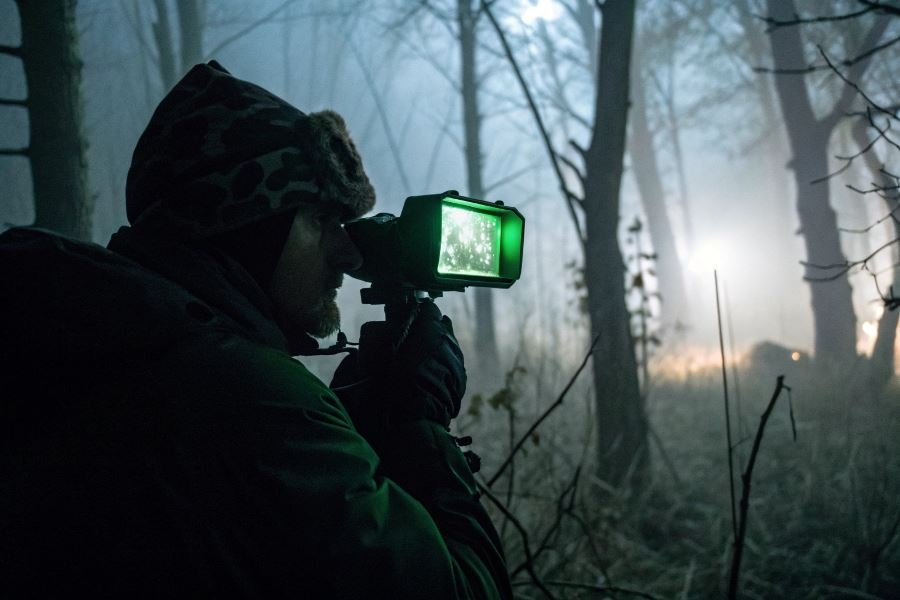
Ever stood in pitch-black woods, knowing your prey is just yards away but completely invisible to your naked eye? This is where modern hunting technology becomes not just an advantage, but a game-changer.
Night hunting has undergone a remarkable transformation since the military first developed rudimentary night vision during World War II. What began as bulky, limited-range equipment has evolved into sophisticated devices that fit in your pocket yet reveal the invisible world with stunning clarity. Today’s hunters face a critical choice between two dominant technologies: thermal imaging and night vision.
The evolution of night hunting technology
Night vision devices (NVDs) first revolutionized hunting in the 1960s when civilian versions became available, amplifying existing light to create that iconic green-tinted view. Thermal imagers, however, represent a different approach altogether, detecting heat signatures rather than light. This fundamental difference traces back to their origins—thermal technology was initially developed for military applications in the 1950s but only became accessible to civilian hunters in the early 2000s when prices finally dropped below the stratosphere.
Thermal vs. night vision: The fundamental divide
Thermal imaging works by detecting heat signatures, creating images based on temperature differences. It doesn’t need any light source whatsoever—a deer’s body heat stands out against the cooler forest backdrop like a beacon.
Night vision, meanwhile, amplifies existing light (including infrared light invisible to humans) to create a visible image. It needs some ambient light—moonlight, starlight, or infrared illumination—to function effectively.
This core difference creates distinct advantages for each technology:
“Thermal sees what’s alive, night vision sees what’s there.” – Veteran hunting guide
Making the right choice for your hunt
When deciding between these technologies, consider:
- Target detection range: Thermal typically offers superior detection at greater distances
- Environmental conditions: Heavy fog or rain? Thermal cuts through better
- Detail recognition: Night vision provides better facial features and terrain details
- Battery life: Night vision typically consumes less power
- Budget considerations: Quality night vision generally starts at lower price points
The ultimate decision comes down to your specific hunting environment, target species, and personal preferences. Many serious hunters eventually invest in both technologies, using them as complementary tools rather than competitors.
The Ultimate Field Test: Thermal vs Night Vision for Hunters
When the sun dips below the horizon, the serious hunter’s advantage comes from technology that extends vision beyond human limits. The debate between thermal imagers and night vision devices has raged across hunting forums, campfires, and gear shops for years. Let’s cut through the marketing hype and get down to performance metrics that matter when you’re tracking game in the darkness.
Deciding between thermal imagers vs night vision devices: which is better for hunting depends entirely on your specific needs, hunting environment, and target game. Both technologies offer distinct advantages that can make or break your nighttime hunting experience, but they operate on fundamentally different principles that affect everything from detection range to battery consumption.
Range and Weather Warriors
Detection range is where these technologies begin to show their true colors. Night vision devices typically offer effective detection ranges of 75-200 yards in optimal conditions. The ATN X-Sight 4K Pro pushes this boundary with detection capabilities reaching up to 300 yards in moonlit conditions. However, introduce fog, rain, or heavy snow, and performance drops dramatically.
Thermal imagers, by contrast, shine in adverse weather. The Pulsar Thermion XP50 can detect heat signatures at ranges exceeding 2,000 yards in ideal conditions, and maintains impressive performance even through moderate fog or light rain. Why? Because thermal doesn’t need ambient light—it reads heat differentials.
The performance gap widens further in dense forests or brush, where thermal can detect animals hidden behind light foliage that would completely obscure them from night vision.
Clarity and Identification Capabilities
| Feature | Thermal Imaging | Night Vision |
|---|---|---|
| Image Detail | Heat signatures only | Actual visual details |
| Color Representation | False color palettes | Green or black/white |
| Target ID Confidence | Medium (shape-based) | High (visual features) |
| Brush Penetration | Excellent | Poor |
Night vision excels in target identification because it shows you what your eyes would see with amplified light. You’ll distinguish antler points, facial features, and other details crucial for ethical hunting and species identification. The Sightmark Ghost Hunter offers remarkable clarity with its Gen 3 technology, allowing hunters to confidently identify game at 100+ yards.
Thermal imaging presents a different picture—literally. You’ll see heat signatures that reveal an animal’s presence with startling clarity, but identifying specific features requires interpretation skills. Is that heat blob a trophy buck or a doe? The learning curve is steeper, but modern units like the FLIR Scout TK offer enhanced resolution that makes identification increasingly reliable.
Field Endurance: Battery Life and Durability
Battery performance can make or break a hunt. Traditional night vision devices typically offer 40-60 hours of continuous operation on a single set of batteries—impressive longevity that keeps you hunting through multiple nights. The Night Owl Optics units are particularly noted for their power efficiency.
Thermal imagers are power-hungry by comparison, typically offering 4-8 hours of operation before requiring a recharge or battery swap. However, manufacturers have responded to this limitation—the Trijicon IR-HUNTER features hot-swappable batteries that allow for extended field use without powering down.
Durability considerations favor thermal in extreme conditions. Most quality thermal units are fully waterproof and rated for operation in temperatures from -4°F to 122°F. Night vision typically has narrower operational temperature ranges and can be more sensitive to extreme cold.
The bottom line: Thermal imaging dominates for detection range and adverse weather performance, while night vision offers superior target identification and battery life. Your hunting environment, target species, and personal preferences should guide your choice between these powerful technologies.
The Ultimate Showdown: Thermal vs Night Vision for Hunting Success
Cost vs benefit across hunting scenarios
When you’re stalking game in the darkness, your choice between thermal imaging and night vision can make or break your hunt. Different scenarios demand different tools, and understanding the cost-benefit equation is crucial before dropping serious cash on either technology.
For big game hunting in dense forests, thermal imagers deliver exceptional value despite their higher price point (1, 500−4,000). Their ability to detect heat signatures through brush, fog, and light rain justifies the investment for dedicated hunters pursuing deer, elk, or wild boar. The thermal advantage becomes particularly evident when tracking wounded game through thick vegetation.
Night vision devices (500−2,000) offer superior cost efficiency for predator hunting in open terrain. When calling coyotes or foxes across fields with minimal obstructions, the enhanced detail and depth perception of night vision often outperforms thermal options costing twice as much. Your ability to identify targets at distance becomes significantly more precise.
For varmint control on properties or farms, the math changes again. Thermal scopes excel at rapid target acquisition when dealing with multiple fast-moving targets like raccoons or feral hogs. The instant heat detection capability justifies the premium price for those protecting livestock or crops from nocturnal raiders.
The smartest hunters match their technology to their specific quarry and terrain rather than simply buying the most expensive option available.
Top thermal imagers that deliver results
- Pulsar Thermion 2 XP50 ($3,999)
- 640×480 thermal resolution with 2.5-20x magnification
- 12-hour battery life with hot-swappable power
- Built-in video recording and recoil rating for calibers up to .375 H&H
- ATN ThOR 4 ($2,699)
- 384×288 sensor with ballistic calculator
- Dual-stream video capability for smartphone connectivity
- Exceptional 18-hour battery performance in field conditions
- Trijicon IR-HUNTER ($3,499)
- Military-grade durability with 640×480 resolution
- Intuitive controls designed for gloved operation
- Advanced image processing for exceptional clarity in varying conditions
These thermal options represent different approaches to the same challenge, with the Pulsar offering premium resolution, the ATN delivering technological integration, and the Trijicon focusing on rugged reliability.
Night vision devices worth your investment
- Armasight by FLIR NYX-7 Pro ($1,895)
- Gen 3 tube with manual gain control
- 51-hour battery life on single CR123A
- Waterproof construction with multi-coated optics
- ATN PVS-14 ($2,999)
- Military standard Gen 3 technology
- Modular design for helmet, weapon, or handheld use
- Automatic brightness control for varying light conditions
- Sightmark Ghost Hunter ($599)
- Gen 1 technology at an entry-level price point
- Lightweight design at just 13.4 ounces
- 20-hour battery life with IR illuminator included
The night vision market offers more price diversity, with the Ghost Hunter providing an accessible entry point for beginners, while the PVS-14 delivers professional-grade performance for serious hunters.
When making your final decision, consider your hunting environment, target species, and frequency of use. The most expensive option isn’t always the best for your specific needs. Many experienced hunters eventually invest in both technologies, using thermal for detection and night vision for detailed identification and ethical shot placement.