
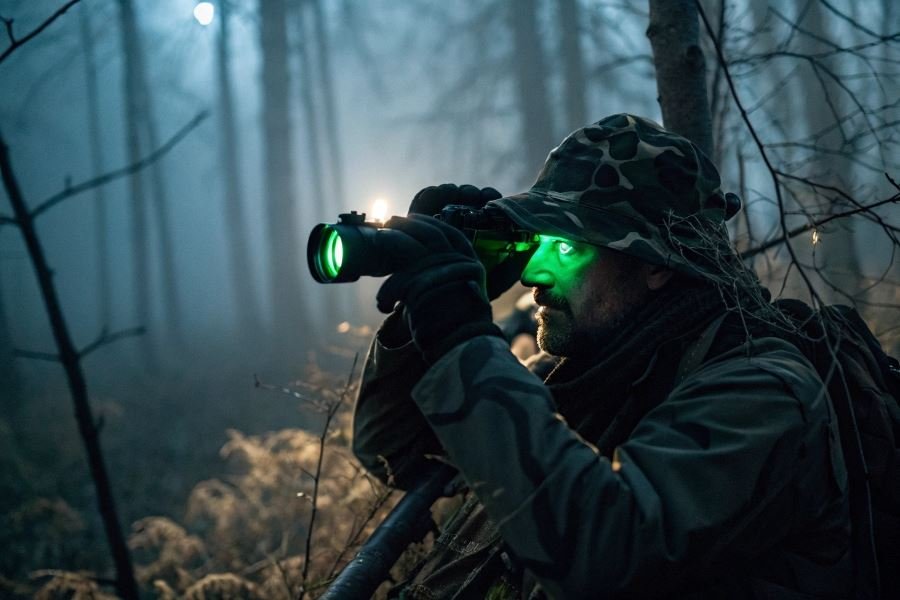
Ever stood in pitch darkness, straining to see what’s lurking 100 yards ahead? That’s where detection range becomes your best friend—or your worst enemy if you’ve chosen the wrong night vision device. Detection range isn’t just another spec on a box; it’s the difference between spotting that trophy buck at 300 yards or missing it completely.
When we talk about detection range in night vision technology, we’re discussing how far you can effectively identify objects in low-light conditions. This capability fundamentally transforms your night experience, whether you’re tracking wildlife, navigating unfamiliar terrain, or ensuring perimeter security. The detection range determines not just what you can see, but how early you can see it—giving you precious extra seconds to react.
Three critical factors shape your detection range experience:
- Ambient light conditions – Even moonlight dramatically affects performance
- Image intensifier generation – Gen3 tubes offer significantly better range than Gen1
- Objective lens diameter – Larger lenses gather more light, extending your visual reach
“The difference between a 200-yard and 400-yard detection range isn’t just numbers—it’s the difference between success and failure in critical situations.”
Your practical applications dictate your range requirements. Wildlife observation might demand longer ranges than urban navigation. Military-grade devices can detect human-sized targets at 1000+ yards, while entry-level civilian options might struggle beyond 200 yards in similar conditions.
Understanding detection range isn’t about chasing specifications—it’s about matching technology to your real-world needs in the darkness.
The Technical Trinity Behind Night Vision Detection
Generation Technology: The Foundation of Range
Night vision technology has evolved dramatically since its military origins in the 1940s. The generation of your device isn’t just marketing jargon—it’s the single most critical factor determining how far you’ll see in the darkness. Gen 1 devices, while affordable at $300-500, typically offer detection ranges of only 75-100 yards in optimal conditions. The leap to Gen 2 devices brings significant improvements with detection ranges extending to 200-300 yards, while top-tier Gen 3 and Gen 4 systems can detect human-sized targets at an impressive 500+ yards.
When evaluating detection range in night vision devices, what to pay attention to goes beyond simple specifications. The generation technology directly impacts the photocathode sensitivity and electron multiplication capabilities, which determine how effectively the device can amplify available light. Gen 3 devices, for instance, use gallium arsenide photocathodes that are significantly more sensitive than the S-25 photocathodes found in Gen 2 units.
Real-world performance differences between generations become most apparent in challenging conditions. While a Gen 2 device might perform adequately on a moonlit night, it will struggle significantly during overcast conditions where a Gen 3 device continues to deliver usable imagery. This performance gap explains the substantial price difference—expect to invest $2,000-3,000 for quality Gen 2+ devices and $3,000-5,000+ for Gen 3 systems.
Resolution and Image Quality: The Detail Determinants
Resolution in night vision isn’t measured in pixels but in line pairs per millimeter (lp/mm). This specification directly correlates with your ability to identify rather than merely detect objects at distance.
Entry-level devices typically offer 45-50 lp/mm, while premium options push beyond 64 lp/mm. The practical difference? At 300 yards, a 64 lp/mm device might allow you to distinguish between a coyote and a domestic dog, while a 45 lp/mm unit would only reveal an unidentifiable four-legged animal.
Signal-to-noise ratio (SNR) works alongside resolution to determine effective range. A higher SNR means cleaner images with less “snow” or electronic noise, particularly crucial in extremely low-light conditions.
| Resolution (lp/mm) | Typical Detection Range | Typical Recognition Range |
|---|---|---|
| 45-50 | 250-300 yards | 150-200 yards |
| 51-57 | 300-350 yards | 200-250 yards |
| 58-64+ | 350-500+ yards | 250-350+ yards |
Magnification and Field of View: The Range-Awareness Balance
Magnification presents a fascinating trade-off in night vision applications. While higher magnification brings distant objects closer, it simultaneously reduces your field of view and decreases the amount of light reaching the intensifier tube.
Most tactical professionals prefer 1x magnification for night vision devices, adding separate magnifiers when needed. This approach preserves the widest possible field of view (typically 40° in quality devices) while maintaining maximum light gathering capability.
The mathematics of field of view directly impact detection capabilities. A 40° FOV allows you to monitor approximately 70 yards of terrain width at 100 yards distance, while a 30° FOV reduces this to about 52 yards. This difference can be critical when tracking moving targets or scanning large areas.
For specialized applications requiring built-in magnification, the sweet spot typically falls between 2.5x-4x, offering enhanced detection range without excessively compromising field of view or light transmission. Beyond 4x, image brightness degrades significantly unless paired with supplemental infrared illumination.
The interplay between these three technical factors—generation technology, resolution quality, and magnification/FOV—creates the foundation for effective detection range in any night vision system. Understanding these relationships empowers you to make informed decisions based on your specific operational requirements rather than marketing claims.
When Mother Nature Challenges Your Night Vision
Weather’s Invisible Hand on Detection Range
Weather doesn’t just ruin picnics—it dramatically alters how your night vision device performs in the field. Rain, fog, and snow create microscopic barriers between you and your target, each water droplet or ice crystal scattering infrared radiation and visible light. During heavy precipitation, expect your detection range to decrease by 30-50% compared to clear conditions.
Humidity plays a particularly sneaky role. Even on seemingly clear nights, high humidity can reduce detection range by up to 25% as water molecules in the air absorb infrared radiation. This explains why your ATN X-Sight 4K might perform differently in Arizona versus Florida on the same moonless night.
Temperature differentials also impact performance. Cold fronts moving through create thermal layers in the air that bend light and infrared radiation, sometimes creating mirage effects that confuse even premium devices. During temperature inversions (when ground level is colder than higher air), detection range often suffers most dramatically.
The Battle Against Artificial Light
Light pollution has become the invisible enemy of night vision enthusiasts. Urban glow can reduce your effective detection range by up to 70% compared to truly dark environments. This is why a device rated for 300 yards might only deliver 100 yards of usable range near city limits.
The type of artificial light matters as much as its intensity. Modern LED streetlights emit different wavelength profiles than older sodium vapor lights, affecting various night vision technologies differently:
| Light Source | Impact on Image Intensifier Tubes | Impact on Thermal Devices |
|---|---|---|
| LED Lighting | Moderate interference | Minimal interference |
| Sodium Vapor | High interference | Minimal interference |
| Halogen | Severe interference | Minimal interference |
| Moonlight | Enhances performance | No significant impact |
Ambient light isn’t always the enemy. Quarter to full moon conditions can actually enhance detection range for traditional night vision, while having minimal impact on thermal devices. This creates interesting tactical considerations when planning nighttime activities.
Field Testing Before You Commit
Don’t trust specifications alone—real-world testing reveals the truth about detection range. Before purchasing, arrange to test devices under conditions that match your intended use:
The Three-Distance Method works remarkably well: Place three objects of similar size but different thermal properties (like a metal can, wooden block, and plastic bottle) at increasing distances. The furthest object you can identify—not just detect—represents your practical identification range.
Always test during various moon phases if possible. A device that performs admirably during a new moon might be your best choice if you’ll primarily operate in extremely dark conditions.
For thermal devices, temperature differential testing is crucial. The standard “Delta-T” test involves viewing objects with 2°C, 5°C, and 10°C temperature differences from their backgrounds. A quality thermal device should detect the 2°C differential at 50% of its maximum rated range.
Record atmospheric conditions during testing—temperature, humidity, and barometric pressure all influence performance. The Kestrel 5700 weather meter has become standard equipment for serious night vision evaluators precisely because these variables matter so much.
Remember that detection, recognition, and identification represent three different ranges—each approximately half the distance of the previous. A target detected at 600 yards might only be recognizable at 300 yards and identifiable at 150 yards.