
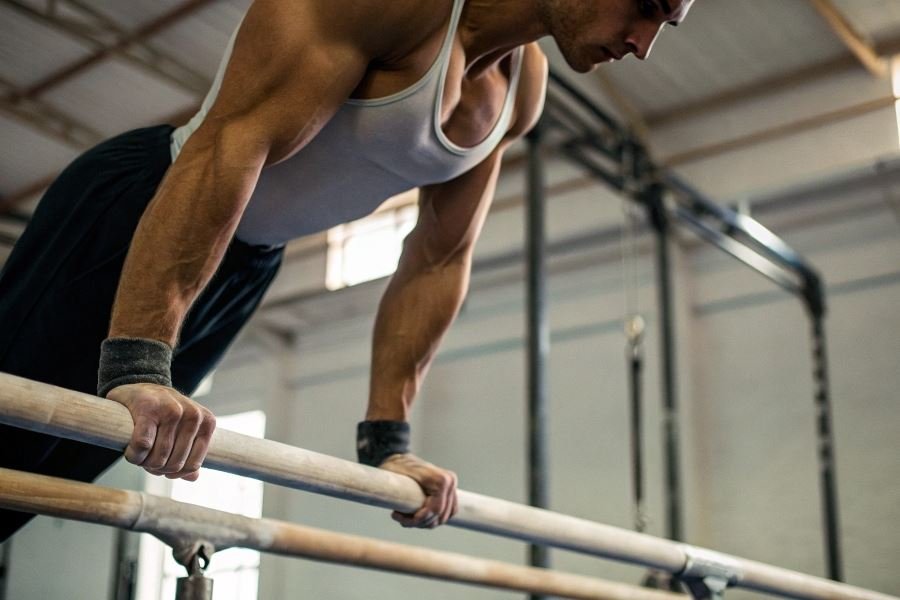
Ever watched gymnasts effortlessly swing and hold positions on parallel bars and thought, “That’s impossible for regular humans”? Think again. Parallel bars aren’t just for Olympic athletes—they’re one of the most effective tools for developing functional upper body strength that translates to everyday life.
Parallel bar training has experienced a renaissance in fitness communities across America, with good reason. These simple structures offer an unmatched combination of strength development and mobility improvement. When you train on parallel bars, you’re not just building muscle—you’re creating a foundation of stability that supports everything from carrying groceries to maintaining proper posture at your desk.
Why your body will thank you for parallel bar training:
The beauty of parallel bars lies in their simplicity and effectiveness. These exercises engage multiple muscle groups simultaneously—your chest, shoulders, triceps, and core all activate during even basic movements. Unlike isolated machine exercises, parallel bar training develops functional strength that mimics real-world movements.
“The parallel bars are like the squat rack for your upper body—they build foundational strength that everything else depends on.” – Coach Mike Fitch, movement specialist
Safety first: Protecting your journey
Before attempting your first dip, ensure you’re working with stable equipment. Commercial parallel bars should be firmly anchored, while portable versions need level ground and weight capacity verification. Start with assisted variations using resistance bands if you’re building initial strength.
Essential equipment checklist:
- Sturdy parallel bars (24-28 inches apart)
- Non-slip gloves for grip security
- Cushioned surface beneath bars
- Resistance bands for assistance
Remember that proper form trumps repetitions every time. Begin with support holds to build foundational strength before progressing to more dynamic movements. Your parallel bar journey starts with respect for the process—master the basics, and the impressive skills will follow naturally.
Mastering the Parallel Bars
The parallel bars stand as one of gymnastics’ most challenging and rewarding apparatus. Learning how to train correctly on parallel bars: tips for beginners can transform your upper body strength and stability while building impressive functional muscle. Whether you’re a gymnastics enthusiast or a fitness buff looking to diversify your routine, mastering these twin rails opens up a world of bodyweight possibilities.
Grip and Body Position Fundamentals
Your journey begins with proper hand placement. Position your hands shoulder-width apart or slightly wider, with fingers pointing forward and thumbs wrapped around the bars. Your wrist alignment is critical – keep them straight rather than bent to prevent strain and injury.
For beginners, the support position forms your foundation. Start by jumping up, straightening your arms, and holding your body above the bars with shoulders depressed (away from your ears). Your torso should remain upright, with core engaged and legs either straight or slightly bent at the knee.
The quality of your support position determines 80% of your success on parallel bars. Master this before attempting any dynamic movements.
Many newcomers make the mistake of shrugging their shoulders toward their ears, which creates unnecessary tension and reduces stability. Instead, focus on pushing the bars downward while keeping your shoulders away from your ears – imagine trying to make your shoulders meet your lats.
Progressive Exercise Sequence
Building strength on parallel bars requires methodical progression:
- Support holds – Begin with 3 sets of 20-30 second holds in the support position
- Shoulder shrugs – From support, lower slightly by shrugging shoulders, then press back up
- Straight arm forward leans – Shift weight forward while maintaining straight arms
- Straight arm backward leans – Shift weight backward while maintaining straight arms
- Dips – Lower body by bending elbows, then press back up
For optimal progression, master each exercise before advancing to the next. A beginner-friendly training schedule might look like:
| Week | Exercise | Sets × Reps/Time | Rest |
|---|---|---|---|
| 1-2 | Support holds | 3×20 seconds | 90 sec |
| 3-4 | Support + Shoulder shrugs | 3×30 sec + 3×5 | 90 sec |
| 5-6 | Forward/backward leans | 3×8 each direction | 2 min |
| 7-8 | Assisted dips | 3×5-8 | 2 min |
Equipment quality matters significantly. Consider investing in adjustable Gymnastics Parallel Bars for home training or find a gym with professional-grade equipment.
Form Mistakes to Avoid
The parallel bars quickly expose technical flaws that can lead to injury or stalled progress:
Elbow flaring during dips places dangerous stress on shoulder joints. Keep elbows tracking backward, not outward.
Excessive forward lean shifts weight improperly and can cause wrist strain. Maintain vertical forearms whenever possible, especially during support positions and dips.
Collapsed shoulders reduce stability and power. Always actively push down through the bars rather than passively hanging from your joints.
Swinging legs indicates core weakness. Keep your lower body controlled and still during static holds and controlled during dynamic movements.
Consistent practice with proper form builds the specialized strength needed for parallel bar mastery. Your body will adapt to these challenging positions over time, but rushing progression almost guarantees setbacks. Listen to your wrists and shoulders – they’ll tell you when you’re ready to advance.
Building Your Parallel Bar Mastery Program
Beginner Workout Routines That Actually Work
Let’s cut straight to the chase—parallel bars are one of the most rewarding gymnastics apparatus you’ll ever train on, but they demand a structured approach. Your first few weeks should focus on building foundational strength and comfort on the bars.
Here’s a sample beginner routine that’s proven effective for newcomers:
Day 1: Strength Foundation
- Support holds: 5 sets of 20-30 seconds
- Assisted dips: 3 sets of 8-10 reps
- Shoulder shrugs in support position: 3 sets of 12
- Rest 90 seconds between sets
Day 2: Movement Patterns
- Swing practice: 5 sets of 10 swings
- Forward lean holds: 3 sets of 15 seconds
- Assisted L-sits: 4 sets of 10-15 seconds
- Rest 2 minutes between exercises
Day 3: Skill Integration
- Support to tuck position transitions: 3 sets of 8
- Straight arm depression holds: 4 sets of 20 seconds
- Basic swing to support practice: 5 sets of 5 reps
- Rest as needed, focusing on quality
The difference between flailing and flowing on parallel bars isn’t talent—it’s smart programming and consistent practice.
Tracking Your Parallel Bar Journey
Progress on parallel bars isn’t linear, but it is measurable. Create a training journal that tracks:
- Time metrics: How long can you hold support positions?
- Rep quality: Are your movements controlled or desperate?
- Recovery needs: How many days between sessions feels optimal?
- Technical milestones: First unassisted dip, first L-sit, first controlled swing
A simple progression framework looks like this:
| Skill Level | Support Hold | Dips | L-Sit | Swing Control |
|---|---|---|---|---|
| Beginner | 20-30 sec | 0-5 | 0-5 sec | Basic pendulum |
| Intermediate | 45-60 sec | 8-12 | 10-20 sec | Forward/backward |
| Advanced | 90+ sec | 15+ | 30+ sec | Complex transitions |
Don’t rush advancement. Master each level before progressing—your shoulders will thank you. Record video of your practice sessions every two weeks to catch technical improvements your muscles might feel but your eyes miss.
Complementary Exercises That Supercharge Progress
What you do off the bars dramatically impacts what you can do on them. These complementary exercises create the foundation for parallel bar success:
Core Strengtheners:
- Hollow body holds: 3 sets of 30-45 seconds
- Hanging leg raises: 3 sets of 10-12 reps
- Plank variations: 3 sets of 45-60 seconds
Shoulder Stabilizers:
- Face pulls with TRX: 3 sets of 15
- Cuban rotations: 3 sets of 12
- Scapular push-ups: 3 sets of 15
Wrist Conditioners:
- Rice bucket rotations: 2 minutes each direction
- Wrist curls and extensions: 3 sets of 15
- Support position wrist stretches: 30 seconds each position
Implement these complementary exercises 2-3 times weekly, ideally on days you’re not on the bars. This creates a balanced approach that builds necessary strength while allowing for recovery.
Remember that parallel bar training is as much about building body awareness as it is about strength. The athletes who progress fastest aren’t necessarily the strongest—they’re the ones who develop the neural pathways for precise movement control through consistent, structured practice.