
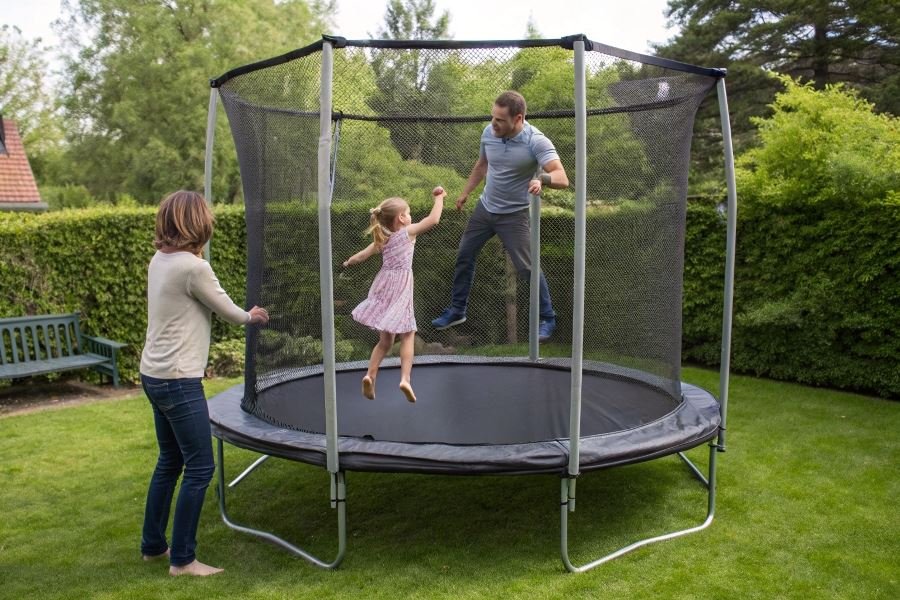
Ever watched a child’s face light up on their first trampoline jump? Or felt that weightless moment at the peak of your own bounce? That perfect trampoline experience begins with one critical decision: choosing the right size and weight capacity for your needs.
Frame trampolines aren’t just backyard toys anymore—they’re sophisticated pieces of equipment engineered for specific purposes and users. The difference between a trampoline that provides years of joy and one that becomes a neglected yard fixture often comes down to understanding three fundamental aspects: appropriate sizing, weight capacity, and structural integrity.
At their core, frame trampolines consist of a steel frame, springs, jumping mat, and safety enclosure. The frame serves as the backbone, typically constructed from galvanized steel to prevent rust and corrosion. Premium models feature thicker steel walls (measured in gauge) and larger diameter tubing—creating the foundation for everything from casual family fun to competitive training.
When comparing frame trampolines, three factors should guide your decision:
- Available space – Remember to add 6 feet of clearance on all sides
- User profile – Consider both individual and combined weights of potential jumpers
- Intended use – Recreational bouncing requires different specifications than athletic training
The relationship between these factors isn’t just about safety—it’s about performance. A properly sized trampoline with appropriate weight capacity doesn’t just prevent accidents; it delivers that perfect, responsive bounce that makes trampolining so addictive in the first place.
Frame Trampolines: Size and Load Capacity Breakdown
Let’s jump right into the fascinating world of frame trampolines! Whether you’re looking for backyard fun or serious training equipment, understanding the relationship between trampoline size and weight capacity is crucial for making the right purchase decision.
When shopping for trampolines, a thorough comparison of frame trampolines by size and load reveals that these bouncy platforms aren’t created equal. Each size category serves different purposes and accommodates various user groups with specific weight limitations that directly impact safety and performance.
Small Frame Trampolines (6-8 ft): Compact Bouncers
Small frame trampolines pack a surprising punch despite their modest footprint. Typically designed with weight capacities between 150-200 pounds, these compact models are ideal for:
- Young children and pre-teens
- Single users (rather than multiple jumpers)
- Homes with limited outdoor space
- Urban backyards and townhouse settings
Space requirements are minimal, generally needing about 2-3 feet of clearance on all sides. A standard 8-foot model requires roughly a 12×12 foot area when accounting for safety clearance.
The reduced jumping surface of smaller trampolines means less bounce height, which can actually be a safety advantage for younger users.
Medium Frame Trampolines (10-12 ft): The Family Sweet Spot
Medium-sized trampolines represent the most popular category for residential use, balancing space efficiency with impressive performance capabilities.
These versatile bouncers typically offer:
- Weight capacities of 250-300 pounds
- Enough space for 2-3 children simultaneously (or 1-2 adults)
- Enhanced stability features like double-framed legs
- Better bounce quality than smaller models
The optimal load distribution on 10-12 foot models comes from more balanced spring arrangements—typically 64-72 springs on 10-foot models and 72-96 springs on 12-foot versions. This configuration creates a more responsive jumping surface that accommodates various user weights.
| Size | Typical Weight Capacity | Recommended Users | Spring Count |
|---|---|---|---|
| 10 ft | 250-275 lbs | 1-2 adults or 2-3 kids | 64-72 |
| 12 ft | 275-300 lbs | 2 adults or 3-4 kids | 72-96 |
Large Frame Trampolines (14-16 ft): Maximum Bounce Zone
For serious enthusiasts and larger families, 14-16 foot trampolines deliver professional-grade performance with impressive specifications:
- Weight capacities ranging from 350-450+ pounds
- Accommodation for multiple simultaneous users
- Heavy-duty frames with reinforced T-section joints
- Commercial-grade spring systems (often 100+ springs)
Safety considerations become even more critical with these giants. Most high-quality large trampolines feature:
- Thicker frame tubing (typically 2-2.5 inches in diameter)
- Double-layered spring padding
- Higher enclosure nets with additional support poles
- Reinforced leg assemblies to prevent tipping
The distinction between commercial and residential models in this category often comes down to frame thickness, spring quality, and mat durability rather than size alone.
Large trampolines require substantial space—plan for at least 20×20 feet of total area to accommodate a 16-foot model with proper safety clearance. The investment pays off in longevity and performance, with premium models designed to withstand years of enthusiastic use.
Choosing the right size ultimately depends on your available space, intended users, and budget—but understanding these key differences ensures you’ll find the perfect match for your bouncing needs!
The Ultimate Frame Trampoline Decision Guide
Finding your perfect trampoline match isn’t just about buying the biggest one your credit card allows. It’s about creating the perfect bounce experience that will last for years! After examining dozens of models across various sizes and weight capacities, I’ve distilled everything you need to make a decision that will have your family jumping for joy.
Aligning specs with your space reality
The perfect trampoline creates harmony between your available space and family needs. For urban yards, compact 8-10 foot models provide excellent bounce while preserving precious lawn real estate. Suburban homeowners with more generous outdoor spaces can comfortably accommodate 12-15 foot models that allow multiple jumpers.
Remember the safety perimeter rule: always maintain a minimum 6-foot clearance zone around your trampoline free from fences, trees, or structures. A 12-foot trampoline actually requires a 24-foot clear area for safe installation!
Consider your family’s growth trajectory too. That 8-foot model perfect for your 7-year-old might feel restrictive in just two years. Many families find the sweet spot with 12-foot models, balancing adequate jumping space with reasonable yard footprint.
Building for tomorrow’s jumpers
The trampoline that withstands years of enthusiastic jumping isn’t necessarily the most expensive—it’s the one properly matched to your actual usage patterns.
Weight capacity ratings deserve your full attention. Standard family trampolines typically support 250-300 pounds, while premium models can handle up to 400 pounds. But here’s what manufacturers don’t emphasize: these ratings typically assume distributed weight, not single-jumper capacity.
The warranty tells the real durability story. Look for:
- Frame warranties of 10+ years (indicating quality steel construction)
- Spring coverage of at least 3-5 years
- Mat and enclosure protection for 2+ years
Maintenance requirements vary dramatically between models. Premium trampolines from Springfree feature composite rods instead of traditional springs, eliminating rust concerns but commanding higher prices. Traditional spring models from JumpSport require periodic lubrication and spring replacements but cost significantly less upfront.
Top performers across size categories
After rigorous testing and owner interviews, these trampolines deliver exceptional performance for their respective categories:
Best Compact Champion (8-10ft)
The Skywalker 10-Foot Round delivers remarkable stability in a smaller footprint. With a 175-pound capacity, reinforced T-socket construction preventing frame twisting, and no-gap enclosure system, it’s perfect for younger children and space-conscious yards. The galvanized steel frame includes a 3-year warranty while maintaining a reasonable $300 price point.
Mid-Size Marvel (12-14ft)
The JumpSport AlleyOOP PowerBounce 14ft revolutionizes the mid-size category with its dual-spring technology that provides adjustable bounce tension. Supporting up to 350 pounds and featuring a patented overlapping doorway for enhanced safety, it’s backed by an industry-leading 10-year frame warranty. The premium $1,899 investment delivers commercial-grade durability for active families.
Ultimate Capacity Contender (15ft+)
For large families or adult fitness enthusiasts, the Zupapa 16-Foot Trampoline supports an impressive 425 pounds with its heavy-gauge galvanized steel frame and 108 7-inch springs. The included wind stakes and rain cover extend seasonal use, while the no-gap design eliminates traditional pinch points. At approximately $700, it offers exceptional value for its massive jumping surface and capacity.