
Ever wondered how elite tactical teams maintain razor-sharp skills without burning through thousands of rounds of live ammunition? The answer might be sitting in your sporting goods store’s airgun section.
Pneumatic rifles—sophisticated air-powered weapons that use compressed air or gas to propel projectiles—have revolutionized tactical training across military, law enforcement, and civilian sectors. These aren’t your grandfather’s BB guns. Modern pneumatic rifles deliver remarkable accuracy, realistic operation, and tactical functionality that mirrors their firearm counterparts, but with distinct advantages that make them ideal training tools.
The training edge: Benefits beyond the budget
The advantages of pneumatic rifles for tactical training extend far beyond cost savings (though paying pennies per shot instead of dollars certainly doesn’t hurt). Training with these systems eliminates the need for dedicated firing ranges, reduces noise concerns, and removes the administrative burden of ammunition logistics.
“The ability to train anywhere, anytime without environmental restrictions has completely transformed our force readiness protocols.” — Former Special Operations instructor
Perhaps most importantly, pneumatic rifles allow for consequence-free repetition. Shooters can practice malfunction drills, tactical reloads, and position transitions thousands of times without the fatigue and stress that comes with live fire exercises.
Selecting your tactical trainer: What matters most
When evaluating pneumatic rifles for tactical training, prioritize these critical features:
- Realistic weight and balance matching your actual firearm
- Authentic manual of arms with identical controls and operation
- Consistent accuracy at your intended training distances
- Durable construction that withstands intensive training scenarios
- Compatible accessories that mirror your tactical loadout
The right pneumatic rifle doesn’t just supplement firearm training—it enhances it, creating muscle memory and tactical awareness that transfers seamlessly to real-world applications.
Top 3 Pneumatic Rifles for Tactical Training
When it comes to honing your tactical skills, the right equipment makes all the difference. The best pneumatic rifles for tactical training combine accuracy, reliability, and realistic feedback without the high costs and restrictions of firearm training. Whether you’re a seasoned operator or just starting your tactical journey, these air-powered alternatives deliver serious performance that translates to real-world proficiency.
High-precision pneumatic rifles for advanced training
For those who demand surgical precision, advanced pneumatic rifles offer match-grade accuracy that rivals their firearm counterparts. The FX Impact X MKII stands as the undisputed champion in this category, delivering sub-MOA accuracy at 50 yards. With adjustable power settings from 12 to 80 ft-lbs and a match-grade barrel, it’s the gold standard for serious training.
The Daystate Red Wolf deserves equal attention with its electronic firing system that virtually eliminates trigger lag—critical for developing proper trigger discipline. Its carbon fiber tank provides up to 200 consistent shots, perfect for extended training sessions.
Key features to look for in precision trainers:
- Regulated air systems for shot consistency
- Match-grade barrels with precision rifling
- Adjustable triggers (under 1lb pull weight)
- Modular platforms that mimic tactical firearms
Budget-friendly options for beginners
Not everyone needs to invest $2,000+ in their first tactical trainer. Several manufacturers offer excellent entry-level options that deliver respectable performance without breaking the bank.
The Umarex T4E TR50 provides a realistic training platform at around $200 that accepts tactical accessories and delivers enough accuracy for fundamental skill development. Its CO2-powered system offers simplicity and reliability that beginners appreciate.
| Model | Power Source | FPS | Effective Range | Price |
|---|---|---|---|---|
| Umarex T4E TR50 | CO2 | 410 | 30 yards | $199 |
| Crosman DPMS SBR | CO2 | 430 | 25 yards | $220 |
| Sig Sauer MCX | CO2 | 700 | 40 yards | $269 |
The Crosman DPMS SBR deserves special mention for its full-auto capability and AR-platform compatibility, allowing beginners to practice with the same accessories they might use on centerfire platforms.
Versatile rifles for various scenarios
The true workhorses of tactical air rifle training bridge the gap between precision and practicality. These platforms adapt to multiple training scenarios from CQB drills to distance shooting.
The AEA Zeus .45 exemplifies versatility with its semi-automatic action and substantial power. Capable of delivering 230 ft-lbs of energy, it provides realistic recoil impulse for force-on-force training while maintaining enough accuracy for precision work at 100 yards.
What makes these versatile platforms stand out is their ability to transition between different training modalities without compromising performance in either role.
The Hatsan BullBoss offers another excellent option with its bullpup design providing a compact platform that excels in CQB scenarios while delivering enough power and accuracy for longer-range applications.
Training versatility factors:
- Quick-change magazines for reload drills
- Adjustable power settings for different scenarios
- Compatible mounting systems for various optics
- Similar manual of arms to tactical firearms
When selecting your pneumatic training rifle, consider your specific training goals, budget, and experience level. The right platform will grow with your skills while providing the feedback necessary to develop proper fundamentals that transfer directly to tactical applications.
Maximizing Training Effectiveness with Pneumatic Rifles
Tactical training with pneumatic rifles isn’t just about pulling triggers—it’s about building muscle memory, refining technique, and developing skills that translate to real-world scenarios. Whether you’re a competitive shooter or tactical enthusiast, pneumatic rifles offer an accessible, cost-effective training platform that can dramatically improve your performance.
Tactical Drills That Deliver Results
The beauty of pneumatic rifles lies in their versatility for training scenarios. Start with the “Transition Drill”—engaging multiple targets at varying distances to develop target acquisition speed. Set up three targets at 10, 15, and 20 yards, then practice shifting between them with minimal time lag.
The “Failure to Stop” drill simulates critical defensive scenarios. Place a silhouette target at 15 yards and practice delivering two shots to the center mass followed by one precision shot to the head area. This builds the fundamental rhythm of controlled pairs while reinforcing accuracy under pressure.
Movement-based drills truly separate casual shooters from tactical operators. The “Box Drill” requires navigating a square pattern while engaging targets from different positions—standing, kneeling, and prone. This builds positional awareness and teaches you to maintain accuracy during movement.
The difference between good and great shooters isn’t just accuracy—it’s maintaining that accuracy while moving, communicating, and problem-solving.
For advanced practitioners, incorporate stress elements like shot timers, physical exertion (10 push-ups before shooting), or complex decision-making scenarios with “shoot/no-shoot” targets.
Maintenance Protocols for Peak Performance
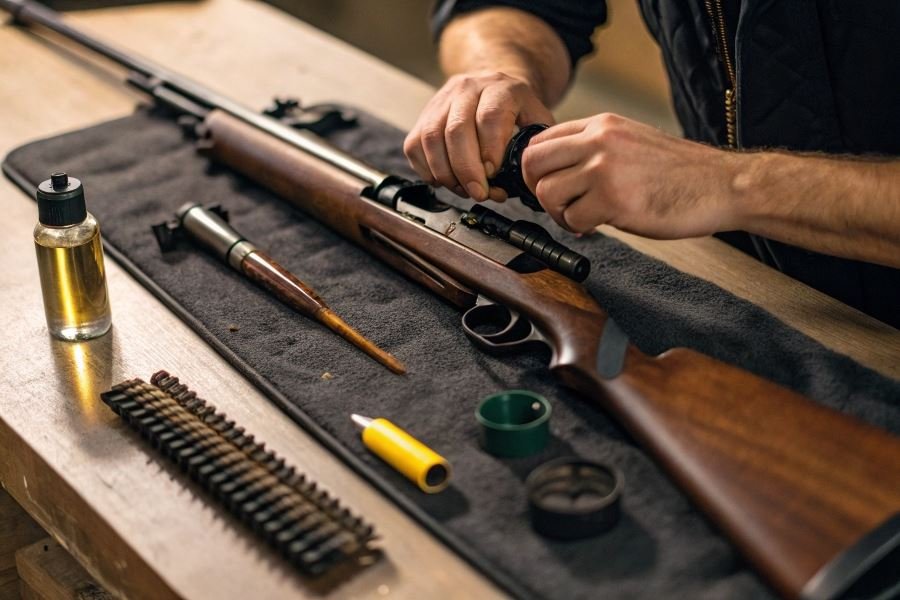
Pneumatic rifles demand specific care routines that differ from firearm maintenance. The heart of your system—the air reservoir—requires regular inspection for leaks, particularly around O-rings and seals.
After every training session:
- Clean the barrel using a proper-sized cleaning rod and patches
- Inspect and lubricate moving parts with manufacturer-recommended oil
- Check all mounting hardware for tightness
- Store with partial pressure in the reservoir (never completely empty)
Quarterly maintenance should include a deeper dive: disassemble the action according to manufacturer guidelines, clean trigger assemblies, and replace any worn O-rings. Products like Crosman Pellgunoil specifically formulated for pneumatic systems will extend your rifle’s lifespan significantly.
Safety Protocols That Cannot Be Compromised
Pneumatic rifles may lack firearm classification, but they demand identical safety discipline. The foundation remains the four universal safety rules:
- Treat every weapon as if it were loaded
- Never point at anything you don’t intend to destroy
- Keep your finger off the trigger until ready to fire
- Be certain of your target and what lies beyond
For training-specific safety:
| Safety Element | Implementation |
|---|---|
| Eye Protection | ANSI Z87.1 rated minimum |
| Training Zone | Dedicated area with proper backstop |
| Equipment Checks | Pre-session inspection of rifle and targets |
| Briefing | Review of drills and safety protocols before starting |
Always designate a safety officer during group training sessions who maintains situational awareness while others focus on drills. Establish clear commands for “cease fire” that everyone recognizes instantly.
Pneumatic training isn’t just about saving ammunition costs—it’s about creating more training opportunities with less logistical overhead. By implementing these drills, maintenance routines, and safety protocols, you’ll extract maximum value from your pneumatic platform while building skills that transfer seamlessly to any shooting discipline.