
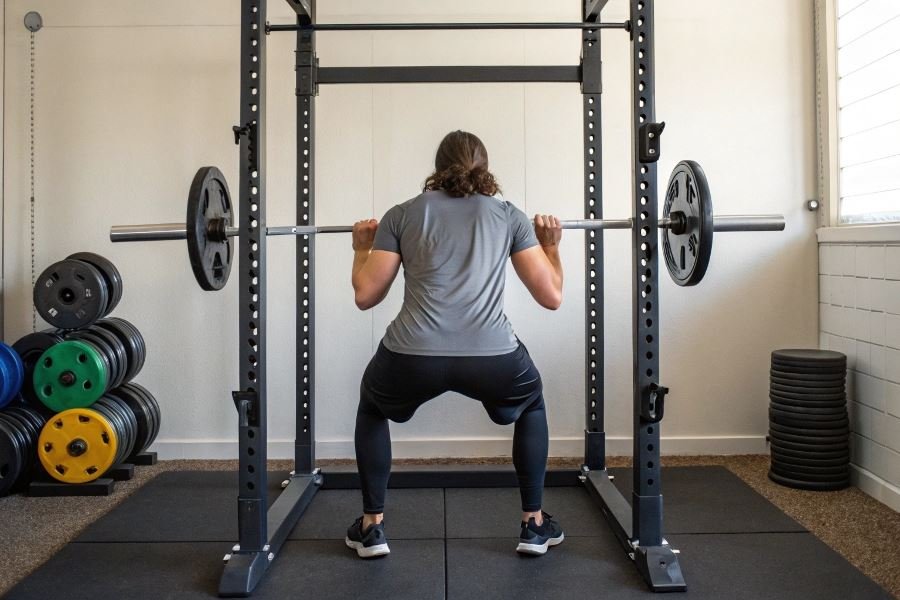
Ever watched someone confidently perform heavy squats without a spotter and wondered how they’re not terrified? The answer is likely standing right behind them—a power rack, the unsung hero of the weight room.
A power rack (sometimes called a power cage or squat rack) is essentially a steel framework with adjustable safety bars and hooks that allow you to lift heavy weights safely without a spotter. Think of it as your personal strength training guardian angel. When properly set up, those safety bars catch the weight if you fail a rep, preventing what could otherwise be a dangerous situation.
Why beginners need power racks more than anyone else
For newcomers to strength training, power racks aren’t just convenient—they’re transformative. They allow you to perform the “big four” compound movements (squats, bench press, overhead press, and rack pulls) with confidence. The safety features mean you can push yourself without the fear that typically holds beginners back from progressive overload—the key principle behind getting stronger.
“The power rack is where potential meets safety. It’s where beginners become intermediates.”
Safety isn’t optional
Selecting the right power rack isn’t just about aesthetics or price—it’s about creating an environment where you can safely challenge yourself. The adjustability of the safety pins, the stability of the frame, and the weight capacity all directly impact your training journey. A properly selected rack prevents injuries and builds confidence, while a poorly chosen one can do the opposite.
What truly matters in your first power rack
When shopping for your first power rack, focus on:
- Stability – Does it wobble when loaded?
- Height clearance – Can you perform overhead movements?
- Safety features – Are the spotter arms/pins robust?
- Weight capacity – Will it support your future strength goals?
Remember, a power rack is an investment in your strength training future—perhaps the most important piece of equipment you’ll ever buy.
Essential Features Every Power Rack Should Have
When stepping into the world of strength training, finding the right equipment can make or break your fitness journey. Power racks stand as the cornerstone of any serious home gym setup, offering versatility and safety that’s unmatched by other equipment. For those just beginning their strength training adventure, understanding what to look for in a power rack is crucial for both safety and progress.
Many beginners struggle when selecting their first power rack because they’re overwhelmed by options and technical specifications. Power racks for beginners: what to pay attention to often comes down to three critical areas: construction quality, safety features, and spatial considerations. Getting these right will ensure your investment supports your fitness goals for years to come.
Built to Last: Construction and Weight Capacity
The foundation of any worthwhile power rack is its structural integrity. Look for racks constructed from 11-gauge steel or thicker (lower gauge numbers indicate thicker steel). This isn’t just about durability—it directly impacts how much weight the rack can safely support.
Weight capacity requirements should exceed your current lifting abilities by at least 50%. While you might only squat 200 pounds today, your future self will thank you for investing in a rack rated for 800-1000 pounds. Most quality beginner racks offer capacities between 700-1200 pounds, providing ample room for growth.
Pay attention to these construction details:
- Welded versus bolted connections (welded typically offers greater stability)
- Upright thickness (2″×2″ minimum, with 3″×3″ being ideal)
- Base stability features like plate storage pegs or floor anchoring options
The difference between a wobbly rack and a rock-solid foundation becomes apparent the moment you rack a heavy barbell after a challenging set.
Safety First: Protection Systems That Matter
When pushing your limits, safety features aren’t optional—they’re essential. Three key components deserve your attention:
| Safety Feature | Function | What To Look For |
|---|---|---|
| J-hooks | Hold barbell when not in use | Thick UHMW lining, weight rating |
| Safety bars/pins | Catch failed lifts | Height adjustability, strength rating |
| Spotting systems | Additional protection | Straps vs. pins, ease of adjustment |
The best racks for beginners include Rogue Fitness style numbered hole spacing—1″ in the bench press zone and 2″ elsewhere—allowing precise height adjustments for both J-hooks and safety bars.
Never compromise on safety features. Even experienced lifters fail reps, and when you’re under heavy weight, reliable safety mechanisms prevent potentially serious injuries.
Size Matters: Finding Your Perfect Fit
Before falling in love with any power rack, grab a tape measure. Three spatial considerations will determine whether your relationship with your rack is harmonious or frustrating:
-
Ceiling height compatibility: Standard power racks require 7-8 feet of clearance. For lower ceilings, consider short racks or squat stands.
-
Footprint requirements: Most full-sized power racks need approximately 4’×4’ of floor space, plus working room around the perimeter. Half racks can reduce this footprint while maintaining core functionality.
-
Workout space: Allow at least 2 feet on all sides for plate loading and movement patterns. Remember that some exercises, like barbell rows, require additional space in front of or behind the rack.
The perfect power rack fits your space like a glove—snug enough to feel secure, but with enough room to move naturally through all your exercises.
By focusing on these essential features—robust construction, comprehensive safety systems, and appropriate sizing—beginners can select a power rack that will support not just their current needs, but their strength training journey for years to come.
Power Up Your Rack: Essential Accessories for Beginners
When you’ve invested in a power rack, you’re already on the right path to building serious strength. But a bare-bones rack is just the beginning. The right accessories transform your basic setup into a complete home gym that rivals commercial facilities. Let’s dive into the three must-have power rack additions that will maximize your training potential from day one.
Pull-up Bars and Attachment Options
The humble pull-up bar might seem basic, but it’s the gateway to upper body development that few exercises can match. Most quality racks come with a standard straight pull-up bar, but don’t settle for the basics when your gains are on the line.
Multi-grip pull-up bars offer various hand positions that target different muscle groups:
- Neutral grip (palms facing each other) reduces shoulder strain
- Wide grip activates more lat engagement
- Angled grips allow for natural wrist positioning
The Rogue Fitness Monster Lite Multi-Grip Bar exemplifies versatility with its knurled grips and multiple hand positions, supporting users up to 500 pounds.
Beyond standard pull-ups, consider attachments that expand your exercise library exponentially:
| Attachment | Primary Benefit | Approximate Cost |
|---|---|---|
| Gymnastic Rings | Instability training for core | $30-60 |
| Band Pegs | Variable resistance training | $20-40 |
| Dip Bars | Chest/tricep development | $60-120 |
Weight Plate Storage Solutions
Nothing kills workout momentum faster than tripping over weight plates scattered across your floor. Proper storage isn’t just about organization—it’s about safety, efficiency, and extending the life of your equipment.
Vertical plate storage posts attach directly to your rack, keeping weights accessible while saving valuable floor space. Look for posts with:
- Weight capacity ratings (typically 300+ pounds per post)
- Compatibility with both standard and Olympic plates
- Powder-coated finish to prevent corrosion
The Titan Fitness Weight Plate Holders offer excellent value with their 10-inch length that accommodates multiple plates per post.
Horizontal plate storage options work well for those with wall space to spare:
“The most efficient home gym setup keeps everything within arm’s reach but nothing in your way.”
For bumper plates specifically, dedicated trees provide better organization and prevent the warping that can occur when rubber plates are stored vertically for extended periods.
Bench Compatibility and Exercise Expansion
A power rack without a compatible bench is like a sports car without seats—functional but severely limited. The bench-rack relationship determines approximately 40% of the exercises you’ll be able to perform effectively.
Key bench compatibility factors:
- Height adjustment range (ideally 17-20 inches at flat position)
- Width (should pass through rack opening with clearance)
- Weight capacity (minimum 700 pounds including user weight)
The Rep Fitness AB-5200 Adjustable Bench features a ladder adjustment system that eliminates wobble during heavy pressing movements—critical for safety under load.
Beyond the bench, consider these exercise-expanding accessories:
- Landmine attachments transform one corner of your rack into a pivot point for dynamic movements
- Safety straps provide a softer alternative to metal safety pins when failing on heavy lifts
- Pulley systems add cable exercise options without requiring additional floor space
With these three accessory categories properly addressed, your beginner power rack transforms into a comprehensive strength training station capable of supporting years of progressive overload and technique development.