
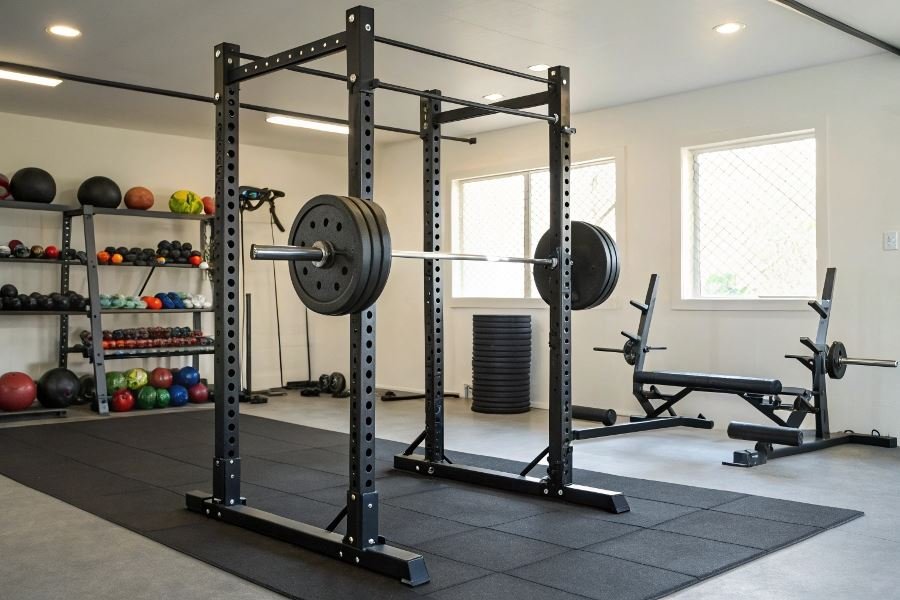
Ever walked into a gym and wondered why some people are training inside what looks like a metal cage while others are using what appears to be glorified sawhorses? That’s the power rack versus power stand dilemma – and your choice between them could be the difference between crushing your fitness goals or wasting precious gym time.
Power racks (sometimes called power cages) are four-post structures with adjustable safety bars and J-hooks that create a complete training station. Think of them as your strength training command center – they typically stand 7-8 feet tall and allow for exercises to be performed safely inside their frame. Power stands, meanwhile, are more minimalist – typically just two adjustable posts designed to hold a barbell at various heights.
The difference goes far beyond appearances. Power racks offer superior stability, versatility, and safety features. They allow for spotterless training with heavy weights and accommodate dozens of exercises from squats to pull-ups. Power stands deliver portability and space efficiency but sacrifice some stability and exercise variety.
Matching your equipment to your training goals is crucial. If you’re focused on powerlifting or progressive overload training, a power rack’s safety features and versatility make it worth the investment. For Olympic lifting or more dynamic movements where you need space to drop weights, power stands might be your better option.
The right choice ultimately depends on your training style, available space, and safety requirements – not just what looks impressive in your home gym.
Making the Right Choice: Power Racks vs Power Stands
When building your strength training sanctuary, few decisions impact your workout potential more than choosing between power racks and power stands. Power racks vs power stands: which is better for your goals depends on several critical factors that directly influence your training experience, safety, and long-term satisfaction with your equipment investment.
Space Requirements and Home Gym Compatibility
Power racks demand respect—and floor space. A typical full-size power rack requires approximately 4×4 feet of floor space and ceiling clearance of at least 7-8 feet. This footprint makes them challenging for apartment dwellers or those with limited dedicated workout areas.
Power stands, by comparison, are the minimalists of strength equipment:
- Typically require only 2×2 feet of floor space
- Can be easily separated and stored when not in use
- Don’t require specific ceiling height considerations
Home gym compatibility score:
| Equipment | Small Spaces | Medium Spaces | Dedicated Gym Rooms |
|---|---|---|---|
| Power Stands | Excellent | Excellent | Good |
| Power Racks | Poor | Good | Excellent |
Exercise Versatility and Movement Limitations
The versatility gap between these equipment options is substantial. Power racks serve as complete training stations with capabilities for:
- Pull-ups and chin-ups
- Band-assisted exercises
- Suspension training attachment points
- Dip station attachments
- Landmine attachments
Power stands primarily excel at one thing: supporting barbell exercises from the floor. While perfect for bench press, squats, and shoulder press, they lack the attachment points and versatility that make power racks true training hubs.
Safety Features and Spotting Capabilities
Safety should never be compromised when lifting heavy weights alone.
Power racks provide comprehensive safety systems:
- Adjustable safety bars/pins that catch failed lifts
- J-hooks at multiple heights
- Full cage protection during exercises
Power stands offer minimal safety features, typically limited to:
- Barbell cradles at fixed heights
- No protection for failed lifts
- Limited or no spotting capabilities
This safety differential becomes critical when pushing your limits without a training partner.
Weight Capacity and Stability Considerations
The structural integrity difference between these options is significant:
Power Racks:
- Weight capacities ranging from 500-1500+ pounds
- Four-post design creating exceptional stability
- Ability to bolt to floor for maximum security
Power Stands:
- Typically rated for 300-600 pounds
- Two-post design with narrower base
- More susceptible to tipping under uneven loads
For serious lifters approaching advanced numbers, this capacity difference can become the deciding factor.
Price Points and Investment Value
Budget considerations often drive equipment decisions. Power stands typically range from $100-300, making them accessible entry points for beginners. Quality power racks start around $300 for basic models and can exceed $1,000 for commercial-grade options with attachments.
However, value transcends initial price. A power rack’s versatility, safety features, and longevity often provide superior cost-per-exercise value despite the higher upfront investment. Power stands, while budget-friendly, may require eventual replacement as training goals advance.
The decision ultimately hinges on your specific training goals, available space, and budget priorities. For dedicated lifters with adequate space, a power rack’s comprehensive capabilities make it the superior long-term investment. For those with space constraints or more casual training approaches, power stands offer a practical, economical solution that still enables effective strength development.
Matching Your Lifting Goals to the Perfect Power Equipment
Beginners vs Advanced Lifters
The journey from novice to seasoned lifter significantly impacts which power equipment serves you best. For beginners still mastering fundamental movements, power stands offer an approachable entry point. Their simplified design removes intimidation while providing essential functionality for basic compound lifts.
“I started with stands because they felt less overwhelming,” explains competitive powerlifter Jake Thompson. “They forced me to focus on stability and core engagement before graduating to a full rack.”
Advanced lifters, however, typically benefit from the comprehensive capabilities of a power rack. The ability to safely push limits with heavy weights, incorporate band work, and execute specialized training techniques becomes invaluable as you progress. The safety features of a full rack—particularly adjustable safety bars—become non-negotiable when working near your one-rep max.
Key consideration: Your training age should influence your equipment choice, but always leave room for growth rather than limiting your potential.
Training Focus Determines Optimal Equipment
Your primary fitness goals should drive your equipment selection:
| Training Focus | Power Rack Advantages | Power Stand Advantages |
|---|---|---|
| Powerlifting | Safety systems for max attempts, band pegs for accommodating resistance | Minimal for competitive lifters |
| Bodybuilding | Attachment variety for isolation work, pull-up options | Adequate for moderate weight work, less ideal for progressive overload |
| General Fitness | Versatility for circuit training, multiple exercises | Space efficiency, cost-effective for basic strength needs |
Powerlifters pursuing maximum strength will find power racks from manufacturers like Rogue Fitness or EliteFTS essential for safely handling near-maximal loads. The ability to fail a squat or bench press without injury becomes critical when pushing boundaries.
Bodybuilders focusing on hypertrophy benefit from a rack’s versatility—particularly models with multiple attachment options for cable work, dips, and pull-ups. This creates a complete training station rather than just a place to squat.
For general fitness enthusiasts, the decision hinges on training variety. If your routine incorporates diverse movements beyond the basic barbell lifts, a power rack’s adaptability provides significant advantages.
Future-Proofing Your Investment
Think of equipment purchases as investments in your long-term fitness journey, not just solutions for today’s needs.
Power stands may seem sufficient initially, but consider:
- Skill progression – As technique improves, you’ll likely lift heavier weights requiring enhanced safety features
- Training evolution – Your goals may expand beyond basic movements to more specialized protocols
- Adaptability – Quality power racks from companies like Titan Fitness offer modular designs that grow with your needs
The adaptability factor cannot be overstated. Many quality power racks feature:
- Adjustable heights for various exercises
- Attachment compatibility for future accessories
- Upgrade paths within the same ecosystem
Budget reality check: While power racks represent a larger initial investment (typically $300-1200 versus $100-300 for stands), the cost-per-use over a training lifetime often makes them more economical when factoring potential replacement or upgrade costs.
Remember that your equipment should support your ambitions, not constrain them. The ideal choice accommodates not just where your fitness journey stands today, but where it’s headed tomorrow.